Asia · Trade
Vietnam Automakers Push to Relax Euro 5 Tech Transfer Rules
Industry groups warn that strict technology transfer requirements could undercut domestic production and export growth
KEY TAKEAWAYS
- ·Four Vietnamese automotive industry groups warn that strict Euro 5 technology transfer rules threaten to undermine investment, production capacity, and export competitiveness.
- ·The coalition argues that overly rigid requirements may discourage foreign partners from sharing emission control technologies needed to comply with tightening regional standards.
- ·Vietnam exported over USD 3 billion in vehicles and automotive components in 2025, making regulatory flexibility critical to maintaining its position in ASEAN's automotive value chain.
Industry Coalition Raises Alarm
Vietnam's automotive sector is pushing back against technology transfer requirements tied to Euro 5 emission standards, with four major industry players warning that the restrictions could damage domestic manufacturing. The Vietnam Automobile Manufacturers' Association, the Vietnam Association of Motorcycle Manufacturers, TC Group, and THACO have jointly raised concerns that the current regulatory framework poses risks to investment flows and export competitiveness.
The industry coalition argues that stringent conditions around Euro 5 technology transfer may discourage foreign partners from sharing advanced emission control systems with Vietnamese manufacturers. This comes as Southeast Asia's automotive hubs race to upgrade their fleets to meet stricter environmental standards while maintaining cost advantages.
The Euro 5 Challenge
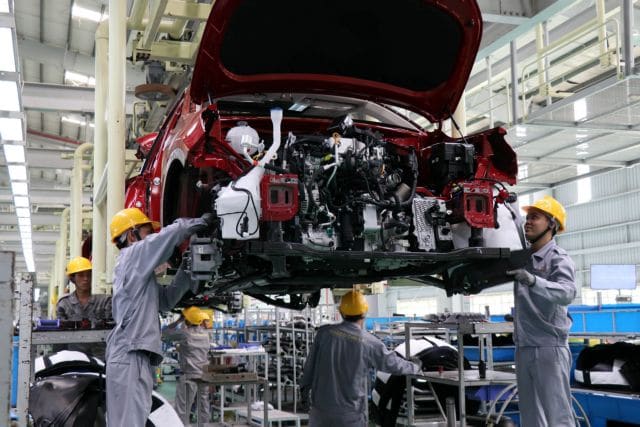
Euro 5 standards, which limit nitrogen oxide, particulate matter, and other pollutants from vehicle exhaust, represent a significant technical leap for manufacturers. Compliance requires sophisticated fuel injection systems, catalytic converters, and engine management software that many Vietnamese producers currently source from international partners.
The technology transfer rules in question appear designed to ensure domestic firms gain know-how rather than simply importing finished components. But the four industry groups contend that overly rigid requirements may backfire, leaving local manufacturers unable to access the technologies they need to compete in regional markets.
Vietnam's automotive sector has grown steadily over the past decade, with both domestic assembly operations and parts manufacturing expanding. The country exported approximately 150,000 vehicles and automotive components worth over USD 3 billion in 2025, positioning it as an emerging player in ASEAN's automotive value chain.
Investment and Export Stakes
The industry coalition's warning centers on three interconnected risks. First, foreign automotive companies may opt to invest in neighboring countries with more flexible regulatory environments if technology transfer obligations become too onerous. Thailand and Indonesia, both with established automotive ecosystems, remain attractive alternatives.
Second, domestic manufacturers could face production bottlenecks if they cannot secure Euro 5-compliant components quickly enough to meet market demand. Vietnam's emission standards are set to tighten further in coming years, and delays in technology adoption could leave local producers at a disadvantage against imports.
Third, export opportunities may shrink if Vietnamese vehicles and parts fail to meet the emission standards required by key markets. Many ASEAN countries and traditional export destinations have already implemented or announced Euro 5 or equivalent standards, making compliance a prerequisite for market access.
The four groups have not publicly detailed which specific provisions they seek to modify, but industry observers suggest the debate likely revolves around localization requirements, intellectual property protections, and timelines for domestic production of key components.
Regional Context
Vietnam's push to balance technology acquisition with regulatory pragmatism reflects a broader tension across developing Asian automotive markets. Governments want to build domestic capabilities and avoid dependence on imported technologies, but overly restrictive policies can deter the very partnerships needed to achieve those goals.
China faced similar challenges during its automotive industry's rapid expansion, eventually settling on joint venture structures that required technology sharing but offered market access in return. ASEAN countries, with smaller domestic markets, have generally adopted lighter-touch approaches to encourage investment.
For Vietnam, the stakes extend beyond the automotive sector. The country has positioned itself as a manufacturing alternative to China for multinational companies seeking supply chain diversification. A reputation for regulatory flexibility and openness to technology partnerships has been central to that pitch.
How Vietnamese policymakers respond to the industry coalition's concerns will signal whether the country prioritizes near-term technology transfer gains or longer-term competitiveness and investment appeal. The outcome will likely influence not only the automotive sector but also perceptions of Vietnam's regulatory environment across advanced manufacturing industries.
The debate arrives as Vietnam prepares for a wave of electric vehicle investment, with several domestic and foreign players announcing plans for EV production facilities. Emission standards and technology transfer rules established now will shape the framework for that next generation of automotive development.
RELATED STORIES
Indonesia's Food Exports Reach $6.25 Billion, Fourth in ASEAN Behind Thailand and Vietnam
Siti Nuraini · 3 min
Vietnam's Manufacturing Surge Raises Questions About Industrial Independence
Cheng Wei-Lun · 4 min

HiteJinro Expands Vietnam Footprint with Scholarship Program and New Production Facility
Cheng Wei-Lun · 3 min
Vietnam Eyes Second LNG Supply Contract as Energy Transition Accelerates
Cheng Wei-Lun · 3 min
Spot something wrong? Email editor@briefasia.com. We log every correction publicly.