Finance · Deals
Unitree Targets $622 Million IPO as Meituan and Tencent Circle China's Humanoid Robot Play
The Hangzhou-based robotics firm is set to become the first A-share company focused on humanoid robots, with a post-listing valuation reaching up to $7.4 billion.
KEY TAKEAWAYS
- ·Unitree is raising approximately $622 million in an IPO backed by Meituan and Tencent, targeting a post-listing valuation between $5.9 billion and $7.4 billion.
- ·The company will become the first A-share listed firm with humanoid robotics as its core business, aligning with Beijing's push for domestic automation supply chains by 2027.
- ·Strategic backing from Meituan and Tencent offers Unitree access to real-world deployment environments and AI infrastructure beyond capital alone.
Capital Floods China's Humanoid Robot Sector
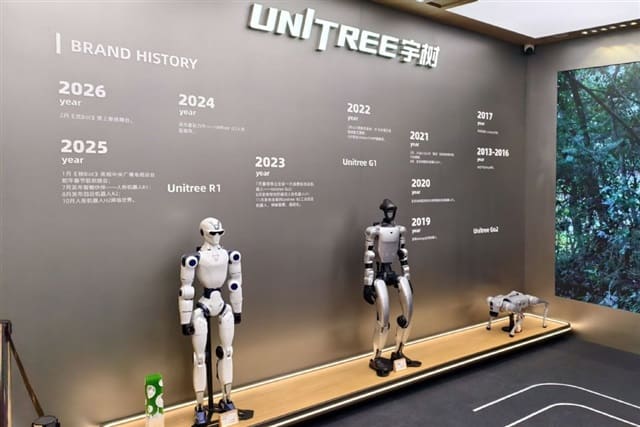
Unitree, the Hangzhou-headquartered robotics manufacturer, has entered the final stages of its initial public offering on China's A-share market. The company is targeting approximately CNY 4.2 billion in proceeds, equivalent to $622 million at current exchange rates. Two of China's largest technology conglomerates, Meituan and Tencent, have positioned themselves as investors in the offering, according to the company.
The deal would mark a watershed moment for China's domestic equity markets. Unitree is poised to become the first publicly traded company on the A-share exchange whose core business thesis centers on humanoid robotics, a sector that has seen accelerating investment from Beijing as part of its broader push into advanced manufacturing and automation.
Post-listing valuations are expected to settle between CNY 40 billion and CNY 50 billion, translating to a range of $5.9 billion to $7.4 billion. That pricing reflects investor appetite for exposure to a segment where China is racing to close the gap with U.S. and Japanese competitors, particularly as labor costs rise in coastal manufacturing hubs and the government prioritizes self-sufficiency in critical technologies.
Strategic Backing from Tech Giants
The involvement of Meituan and Tencent signals more than passive capital allocation. Meituan, which operates China's largest food delivery and local services platform, has been testing autonomous delivery robots in dozens of cities and views humanoid form factors as a potential next-generation solution for last-mile logistics. Tencent, meanwhile, has diversified its venture portfolio beyond gaming and social media into robotics, artificial intelligence, and industrial automation, often taking minority stakes in companies that align with national technology priorities.
Neither company has disclosed the size of its investment or the stake it will hold post-IPO. However, the participation of such heavyweight backers is likely to anchor institutional demand and provide Unitree with strategic partnerships that extend beyond balance-sheet support. Meituan's operational scale offers a natural testing ground for humanoid robots in real-world commercial environments, while Tencent's cloud and AI infrastructure could integrate with Unitree's control systems and software stack.
A-Share Debut Amid Policy Tailwinds
China's A-share market has historically favored state-owned enterprises and large-cap industrials, but recent regulatory shifts have opened pathways for technology-focused companies, especially those aligned with the government's "New Quality Productive Forces" framework. Humanoid robotics sits at the intersection of artificial intelligence, precision manufacturing, and automation, all of which Beijing has identified as strategic priorities in its latest Five-Year Plan.
Unitree's IPO arrives as the Ministry of Industry and Information Technology has signaled plans to accelerate the commercialization of humanoid robots, targeting applications in manufacturing, logistics, healthcare, and public services. The ministry has set a goal of establishing a complete domestic supply chain for humanoid robotics by 2027, reducing reliance on imported components such as sensors, actuators, and control chips.
The company's listing could also serve as a bellwether for other robotics startups eyeing public markets. Several Chinese firms, including those developing quadruped robots, exoskeletons, and industrial cobots, are reportedly in pre-IPO stages, awaiting signals from regulators and investors about the sector's viability as a standalone investment category.
Valuation in Context
At the midpoint of its expected valuation range, Unitree would be worth roughly $6.7 billion, a figure that places it in the upper tier of Asia-Pacific robotics companies by market capitalization. For comparison, Japan's Cyberdyne, which specializes in exoskeleton technology, trades at approximately $1.2 billion, while South Korea's Hyundai Robotics is valued at around $3.5 billion as part of the broader Hyundai Heavy Industries group.
The valuation also reflects the premium investors are willing to pay for exposure to humanoid platforms specifically, rather than industrial automation more broadly. Humanoid robots remain in early commercialization stages, with most revenue still derived from research partnerships, pilot programs, and niche applications. Volume production and mass-market deployment are not expected until the latter half of the decade, meaning Unitree's valuation is largely predicated on future growth rather than current cash flow.
What Comes Next
Unitree has not yet announced a firm listing date, though market participants expect the IPO to close before the end of the third quarter. The company will need to navigate China's multi-stage approval process, which includes reviews by the China Securities Regulatory Commission and the stock exchange itself.
If successful, the offering will provide Unitree with capital to scale manufacturing, invest in research and development, and expand its talent base. It will also test whether public market investors share the enthusiasm for humanoid robotics that has, until now, been concentrated among venture capitalists, strategic corporates, and government-backed funds. The answer will shape not only Unitree's trajectory but the broader path for China's ambitions in next-generation automation.
RELATED STORIES
Unitree Robotics IPO Oversubscribed 2,700 Times as Investors Bet on China's Robot Push
Cheng Wei-Lun · 3 min

DeepSeek Backs Unitree Robotics With RMB141 Million Pre-IPO Stake
Cheng Wei-Lun · 4 min

China's Star Fund Managers Lose Ground After Rotating Into AI Stocks
Cheng Wei-Lun · 4 min

State Funds Step In as AI Volatility Tests China's Bull Market Strategy
Cheng Wei-Lun · 3 min
Spot something wrong? Email editor@briefasia.com. We log every correction publicly.