Asia · Politics
Trump Orders Pentagon to Scale Back Joint Drills with South Korea
The president cited Seoul's refusal to join US actions against Iran and his relationship with North Korean leader Kim Jong Un in directing the military to reduce the annual exercises.
KEY TAKEAWAYS
- ·President Trump instructed the Pentagon to substantially reduce the Ulchi Freedom Shield exercises with South Korea, involving 18,000 personnel, just hours before the drills were set to begin on August 17.
- ·Trump cited Seoul's refusal to join US denuclearization efforts against Iran and his relationship with Kim Jong Un as reasons for scaling back the exercises.
- ·The directive raises questions about how Washington will balance security commitments in Asia with expectations that allies support broader US foreign policy goals beyond their regions.
A Last-Minute Directive
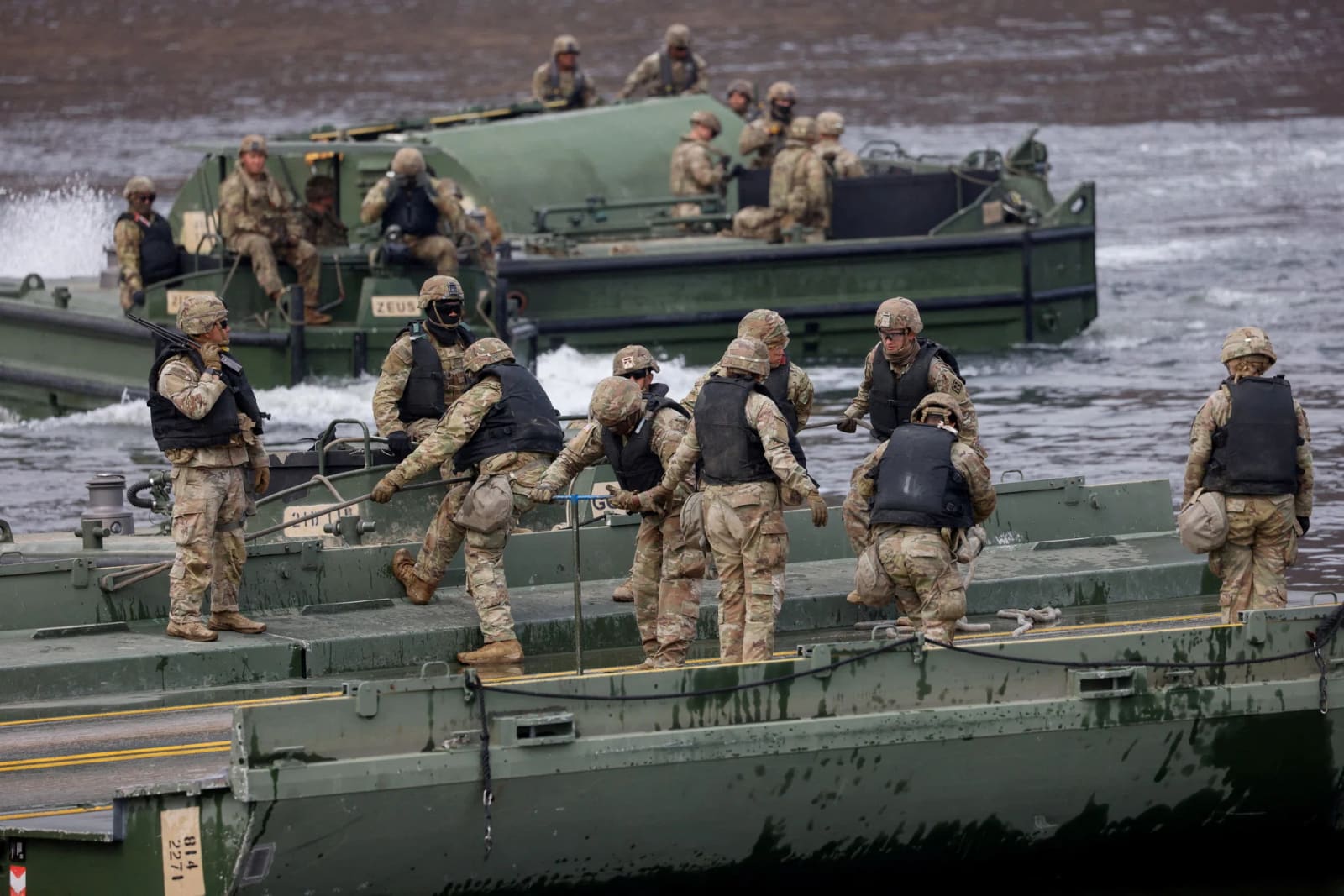
President Donald Trump instructed the Pentagon on August 16 to substantially reduce joint military exercises with South Korea, announcing the decision on Truth Social just hours before the annual drills were scheduled to commence. Trump acknowledged the timing made full cancellation impossible but said he was "not happy" the United States had committed to participate.
The Ulchi Freedom Shield exercises are set to run from August 17 through 27, involving approximately 18,000 South Korean military personnel. Military planners designed this year's drills to address evolving threats from Pyongyang, including operations focused on countering drones, GPS jamming, and cyberattacks.
Iran Policy at the Center
Trump linked his directive to Seoul's position on Iran, revealing he had asked South Korean President Lee Jae-myung whether the country would join US efforts toward "denuclearization of the Islamic Republic of Iran." Seoul declined.
"While somewhat unrelated (?), I recently asked the President of South Korea if they would like to join us in the Denuclearization of the Islamic Republic of Iran, and they said, 'No thanks!'" Trump wrote in his post.
The comment suggests Washington is weighing alliance contributions beyond the Korean Peninsula as it calculates military cooperation in Northeast Asia. South Korea has historically avoided direct involvement in Middle Eastern conflicts despite maintaining economic ties with Gulf states and Iran.
The North Korea Calculation
Trump also invoked his relationship with North Korean leader Kim Jong Un as justification for scaling back the exercises. He described the drills as sending a signal that is "totally inappropriate and hostile" to a country that has been "unthreatening and respectful" during his presidency.
Pyongyang has consistently condemned US-South Korea military exercises as rehearsals for invasion. North Korea launched a ballistic missile from its eastern coast toward the Sea of Japan on August 12, the second such test in six days. The regime fired a short-range ballistic missile on August 6.
US military officials have noted that North Korean forces fighting alongside Russia in Ukraine have gained battlefield experience, particularly in unmanned systems, electronic warfare, and cyber operations. On August 11, Ukraine reported that North Korean-made missiles were used in a Russian strike on a steel plant in Zaporizhzhia that killed seven workers, with Moscow also deploying Zircon hypersonic missiles in the attack.
Alliance Under Pressure
Neither the White House nor the Pentagon immediately provided details on how the reduction would be implemented or what specific elements of the exercise would be curtailed. The lack of clarity left South Korean defense officials and US commanders in the region without public guidance on adjustments to the scheduled drills.
The annual exercises have been a cornerstone of the US-South Korea alliance since the 1950s, designed to maintain readiness and interoperability between the two militaries. Any significant reduction would mark a departure from decades of defense policy and could complicate coordination in the event of a crisis on the peninsula.
Trump's directive also raises questions about how Washington will balance its security commitments in Asia with its expectations that allies support broader US foreign policy goals, including actions in the Middle East. South Korea maintains a 28,500-strong US troop presence and hosts key military installations that anchor American power projection in the region.
What Comes Next
The timing of Trump's announcement, delivered via social media rather than through formal diplomatic or military channels, adds uncertainty to the alliance's strategic planning. Seoul has not yet publicly responded to the directive or clarified its position on participating in US actions related to Iran.
Military analysts will be watching whether the reduction affects future exercises or remains limited to this year's drills. The decision also puts pressure on South Korea to navigate between its security dependence on the United States and its desire to maintain an independent foreign policy, particularly regarding conflicts outside Northeast Asia.
RELATED STORIES
Starbucks Korea Reports $13.4 Million Loss After Tumbler Controversy
Cheng Wei-Lun · 2 min

SK Hynix Workers Form Unified Union as Bonus Dispute Deepens
Cheng Wei-Lun · 4 min
Homeplus Reopens 67 Stores After Liquidity Crisis Leaves Shelves Empty
Jun-ho Seo · 3 min
Starbucks Korea Reports First Quarterly Loss After Tumbler Promotion Backlash
Jun-ho Seo · 2 min
Spot something wrong? Email editor@briefasia.com. We log every correction publicly.