Asia · Trade
Thailand Launches Premium Rice Push at Manila Trade Show
Bangkok-backed pavilion at WOFEX 2026 targets Philippine importers with specialty varieties and bilateral trade opportunities
KEY TAKEAWAYS
- ·Thailand's Department of International Trade Promotion and Department of Foreign Trade launched a rice promotion pavilion at the World Food Expo in Manila, featuring six specialty varieties including Hom Mali and Riceberry rice.
- ·The campaign targets Philippine importers, distributors, and food service operators in a market where the country remains one of the world's largest rice importers with a population exceeding 115 million.
- ·Live cooking demonstrations by Thai SELECT-certified chefs and buyer matchmaking sessions aim to secure distribution agreements and expand Thailand's market share against regional competitors Vietnam, India, and Pakistan.
Bangkok Targets Philippine Market
Thailand mounted a coordinated trade offensive in Manila this week, launching a government-backed rice promotion campaign at one of the Philippines' largest food and beverage exhibitions. The initiative brings together two Thai ministries and a roster of exporters seeking to deepen commercial ties in a market where rice remains both staple and political flashpoint.
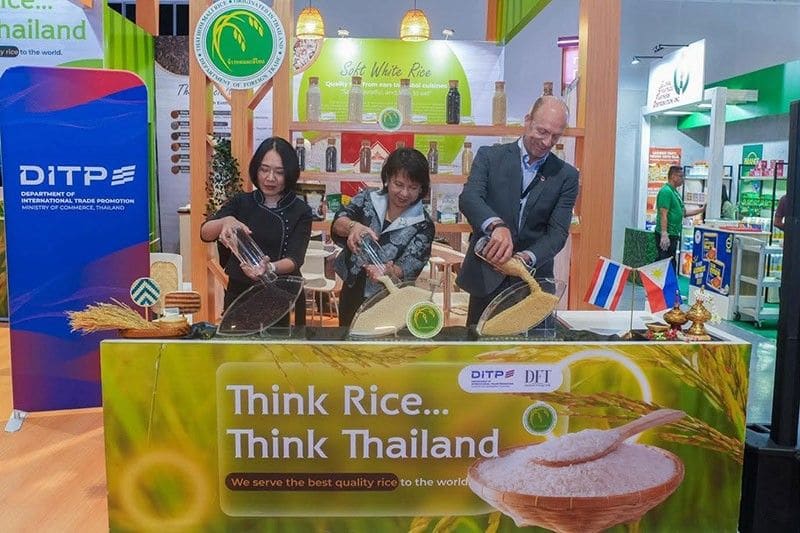
The Department of International Trade Promotion and the Department of Foreign Trade opened a dedicated pavilion at the World Food Expo, held across SMX Convention Center and World Trade Center Metro Manila. The effort operates under the banner "Think Rice, Think Thailand: We Serve the Best Quality Rice to the World," a tagline designed to position Thai exports as premium rather than commodity product.
Ambassador Makawadee Sumitmor joined Sutinee Vathana, director of the Thai Trade Center in Manila, and Ian Roberts, Informa Markets' senior vice president for Asia, at a ceremonial rice pouring to mark the pavilion opening. The gesture underscored the diplomatic weight Bangkok is placing on agricultural trade in the region.
Specialty Varieties Take Center Stage
The pavilion featured six distinct rice types, each targeting different price points and culinary applications. Thai Hom Mali Rice, known internationally as jasmine rice, anchored the display alongside Riceberry, a deep-purple hybrid developed for health-conscious consumers. Sangyod Rice, Chumphae Rice, Thai Fragrant Rice, and Thai White Rice rounded out the lineup.
Live cooking demonstrations by chefs from Thai SELECT-certified restaurants in the Philippines ran throughout the expo. The sessions aimed to show distributors and food service operators how different rice varieties perform in both traditional Thai dishes and fusion applications.
Vathana framed the campaign as a dual-purpose exercise. "This initiative showcases the excellence of Thai rice while creating opportunities for bilateral trade and business cooperation," she said, emphasizing connections with Philippine importers, distributors, retailers, and restaurant operators.
Regional Trade Context
The Philippines remains one of the world's largest rice importers, a position driven by domestic production shortfalls and a population exceeding 115 million. Thailand competes with Vietnam, India, and Pakistan for market share, with each origin offering different quality tiers and pricing structures.
Thai exporters have historically commanded premium pricing based on varietal purity and consistent milling standards. The current campaign seeks to reinforce that positioning as regional competitors invest in their own quality-certification programs and marketing infrastructure.
The timing coincides with broader efforts by Thailand's Ministry of Commerce to diversify export destinations amid shifting demand patterns in traditional markets. Southeast Asian neighbors represent growing opportunity as incomes rise and consumers trade up from basic to specialty rice.
What Comes Next
The WOFEX presence serves as a springboard for follow-on activities, including buyer matchmaking sessions and site visits to Thai milling facilities. The Thai Trade Center in Manila will coordinate ongoing engagement with Philippine businesses that express interest in distribution agreements or private-label partnerships.
Thailand's approach reflects a wider pattern across Asian agricultural exporters: government agencies providing the platform and credibility, while private-sector firms negotiate the commercial terms. The model has proven effective in markets where buyers prioritize supply-chain transparency and regulatory compliance alongside price.
For Philippine importers, the value proposition hinges on consistent quality and reliable delivery schedules, factors that have historically differentiated Thai rice in premium segments. Whether that translates into expanded market share will depend on price competitiveness and the ability of Thai exporters to meet the specific packaging and certification requirements of Philippine retailers and food service chains.
The pavilion will remain a focal point of Thailand's trade strategy in the Philippines through the remainder of 2026, with additional promotional activities planned around major retail and food service buying cycles.
RELATED STORIES
Five ASEAN Members Back Regional Oil Stockpile as Study Nears Completion
Tran Quoc Bao · 3 min

Southeast Asian Firms Overlook Digital Pact Worth USD 2 Trillion
Lim Hui Ying · 4 min
Southeast Asian Factories Adopt Proximity Planning to Retain Workers and Investors
Lim Hui Ying · 3 min
Thailand and New Zealand Set $8 Billion Trade Target Under New Partnership
Priyanka V. Rao · 3 min
Spot something wrong? Email editor@briefasia.com. We log every correction publicly.