Asia · Business
Philippines Cancels Coal Tender for Key Mining Site Months Before Operator Handover
The Department of Energy plans a fresh auction with revised terms for Semirara Island blocks as the incumbent's contract approaches its mid-2027 deadline.
KEY TAKEAWAYS
- ·The Philippines cancelled a coal tender for Semirara Island on 15 September and will launch a revised auction within weeks, less than ten months before the current operator's contract expires on 14 July 2027.
- ·Energy Secretary Sharon Garin cited feedback from pre-submission conferences, persistent water seepage on the island, and unspecified legal factors as reasons for terminating the initial bidding process.
- ·Semirara Mining and Power Corporation has challenged tender requirements in court, seeking to block demands for detailed asset inventories and proprietary technical data intended for prospective rival bidders.
Auction Reset Under Tight Timeline
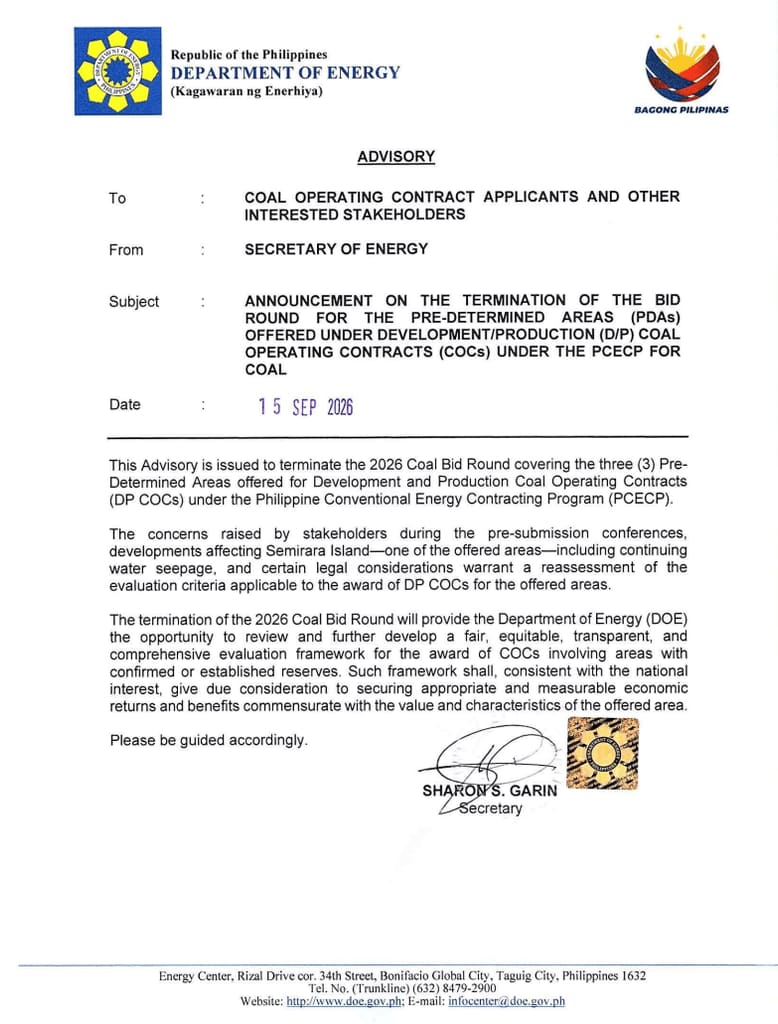
The Philippines has cancelled a tender for coal production rights on Semirara Island and intends to launch a replacement auction in the coming weeks, a move that compresses an already narrow window for any new operator to prepare before the existing contract expires next July. Energy Secretary Sharon Garin terminated the process covering three designated zones on 15 September, citing feedback from pre-submission meetings and operational developments on the island in Antique province, including persistent groundwater infiltration and what the department described only as legal factors.
The decision resets the competition for ten coal blocks currently worked by Semirara Mining and Power Corporation, a unit of conglomerate DMCI Holdings controlled by the Consunji family. SMPC's Coal Operating Contract No. 5 reaches its end date on 14 July 2027. Manila declined the company's request to extend its multi-decade tenure and instead opted to invite rival bids, a strategy intended to test market appetite and potentially capture higher economic rents from one of Southeast Asia's few domestic thermal coal sources.
Garin told reporters the government would proceed with a fresh tender under revised rules, dismissing concerns that the truncated schedule might deter qualified participants or complicate a smooth operational transition. The department said in its notice that scrapping the initial round would enable it to design what it termed a fair, equitable, transparent, and comprehensive evaluation system, particularly for parcels with verified reserves.
Operational and Legal Headwinds
Semirara Island sits roughly 280 kilometres south of Manila in the Visayas region and accounts for the bulk of the country's coal output, supplying thermal power plants that still generate a significant share of grid electricity despite accelerating renewable capacity additions. The island's geology has presented recurring challenges: the Department of Energy's statement referred to continuing water seepage, a technical difficulty that can raise extraction costs and complicate pit planning in open-cast operations.
The legal dimension mentioned by the department remains unspecified in public filings, though SMPC has separately initiated court proceedings over aspects of the tender design. In July the company sought judicial relief against requirements that it furnish exhaustive inventories of fixed assets and disclose proprietary technical data to prospective competitors. SMPC argued that handing over detailed mine plans, equipment lists, and subsurface models would erode its commercial position and potentially violate confidentiality provisions in its existing contract.
Those disclosures were intended to reduce information asymmetry and allow outside bidders to price their offers more accurately, a common practice in resource auctions but one that can trigger resistance from incumbents who view site-specific knowledge as a competitive moat. The court case adds another layer of complexity to a process that has already missed multiple deadlines.
Serial Delays and Regulatory Revision
The tender was originally scheduled to close earlier this year but has been pushed back repeatedly as the Department of Energy revised participation criteria and evaluation metrics. In July, Garin indicated that rule changes would be finalised within a few weeks, according to local business press. That timeline has since slipped, culminating in the outright cancellation announced this week.
Industry observers note that the stop-start pattern reflects broader uncertainty over how Manila will balance energy security, fiscal objectives, and environmental commitments as it manages the transition away from coal-fired generation. The government has pledged to cease building new coal plants and to phase down existing capacity over the next two decades, yet domestic coal remains cheaper than liquefied natural gas imports and provides baseload support that intermittent renewables cannot yet fully replace.
Awarding a fresh operating contract for Semirara therefore carries political as well as commercial stakes. A transparent, competitive auction could set a precedent for future resource tenders and signal regulatory maturity to foreign investors. Conversely, a process perceived as rushed or opaque might invite legal challenges and reinforce perceptions of unpredictability in Philippine mining policy.
Implications for Supply Continuity
The proximity of SMPC's contract expiry raises practical questions about continuity of supply. Open-pit coal mining requires sustained capital investment in haul roads, crushing facilities, port infrastructure, and overburden removal. Any incoming operator would need several months to mobilise equipment, hire personnel, secure environmental permits, and integrate logistics with off-takers, most of whom have long-term fuel supply agreements tied to specific delivery schedules.
If the new tender process extends into early 2027 or if the outcome is contested, the window for a seamless handover narrows further. SMPC has operated the Semirara deposit since the 1980s and maintains the institutional knowledge, workforce, and supply chain relationships that underpin current production rates of several million tonnes per year. Replicating that operational tempo under a different management structure in less than twelve months would test the capabilities of even well-capitalised mining groups.
The Department of Energy has not disclosed which revisions it intends to incorporate into the forthcoming auction documents, nor has it published a revised timeline beyond Garin's reference to a launch within weeks. Market participants will be watching whether the updated framework addresses SMPC's legal objections, clarifies asset transfer protocols, and provides sufficient lead time for due diligence and financing arrangements.
The cancellation underscores the tension between policy ambition and execution capacity in resource-dependent economies navigating energy transitions. Semirara's coal will remain economically important for the remainder of this decade, and the manner in which Manila manages the change of operator will offer a real-time case study in regulatory agility, or the lack thereof.
RELATED STORIES

Filipino Workers Abroad Send Home $3.6 Billion in July
Mariel D. Santos · 3 min

Koloma Targets Fourth Philippine Hydrogen Block in Offshore Palawan Push
Tran Quoc Bao · 3 min
Five ASEAN Members Back Regional Oil Stockpile as Study Nears Completion
Tran Quoc Bao · 3 min

Southeast Asian Firms Overlook Digital Pact Worth USD 2 Trillion
Lim Hui Ying · 4 min
Spot something wrong? Email editor@briefasia.com. We log every correction publicly.