Finance · Markets
Taiwan's TAIEX Plunges Over 2,000 Points as Regional Tech Sell-Off Intensifies
The benchmark index recorded its third-largest single-day drop amid forced deleveraging and program-driven sales, while foreign investors dumped NT$87.6 billion in shares
KEY TAKEAWAYS
- ·Taiwan's TAIEX dropped 2,030.83 points to 41,603.36, its third-largest point decline, driven by forced deleveraging and automated selling rather than fundamental deterioration.
- ·Foreign investors sold NT$87.56 billion in shares while South Korea's KOSPI fell 10.84 percent, reflecting region-wide retreat from semiconductor and AI-related positions.
- ·Bank of America survey shows 82 percent of fund managers view semiconductor trades as overcrowded and 45 percent flag AI as potential bubble risk.
Panic Selling Grips Taipei Markets
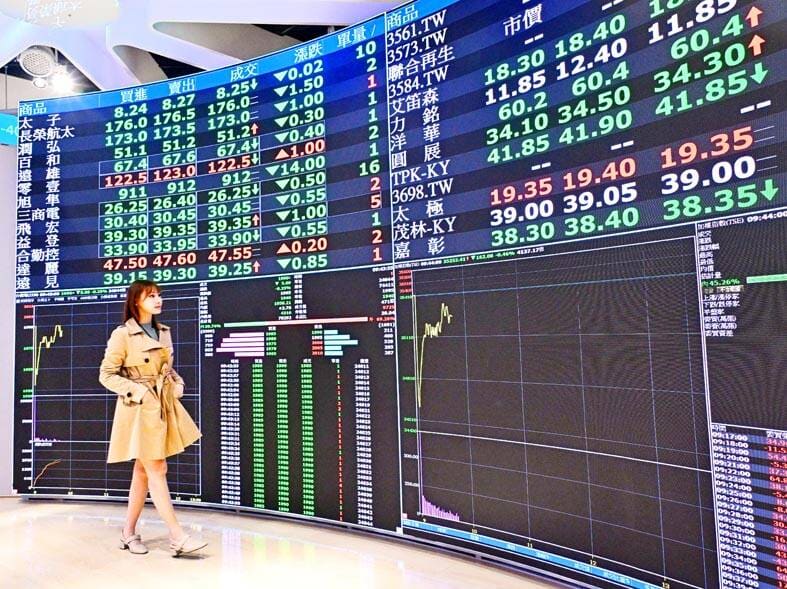
Taiwan's main stock index cratered on Tuesday, shedding 2,030.83 points to close at 41,603.36, a decline of 4.65 percent that marked the third-steepest point loss in the exchange's history. The collapse came as investors fled technology shares across Asia, with semiconductor stocks bearing the brunt of the retreat.
The selloff was driven primarily by technical factors rather than fundamental weakness, according to CTBC Securities Investment Service. Forced unwinding of leveraged positions and algorithm-triggered sales created what the firm described as a temporary liquidity imbalance, amplifying downward pressure as automated systems executed cascading sell orders.
Foreign institutional investors led the exodus, offloading NT$87.56 billion worth of shares on the main board. Proprietary trading desks added to the pressure with net sales of NT$31.73 billion, while mutual funds provided modest support with NT$2.35 billion in purchases. Total turnover reached NT$809.48 billion, substantial but below the volumes typically seen during full capitulation events.
Regional Contagion Spreads
Taiwan's decline mirrored broader distress across Asian technology hubs. South Korea's KOSPI absorbed the heaviest blow, plummeting 10.84 percent as investors dumped memory chip manufacturers and display makers. Japan's Nikkei 225 fell 3.95 percent, with Tokyo-listed semiconductor equipment suppliers and electronics conglomerates among the hardest hit.
The selling extended beyond chipmakers to encompass the entire technology supply chain. Memory manufacturers, silicon wafer suppliers, integrated circuit designers, and companies positioning themselves around artificial intelligence applications all faced heavy liquidation. Even Taiwan Semiconductor Manufacturing Co, which had recently raised its sales guidance and signaled robust demand for advanced chips, dropped 2.98 percent.
Crowded Positioning Unravels
A recent Bank of America survey of global fund managers revealed the structural vulnerabilities now unwinding in real time. Eighty-two percent of respondents identified semiconductor trades as overcrowded, while 45 percent flagged artificial intelligence as a potential bubble, making it the single largest tail risk on their radar. Concerns about a second wave of inflation ranked second at 26 percent.
The data points to a disconnect between long-term confidence in AI-driven growth and short-term anxiety over valuations and position concentration. JP Morgan Asset Management's Taiwan unit noted that while institutional investors remain bullish on AI's trajectory over the next decade, many have grown wary of stretched multiples and the risk that concentrated holdings could amplify volatility during periods of risk aversion.
Fundamentals Remain Intact
CTBC Securities emphasized that the rout did not reflect deteriorating corporate earnings or a meaningful shift in the outlook for technology companies. Taiwan's semiconductor sector continues to benefit from strong demand for advanced chips used in data centers, smartphones, and automotive applications. Export orders remain robust, and capacity utilization rates at leading foundries stay elevated.
The firm characterized the selloff as panic-driven rather than fundamentally justified, pointing to the mechanics of deleveraging and programmatic trading as the primary culprits. When leveraged positions are forced to liquidate, the resulting sales can trigger stop-loss orders and algorithm-driven executions that cascade through the market regardless of underlying business performance.
Sustainability Questions Linger
Despite the technical nature of Tuesday's decline, the episode underscores growing investor scrutiny of AI-related valuations. Taiwan's market has benefited enormously from the AI infrastructure buildout, with chip manufacturers, substrate suppliers, and server assembly companies posting record revenues. The question now confronting investors is whether the pace of capital investment can sustain current stock prices or whether a period of consolidation lies ahead.
The concentration of gains in a narrow set of technology names has left the market vulnerable to shifts in sentiment. When positioning becomes too crowded, even minor catalysts can trigger sharp reversals as investors rush to reduce exposure simultaneously. The lack of capitulation-level volume on Tuesday suggests that some investors may still be holding positions, leaving open the possibility of further pressure if sentiment does not stabilize.
Taiwan's technology sector remains the backbone of the global electronics supply chain, and its long-term growth prospects are tied to secular trends in computing, connectivity, and automation. But the immediate challenge for the market is navigating the gap between those fundamentals and the valuations investors are willing to pay in an environment marked by geopolitical uncertainty and shifting monetary policy expectations.
RELATED STORIES
Taiwan Stock Exchange Moves Odd-Lot Trading Start Time Forward
Cheng Wei-Lun · 3 min

Fubon Hyundai Life Returns to Profit in First Half on Asset Management Gains
Cheng Wei-Lun · 2 min

Taiwan Consumer Confidence Falls Amid Record Growth Forecasts
Cheng Wei-Lun · 2 min
Taiwan GDP Growth Forecast Lifted to 11.6% on AI Chip Demand
Cheng Wei-Lun · 3 min
Spot something wrong? Email editor@briefasia.com. We log every correction publicly.