Asia · Politics
Taiwan Legislature Reviews $6.5 Billion Domestic Drone Procurement Plan
Lawmakers split on special procurement framework for locally developed defense unmanned systems as clause-by-clause debate begins
KEY TAKEAWAYS
- ·Taiwan's Legislative Yuan started clause-by-clause review of a NT$210 billion special procurement act for domestically developed military drones, with ruling and opposition lawmakers split on the framework.
- ·The proposed special act would create dedicated funding for unmanned systems and represents one of the largest single commitments to a domestic defense program in recent years.
- ·The legislative debate centers on balancing procurement speed with accountability, as Taiwan seeks to scale indigenous drone production and reduce reliance on foreign suppliers.
Legislative Battle Over Defense Autonomy
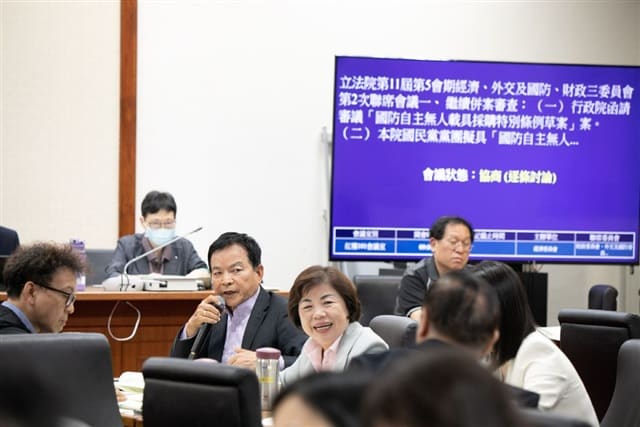
Taiwan's Legislative Yuan launched a detailed clause-by-clause examination of a special procurement bill on July 27, setting the stage for what appears to be a contentious debate over how the island will fund and structure its domestic defense drone program. The draft Special Act for the Procurement of Domestically Developed Defense Unmanned Systems, submitted by the Executive Yuan, proposes NT$210 billion (approximately $6.5 billion) in spending, but lawmakers from ruling and opposition camps remain far apart on the framework.
The legislative review marks a critical juncture for Taiwan's push toward defense self-sufficiency. The proposed act would create a dedicated funding mechanism for unmanned aerial systems designed and manufactured within Taiwan, a strategic priority as the island works to reduce reliance on foreign suppliers and build indigenous capabilities in critical defense technologies.
Divided Chambers
According to the Executive Yuan's submission, the special act aims to accelerate procurement of locally developed unmanned systems across multiple military branches. The NT$210 billion allocation would represent one of the largest single commitments to a domestic defense program in recent years, underscoring the government's view of drones as essential to asymmetric defense strategies.
Yet the clause-by-clause review quickly exposed fault lines. Opposition lawmakers have raised questions about procurement timelines, oversight mechanisms, and whether the special act structure bypasses normal budgetary scrutiny. Ruling party legislators argue the framework is necessary to streamline acquisition and deliver systems on an accelerated schedule, given regional security pressures.
The disagreement is not merely procedural. At stake is how Taiwan will balance speed with accountability in a procurement effort that touches both industrial policy and military readiness. The island's defense industry has made strides in unmanned systems, with several firms developing reconnaissance and loitering munition platforms, but scaling production and integrating these systems into operational units requires sustained funding and clear legal authority.
Strategic Context
Taiwan's focus on unmanned systems reflects broader shifts in defense thinking. Drones offer force multiplication at lower cost than manned platforms, can be deployed in contested environments with reduced risk to personnel, and align with the asymmetric strategies Taiwan has adopted to counter a larger adversary. The island's military has been integrating small tactical drones for reconnaissance, while domestic firms have been working on longer-range and strike-capable variants.
The special act would formalize funding streams and create a legal foundation for multi-year contracts with local manufacturers. Proponents argue this stability is essential for companies to invest in production capacity and supply chains. Critics counter that special acts can insulate spending from regular legislative oversight and warn against locking in large sums without clear performance benchmarks.
Regional Implications
The legislative debate arrives as other governments in the region also ramp up unmanned systems programs. South Korea, Japan, and Australia have all announced significant investments in military drones over the past two years, with an emphasis on interoperability and domestic production. Taiwan's move, if the act passes, would position the island as a notable player in the Asia-Pacific unmanned systems market, both as a user and potentially as an exporter of certain technologies.
The NT$210 billion figure also signals the scale of ambition. For context, Taiwan's total defense budget for fiscal 2026 is approximately NT$600 billion, meaning the special act would represent a substantial off-budget addition spread over several years. How legislators resolve questions around transparency, milestones, and contractor accountability will shape not only this program but the template for future defense procurement reforms.
The clause-by-clause review is expected to continue over the coming weeks, with both sides preparing amendments. The outcome will determine whether Taiwan can move quickly to field domestically developed unmanned systems or whether the process will be slowed by legislative gridlock.
RELATED STORIES

Taiwan's National Security Council Expands Role in Defense Strategy
Cheng Wei-Lun · 3 min
Eurasian Security Bloc Convenes as Shein Prices Hong Kong IPO
Cheng Wei-Lun · 3 min

Taiwan Consumer Confidence Falls Amid Record Growth Forecasts
Cheng Wei-Lun · 2 min

Taiwan GDP Growth Forecast Lifted to 11.6% on AI Chip Demand
Cheng Wei-Lun · 3 min
Spot something wrong? Email editor@briefasia.com. We log every correction publicly.