Finance · Deals
Suzhou Court Orders Chinese Tea Chain to Pay $1.5 Million to Louis Vuitton
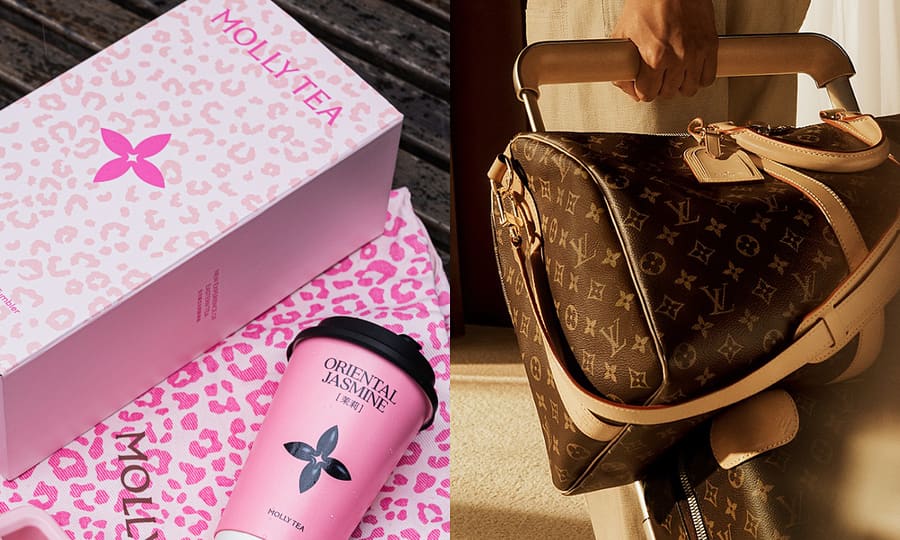
Shenzhen-based Molly Tea used a floral logo closely resembling the French luxury house's protected monogram across its 2,000-store network
KEY TAKEAWAYS
- ·A Suzhou court awarded Louis Vuitton 10.3 million yuan in a trademark infringement case against Molly Tea, a Shenzhen beverage chain that used a four-petaled floral logo resembling the luxury house's protected monogram.
- ·Molly Tea submitted multiple floral trademark applications to Chinese authorities in 2024, but most were rejected; only a design incorporating Chinese characters was registered.
- ·The tea chain plans to appeal and has updated its logo on digital platforms while continuing to operate more than 2,000 stores across China and nine other countries.
The Ruling
The Intermediate People's Court of Suzhou handed down a 10.3 million yuan ($1.5 million) judgment against Molly Tea last week, finding the beverage chain liable for trademark infringement. The damages break down to 10 million yuan for economic losses and 300,000 yuan covering litigation expenses, with payment due within ten days.
Louis Vuitton filed the civil suit in May of last year, according to data from Tianyancha, a Chinese corporate information provider. The luxury goods maker argued that Molly Tea's black-and-white floral emblem mimicked the four-petaled monogram that has anchored its brand identity for more than a century.
The court sided with the Paris-based plaintiff, concluding that the similarity was sufficient to confuse consumers and dilute the value of a legally protected mark. Beyond the financial penalty, the judgment requires Molly Tea to publish corrective statements on the homepages of six social media accounts to counteract any reputational harm.
Trademark Applications and Rejections
Between 2024 and the lawsuit, Molly Tea submitted several trademark applications to the China National Intellectual Property Administration. The filings covered a range of floral patterns intended for use on restaurant services and food products, according to China Daily.
Most applications were denied. The only registration that cleared was a design incorporating Chinese characters spelling out the tea chain's name, a format distinct from the contested floral symbol. The pattern of rejections suggests that examiners flagged the similarity to existing luxury trademarks early in the review process.
China operates under a first-to-file system, meaning priority generally goes to whichever entity registers a mark first. Public domain elements, including motifs rooted in traditional culture, remain available for commercial use, but that defense weakens when an applicant's design closely mirrors a well-known, registered trademark in a way that courts deem likely to cause confusion.
Molly Tea's Response and Logo Update
Molly Tea announced plans to appeal the Suzhou decision. The company has already updated the logo displayed on its WeChat mini-program, swapping the original black-and-white version for a colored variant. It is unclear whether the revised design will satisfy Louis Vuitton or whether the French house will pursue further action if the appeal proceeds.
The tea chain, founded in 2021, reports operating more than 2,000 locations worldwide. Its footprint extends beyond mainland China to the United States, Canada, Australia, the United Kingdom, Thailand, Indonesia, and Singapore. Expansion at that pace typically relies on strong visual branding, which makes the outcome of this case material to the company's international growth strategy.
Public Debate and Legal Precedent
The lawsuit ignited discussion on Chinese social media platform Weibo. Some users argued that the two companies occupy different industries, tea versus luxury leather goods, and that floral motifs appear throughout Chinese historical art. Others countered that the logo's immediate association with Louis Vuitton proves consumer confusion.
Kang Lixia, a partner at Beijing Standzer IP Firm, noted that Molly Tea retains the right to present additional evidence on appeal. She emphasized that while traditional cultural elements belong to the public domain, China's first-to-file principle remains the foundation of trademark law. Courts weigh whether a disputed mark creates a likelihood of confusion, regardless of the defendant's industry, when the plaintiff's brand enjoys widespread recognition.
The judgment reinforces a trend in Chinese courts toward stronger enforcement of foreign intellectual property rights, particularly when a domestic defendant scales rapidly and adopts visual identifiers that echo globally recognized symbols. For multinational brands, the decision signals that Chinese tribunals will award substantial damages when infringement is clear, even if the infringing party operates in a different product category.
What Comes Next
Molly Tea has ten days from the ruling to remit payment or formally lodge an appeal. If the company chooses the latter, the case will move to a higher court, where judges will review the trial record and any new evidence. An appeal could take months to resolve, during which time the tea chain must continue displaying corrective statements and operating under the revised logo.
Louis Vuitton, part of the LVMH conglomerate, has a history of vigorous trademark defense across Asia. The Suzhou case adds to a portfolio of enforcement actions designed to protect the four-petaled monogram, which appears on handbags, luggage, and accessories sold at price points far above the average beverage purchase. The $1.5 million award, while modest by luxury-sector standards, sends a message that brand dilution carries a tangible cost in China's courts.
RELATED STORIES
China's Social Security Fund Doubles Offshore Holdings to $86 Billion
Jun-ho Seo · 3 min
From Tourism Graduate to Indonesia Electronics Distributor: Wook Eyes IPO
Cheng Wei-Lun · 3 min
China Approves $6.84 Billion in New Overseas Investment Quotas
Cheng Wei-Lun · 3 min
Shein Drops 4% in Hong Kong Debut as Tariff Pressure Weighs on Valuation
Priyanka V. Rao · 4 min
Spot something wrong? Email editor@briefasia.com. We log every correction publicly.