Technology · AI
South Korea's OCI Taps AI and Space Markets as Non-China Polysilicon Alternative
SpaceX partnership extends solar supplier's reach beyond Earth-bound data centers into orbital applications
KEY TAKEAWAYS
- ·OCI Holdings is supplying polysilicon to US AI data centers and SpaceX space solar projects, capitalizing on its non-China manufacturing footprint in South Korea and Malaysia.
- ·SpaceX has deepened its supplier relationship with OCI for space-grade solar cells, which require higher purity silicon and stricter quality controls than terrestrial panels.
- ·Demand from AI infrastructure and regulatory pressure under the Uyghur Forced Labor Prevention Act are driving premium pricing for non-Chinese polysilicon despite global oversupply.
Dual Demand Fronts
OCI Holdings, one of Asia's few major polysilicon producers outside China, is experiencing a surge in demand from two distinct but equally capital-intensive fronts: artificial intelligence data centers across the United States and space-based solar projects led by SpaceX.
The South Korean materials supplier has positioned itself at the intersection of two emerging energy narratives. On Earth, hyperscale AI infrastructure operators are scrambling to secure power capacity for training clusters that can draw tens of megawatts per facility. In orbit, SpaceX and other aerospace players are exploring photovoltaic systems for satellite constellations and future space stations that require lightweight, radiation-hardened solar arrays.
OCI's advantage stems from supply chain diversification efforts that accelerated after Washington imposed tariffs and anti-circumvention duties on Chinese solar imports. Data center developers in the US, facing both regulatory pressure and ESG commitments, have increasingly sought procurement options that bypass China's dominant polysilicon industry, which controls roughly 85 percent of global production.
The SpaceX Connection
SpaceX has expanded its supplier relationship with OCI beyond terrestrial photovoltaic projects, according to materials disclosed by the company. Space-grade solar cells demand higher purity silicon and more stringent quality controls than ground-based panels, given the thermal cycling, radiation exposure, and mechanical stress of launch and orbital environments.
The partnership reflects a broader trend among Western aerospace primes to secure supply chains independent of geopolitical risk. OCI operates polysilicon production facilities in South Korea and Malaysia, offering a manufacturing footprint that aligns with both US trade policy and the technical requirements of space applications.
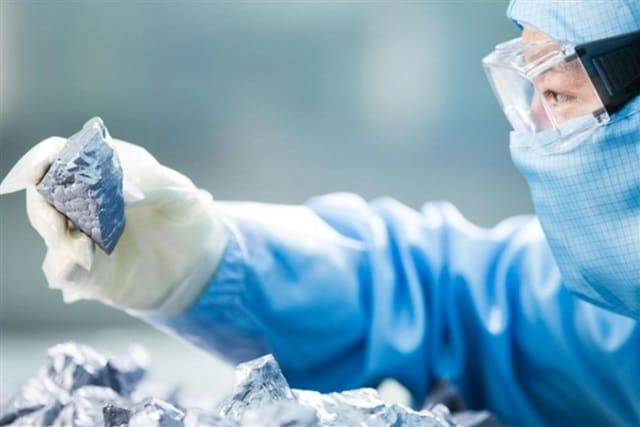
Polysilicon destined for space solar arrays typically undergoes additional purification steps to minimize defects that could degrade under particle bombardment in low Earth orbit. OCI has invested in cleanroom infrastructure and process controls to meet aerospace specifications, a capability that differentiates it from commodity suppliers focused solely on terrestrial panels.
AI Infrastructure as Volume Driver
While space applications carry strategic value, the volume driver for OCI remains the buildout of AI data center capacity in North America. Operators deploying Nvidia H100 and H200 clusters are pairing compute investments with on-site or nearby solar farms to offset grid load and secure renewable energy credits.
A single large language model training run can consume several gigawatt-hours over weeks or months. Data center operators in Texas, Arizona, and Nevada have announced solar procurement agreements totaling multiple gigawatts of nameplate capacity, much of it tied to supply chains that exclude Chinese polysilicon to comply with Uyghur Forced Labor Prevention Act restrictions.
OCI's Malaysia facility has ramped production to serve this demand, with the company targeting customers that prioritize supply chain transparency and traceability. The premium pricing available in the non-China polysilicon market has supported margin expansion even as global panel prices remain under pressure from Chinese overcapacity.
Asia's Non-China Solar Bet
The dynamics playing out around OCI illustrate a broader reconfiguration of Asia's solar supply chain. Japan's Tokuyama and South Korea's Hanwha Solutions also operate polysilicon plants outside China, but combined capacity remains a fraction of what Xinjiang-based producers can deliver.
For Seoul, OCI's position carries industrial policy significance. South Korea has committed billions in subsidies to semiconductor and battery manufacturing under its K-Chips Act and related programs, but solar materials have received less attention despite their strategic overlap with energy security and export competitiveness.
OCI's ability to command premium pricing in both AI infrastructure and aerospace markets suggests that non-China positioning can offset volume disadvantages, at least in segments where buyers face regulatory or reputational constraints on Chinese sourcing.
What Comes Next
The company's trajectory will depend on whether US AI infrastructure spending sustains its current pace and whether space solar moves from pilot projects to serial production. SpaceX has hinted at multi-gigawatt solar requirements for its Starship lunar and Mars architectures, though timelines remain speculative.
Nearer term, OCI faces capacity decisions. Expanding polysilicon production requires long lead times and substantial capital, and any new investment must account for the risk that Chinese competitors could flood exempt markets or that tariffs could shift under future US administrations.
For now, the combination of AI power hunger and space ambitions has handed OCI a rare tailwind in an otherwise oversupplied global solar market. How long that window stays open will hinge on policy, technology roadmaps, and the willingness of Western buyers to pay a premium for supply chain assurance.
RELATED STORIES
KAIST's New President Plans to Embed AI Across All Disciplines
Cheng Wei-Lun · 3 min
South Korea Mobilizes Conglomerates for Humanoid Robot Push
Cheng Wei-Lun · 3 min
SK Hynix Eyes Stake Sale in $3 Billion China Packaging Facility
Cheng Wei-Lun · 2 min
South Korea's Danuri Orbiter Photographs SpaceX Rocket Impact on Moon's Far Side
Cheng Wei-Lun · 4 min
Spot something wrong? Email editor@briefasia.com. We log every correction publicly.