Sustainability · ESG
South Korea Advances Mandatory Climate Disclosure to 2028 as Display Giants Prepare
New statutory requirements move ahead of original timeline, broadening scope beyond initial February draft as Samsung Display and LG Display adapt compliance strategies
KEY TAKEAWAYS
- ·South Korea will require climate-related information under statutory disclosure beginning in 2028, moving faster and covering more firms than the February 2026 draft proposed.
- ·Samsung Display and LG Display are upgrading emissions tracking and reporting systems to meet the new rules, which demand third-party verification and financial statement integration.
- ·The 2028 deadline gives companies roughly 18 months to build data infrastructure, engage auditors, and map complex supply chain emissions across Asia.
Accelerated Timeline for Climate Reporting
South Korea has finalized regulations that will bring climate-related information under mandatory statutory disclosure starting in 2028, according to government plans confirmed in July 2026. The move accelerates the implementation schedule and expands the scope of companies covered compared to a draft framework circulated in February 2026.
The new requirements position South Korea among the first Asian economies to embed climate disclosure into statutory corporate reporting, aligning the country more closely with frameworks emerging in Europe and parts of North America. Companies across sectors will need to report emissions data, climate risk assessments, and transition plans as part of regular financial filings.
The shift reflects Seoul's broader push to standardize environmental reporting amid growing investor demand for comparable data. The February draft had proposed a later start date and narrower sectoral coverage, but regulators opted to compress the timeline following industry consultations and pressure from institutional investors managing trillions of won in assets.
Display Sector in Focus
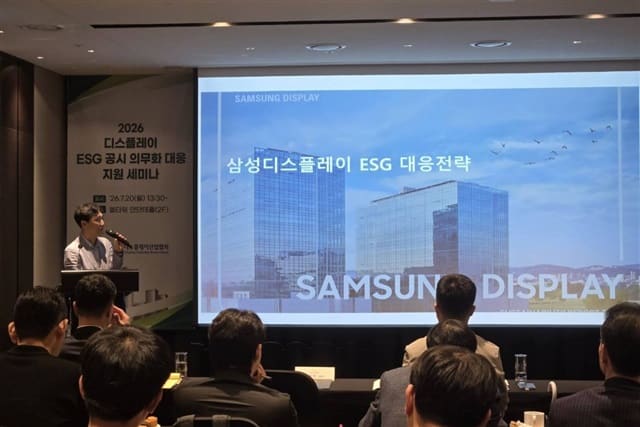
Samsung Display and LG Display, two of the country's largest electronics manufacturers by revenue and emissions footprint, are among the companies preparing compliance frameworks ahead of the 2028 deadline. Both firms operate energy-intensive production lines for OLED and LCD panels, making them significant emitters within South Korea's industrial base.
Samsung Display has begun auditing supply chain emissions data and upgrading internal reporting systems to track Scope 3 emissions beyond direct manufacturing. The company's facilities in Asan and Tangjeong consume substantial electricity, and the firm has indicated it will need to quantify upstream emissions from materials suppliers and downstream product use.
LG Display is similarly expanding its environmental data infrastructure. The company operates major production sites in Paju and Gumi, where it manufactures panels for televisions, monitors, and automotive displays. Internal teams are working to map emissions across the product lifecycle, a requirement under the finalized disclosure rules.
Both companies have existing sustainability reports, but the statutory framework will require third-party verification and integration with financial statements, raising the bar for accuracy and completeness. Penalties for non-compliance or misreporting have not been detailed, but regulators have signaled enforcement will be rigorous.
Regional Context and Investor Pressure
The decision to mandate climate disclosures places South Korea in step with regulatory trends across developed markets. The European Union has phased in the Corporate Sustainability Reporting Directive, while jurisdictions including Singapore and Hong Kong have introduced or proposed similar frameworks for listed companies.
For South Korea, the move also addresses concerns from foreign institutional investors who have pushed for greater transparency on environmental risks in portfolios with heavy exposure to manufacturing and heavy industry. The country's export-driven economy depends on sectors such as semiconductors, displays, batteries, and shipbuilding, all of which face scrutiny over carbon intensity.
Domestic asset managers have also voiced support for standardized reporting, arguing that inconsistent voluntary disclosures make it difficult to assess climate risk and allocate capital efficiently. The statutory requirement is expected to level the playing field and reduce greenwashing by setting clear metrics and verification standards.
The 2028 start date gives companies roughly 18 months from the July 2026 announcement to build out reporting systems, train personnel, and engage auditors. Industry groups have requested transition support, including guidance documents and pilot programs, though details remain under discussion.
Implementation Challenges Ahead
Compliance will require significant investment in data systems, particularly for firms with complex supply chains spanning multiple countries. Display manufacturers source materials including glass substrates, driver ICs, and chemical inputs from suppliers in China, Japan, and Taiwan, complicating efforts to capture Scope 3 emissions with precision.
Smaller suppliers may lack the infrastructure to provide verified emissions data, forcing larger firms to estimate or invest in supplier capacity building. The cost of third-party audits and system upgrades could run into the tens of millions of dollars for large manufacturers, though these expenses are expected to be absorbed into broader sustainability budgets.
Regulators have indicated they will issue detailed technical standards in the coming months, covering everything from emissions accounting methodologies to the format of climate risk disclosures. Companies are awaiting clarity on how to report transition risks, physical risks from extreme weather, and the financial implications of decarbonization pathways.
The display sector's experience with the new rules will likely serve as a bellwether for other industries. If Samsung Display and LG Display navigate the requirements successfully, it may ease adoption across the broader manufacturing base. Conversely, any high-profile compliance failures could prompt calls for regulatory adjustments or extended timelines.
South Korea's approach reflects a calculated bet that mandatory disclosure will drive capital toward lower-carbon business models while maintaining the country's competitiveness in global supply chains where environmental credentials are increasingly tied to market access.
RELATED STORIES

Gates-Backed TerraPower Pulls Korean Firms Into Small Nuclear Reactor Supply Chain
Cheng Wei-Lun · 3 min
Samsung Display Restarts Asan OLED Campus as Foldable Phones Stage Recovery
Cheng Wei-Lun · 4 min

SK Chemicals Targets Europe's Can-Coating Shift After BPA Ban
Cheng Wei-Lun · 2 min
South Korea Breaks Full-Year Export Record in September
Tran Quoc Bao · 3 min
Spot something wrong? Email editor@briefasia.com. We log every correction publicly.