Finance · Deals
SK Hynix Eyes Solidigm IPO to Recover Investment and Fund US Chip Expansion
The South Korean chipmaker's NAND subsidiary could list on Nasdaq as SK hynix seeks to recoup part of its $9 billion acquisition and finance American manufacturing growth.
KEY TAKEAWAYS
- ·SK hynix is exploring a Nasdaq IPO for Solidigm, its US NAND subsidiary acquired from Intel for $9 billion in 2021, to recover costs and raise expansion capital.
- ·The listing would provide liquidity for SK hynix while giving Solidigm direct access to US capital markets and eligibility for CHIPS Act subsidies.
- ·Timing depends on memory market conditions, but enterprise NAND demand has strengthened due to AI-driven data center buildouts requiring high-speed storage.
A Path to Recoup Billions
SK hynix's American NAND memory subsidiary Solidigm appears to be inching toward a public debut on Nasdaq, a strategic maneuver that would allow the South Korean memory giant to claw back a portion of the $9 billion it spent acquiring the business while simultaneously raising capital for US-based manufacturing expansion.
Market observers have turned their attention to Solidigm after indications surfaced that the company may pursue pre-IPO fundraising before a US stock exchange listing. SK hynix declined to provide confirmation last week. In a regulatory filing dated August 5, the parent company responded to speculation about a potential stake sale but offered no definitive timeline or commitment.
The transaction structure under consideration would mark a significant pivot for SK hynix, which absorbed Intel's NAND memory and solid-state drive operations in late 2021. That deal transformed SK hynix into a more diversified player across both DRAM and NAND segments, but it also saddled the firm with substantial debt at a time when memory chip prices were entering a prolonged downturn.
The Solidigm Asset
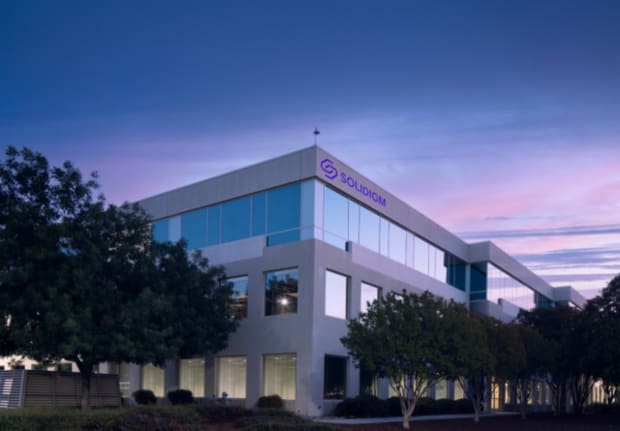
Solidigm operates as a standalone entity headquartered in California, focusing on enterprise and data-center storage solutions. The business inherited Intel's decades of NAND development expertise and a customer roster that spans hyperscale cloud providers and corporate data centers across North America.
Since the acquisition closed, SK hynix has kept Solidigm organizationally separate, maintaining its brand identity and go-to-market strategy distinct from the parent company's consumer-focused products. That structural independence makes the subsidiary a natural candidate for a carve-out IPO, a financing tool that has gained favor among Asian technology conglomerates seeking to unlock value from diversified portfolios.
An IPO would provide SK hynix with liquidity to reduce leverage while retaining majority control of Solidigm's operations and technology roadmap. It would also give Solidigm direct access to US capital markets, a strategic advantage as Washington increases subsidies for domestic semiconductor production under the CHIPS and Science Act.
Timing and Market Context
The timing of any listing will hinge on memory market conditions and investor appetite for chip stocks. NAND prices have stabilized in recent quarters after a brutal 2022-2023 correction, and enterprise storage demand has picked up thanks to AI-driven data center buildouts. Cloud infrastructure providers are expanding capacity to support generative AI workloads, which require vast amounts of high-speed storage alongside compute accelerators.
Solidigm's product lineup is well-positioned for this shift. The company's PCIe Gen5 solid-state drives and high-density NAND arrays cater to AI training clusters and inference servers, segments where growth is outpacing legacy enterprise storage.
A pre-IPO funding round would allow SK hynix to test institutional investor interest and establish a valuation benchmark ahead of a public offering. It could also bring in strategic partners with distribution networks or technology synergies, though SK hynix has given no indication it intends to cede control.
The US Manufacturing Angle
Beyond financial engineering, a Solidigm IPO would bolster SK hynix's ability to expand manufacturing footprint in the United States. The company has explored building or expanding NAND fabrication facilities on American soil to qualify for federal subsidies and meet customer preferences for domestically sourced components.
Listing Solidigm as a US-domiciled public company could strengthen those efforts by creating a locally capitalized entity eligible for grants and tax incentives under the CHIPS Act. It would also insulate the business from some of the geopolitical friction that has complicated cross-border semiconductor trade between the US and Asia in recent years.
SK hynix has not disclosed specific plans for new US fabs, but the company has publicly stated its intention to increase production capacity outside South Korea. A Solidigm IPO would provide a financing vehicle for that expansion without diluting SK hynix's core DRAM operations or straining its balance sheet further.
What Comes Next
The regulatory filing last week suggests SK hynix is at least evaluating its options, even if no final decision has been made. The company's next quarterly earnings call, expected in late October, may offer additional clarity on the timeline and structure of any transaction.
For now, Solidigm remains a wholly owned subsidiary, and SK hynix continues to consolidate its financial results. But the strategic logic for a carve-out is compelling, and market conditions are more favorable than they have been in two years. If SK hynix moves forward, Solidigm could become one of the largest semiconductor IPOs on a US exchange since the memory downturn began, and a test case for how Asian chipmakers navigate the new era of onshoring and industrial policy.
RELATED STORIES
Seoul's KOSPI Climbs 3.2% on Semiconductor Rally
Cheng Wei-Lun · 3 min

Bangladesh Cuts Interest Rates After Two-Year Inflation Fight
Priyanka V. Rao · 3 min

TPG Acquires Majority Stake in Lotte Rental
Jun-ho Seo · 3 min
South Korea Targets 36 Firms Under Stricter Delisting Standards
Cheng Wei-Lun · 3 min
Spot something wrong? Email editor@briefasia.com. We log every correction publicly.