Technology · Dev
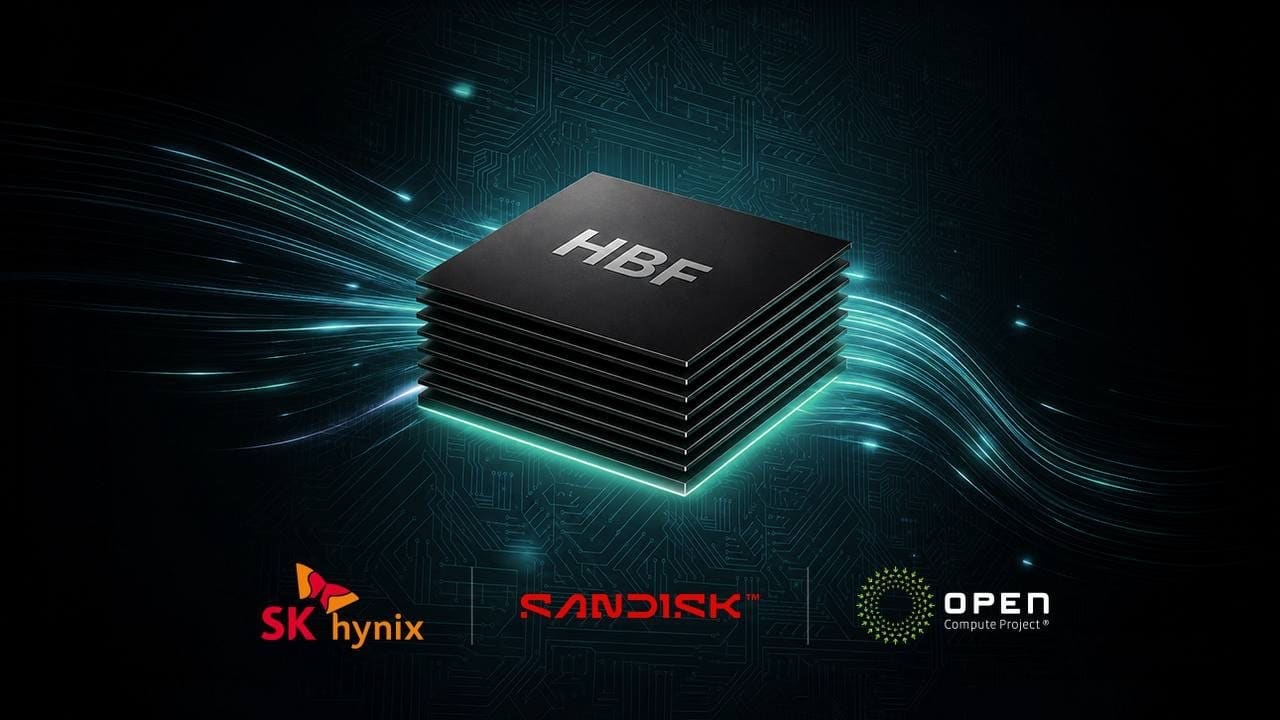
SK hynix and SanDisk Launch First Industry Standard for High Bandwidth Flash Memory
New HBF specification targets the performance gap between HBM and SSDs as AI workloads demand faster, larger memory solutions
KEY TAKEAWAYS
- ·SK hynix and SanDisk released the first industry standard for high bandwidth flash, specifying products with up to 512 gigabytes capacity.
- ·The HBF specification targets the performance and capacity gap between high bandwidth memory and solid-state drives in AI systems.
- ·Adoption depends on buy-in from server makers, cloud operators, and chipset vendors, with major competitors yet to commit publicly.
A New Memory Class Takes Shape
SK hynix and SanDisk introduced the first industry standard for high bandwidth flash on Tuesday, aiming to establish a new memory category that addresses the growing divide between processing speed and storage capacity in artificial intelligence systems. The specification was presented at the Future of Memory and Storage 2026 conference in Santa Clara, California.
According to SK hynix, the HBF standard defines products capable of reaching up to 512 gigabytes in capacity. The collaboration between the South Korean chipmaker and the Western Digital subsidiary represents a significant step toward standardizing a technology that has existed in proprietary forms but lacked industry-wide agreement on architecture and interfaces.
Filling the Gap in AI Infrastructure
The HBF specification responds to a specific problem in modern data center design. High bandwidth memory delivers exceptional speed but remains constrained by relatively small capacities, typically measured in tens of gigabytes. Solid-state drives offer terabytes of storage but cannot match the throughput required by GPU and AI accelerator workloads. High bandwidth flash is engineered to occupy the space between these two extremes.
Industry observers note that AI training and inference workloads increasingly require access to large datasets at speeds far beyond what conventional NAND flash can deliver. Model parameters continue to grow, and the time spent waiting for data movement has become a bottleneck in many high-performance computing environments. A standardized HBF architecture allows system designers to incorporate this intermediate tier without relying on vendor-specific implementations.
Asian Silicon Leadership
The partnership underscores Asia's continued dominance in memory innovation. SK hynix, headquartered in Icheon, holds a leading position in HBM production and has expanded aggressively into advanced packaging technologies. SanDisk, while a brand of California-based Western Digital, maintains substantial engineering and manufacturing operations across the region, including facilities in Japan and partnerships throughout the supply chain.
The timing of the standard's release aligns with broader regional investments in semiconductor infrastructure. South Korea has committed billions in subsidies to maintain its edge in memory manufacturing, while Japan has re-entered the advanced chip race through state-backed ventures. Singapore and Taiwan continue to anchor the packaging and integration segments that make complex memory architectures viable at scale.
What Comes Next
The release of a formal specification does not guarantee immediate adoption. Memory standards typically require buy-in from server manufacturers, hyperscale cloud operators, and chipset vendors before reaching volume production. SK hynix and SanDisk will need to demonstrate interoperability and cost advantages over existing workarounds, such as tiered caching schemes or custom memory controllers.
Other major memory suppliers have yet to publicly commit to the HBF standard. Micron Technology, Samsung Electronics, and China's YMTC all possess the technical capability to produce similar products but may pursue alternative architectures or wait for customer demand to solidify before investing in new production lines.
The conference in Santa Clara is expected to feature additional technical sessions on HBF integration, power efficiency benchmarks, and roadmap discussions. Industry watchers will be looking for signals from chipmakers such as NVIDIA, AMD, and Intel regarding support for the new memory class in future GPU and accelerator designs. Without ecosystem alignment, even the most technically sound standard risks remaining a niche solution.
For now, the SK hynix and SanDisk specification provides a reference point. Whether it becomes the foundation for a new tier of memory infrastructure or one proposal among many will depend on decisions made across the data center supply chain in the coming quarters.
RELATED STORIES

SK Hynix Eyes Deeper Collaboration With Japan's Chip Sector
Cheng Wei-Lun · 4 min

Samsung's Device Division Reports First Quarterly Loss as Chip Costs Surge
Cheng Wei-Lun · 3 min
Samsung and SK Hynix Turn Down KEPCO's Multibillion-Dollar Prepayment Demand
Cheng Wei-Lun · 4 min

South Korea Records Highest September Export Start on Semiconductor Demand
Tran Quoc Bao · 3 min
Spot something wrong? Email editor@briefasia.com. We log every correction publicly.