Technology · Products
Singapore Startup Builds AI Snake Robot to Automate Aircraft Baggage Loading
Antomation's Cargo Cobra system targets 20 percent speed gain while addressing injury rates three times higher than other industries
KEY TAKEAWAYS
- ·Singapore startup Antomation is developing Cargo Cobra, a telescoping AI-powered system that uses snake-like motion and robotic arms to load aircraft baggage, aiming for 20 percent faster speeds than manual crews.
- ·Airport baggage handling injury rates are 5.1 percent, three times the baseline, with the sector accounting for 55 percent of all back injuries among airline employees.
- ·The global airport baggage handling system market is forecast to grow from 9.7 billion US dollars today to 18.5 billion by 2034, driven by Asia-Pacific expansion and persistent labor shortages.
The Problem Inside the Hold
Baggage handlers spend their shifts in cramped, unventilated aircraft bellies, shifting luggage that can weigh 30 kilograms in a high-speed puzzle. Research across the US and Europe shows airport sector injury rates hit 5.1 percent, triple the baseline for other industries, with baggage handling responsible for more than half of all back injuries among airline workers.
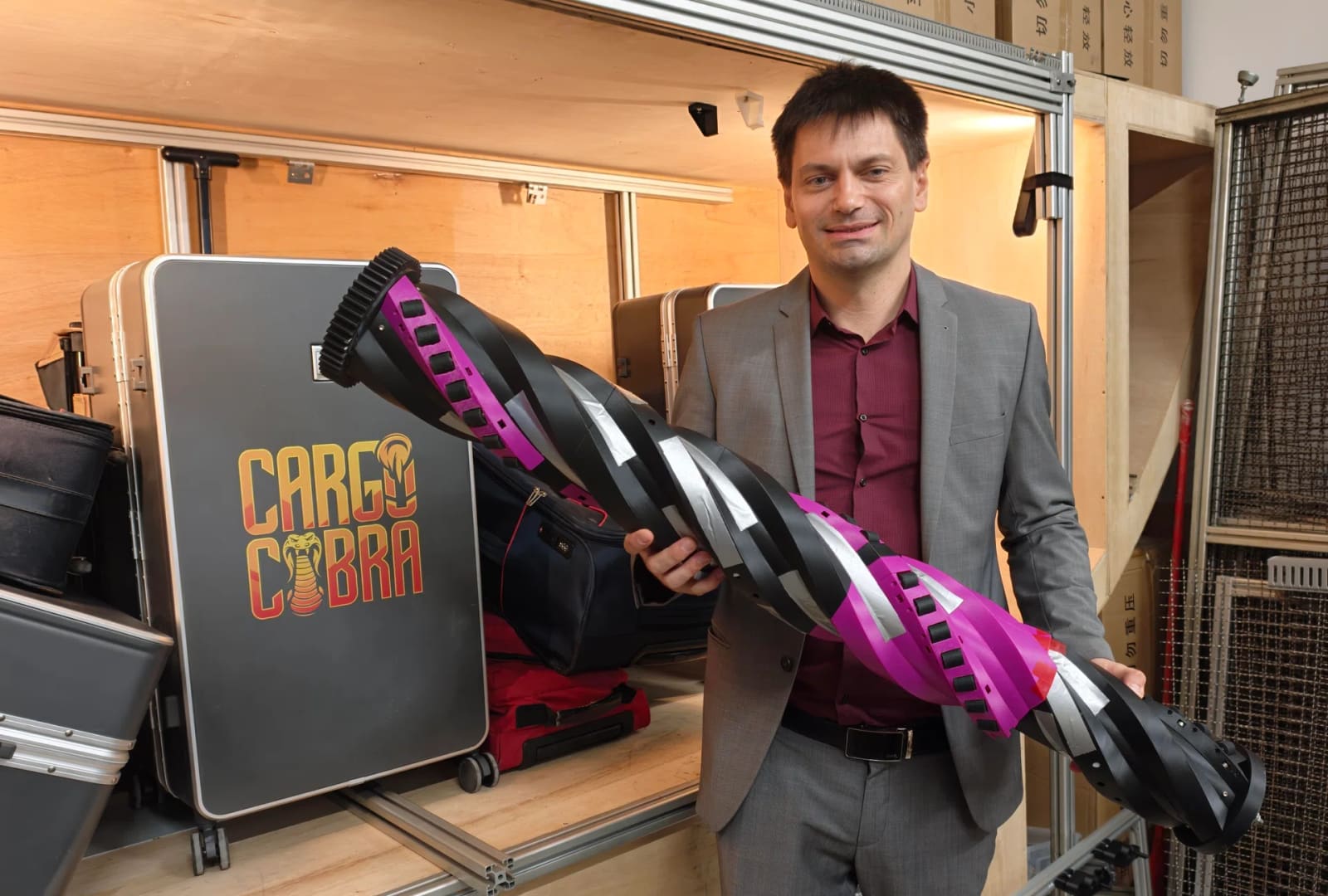
Antomation, a Singapore-based robotics startup, is building a system to pull humans out of cargo holds entirely. The company's Cargo Cobra uses telescoping rollers shaped in a helix, moving baggage through the hold with a motion that resembles a snake. Machine vision cameras and sensors map each bag's dimensions and position, while AI decides placement and robotic arms secure items weighing up to 100 kilograms.
Dominik Braun, the company's CEO and a mechanical engineer who previously built automated production lines for German automakers, said the goal is straightforward: eliminate the need for workers to climb into cargo holds and deliver at least 20 percent faster loading times than manual crews.
How the System Works
Conventional conveyor belts cannot extend their length, limiting how far they can reach into a cargo bay. Cargo Cobra solves this with segments that telescope into each other, adjusting length as the hold fills. The helix mechanism embeds rollers that transport luggage along the extending arm, while suction devices and robotic limbs manipulate bags into position.
The AI layer handles spatial planning, identifying where each piece should go based on size, weight, and the geometry of the hold. Braun is seeking a patent on the extendable roller design.
Antomation won the Aerospace Open Innovation Challenge 2024, organized by Enterprise Singapore and JTC Corporation, after aircraft maker Airbus posed the automated baggage loading challenge. This year, the startup secured a 400,000 Singapore dollar Startup SG Tech grant from EnterpriseSG, earmarked for early-stage companies with proprietary technology and scalable models.
Speed and Scale
Braun expects a working prototype within twelve months. The timeline is tight, but advances in 3D printing and AI coding have compressed development cycles. In Antomation's Ang Mo Kio facility, multiple 3D printers run continuously, producing test components for the robotic arms. Tasks that once required five or six hours of manual programming now take minutes with AI assistance.
The company remains lean, with two engineers in Singapore and three overseas. Braun said recent availability of less expensive, human-style robotic limbs may be integrated into later versions of Cargo Cobra to handle heavier loads.
Market Timing
Aviation's pandemic collapse drove many workers out of labor-intensive airport roles, and recruitment has remained difficult even as passenger traffic rebounded. The global airport baggage handling system market is projected to reach 18.5 billion US dollars by 2034, up from 9.7 billion dollars today, according to Fortune Business Insights. Asia-Pacific is expected to lead that growth.
Labor shortages threaten to constrain capacity gains, making automation attractive to airlines and ground handlers focused on turnaround speed and cost control. Braun noted that customers cite difficulty recruiting for baggage handling roles, calling it a global problem that creates opportunity for investors backing the right solution.
Founded in 2022 with support and investment from technology startup builder Atum Ventures and angel investors, Antomation also applies AI to other aviation challenges, including detecting blockages in heat exchangers for a major aircraft maintenance, repair, and overhaul company.
The company positions itself as a full-stack developer, building custom hardware, software, and AI for specific problems rather than adapting off-the-shelf components. Braun, a self-described tinkerer who has experimented with electronics and software since childhood, said the approach allows Antomation to address constraints that generic systems cannot solve.
Cargo Cobra's design remains in flux. As new robotic components enter the market, Braun plans to evaluate whether they can improve lifting capacity or reduce system cost. The target remains consistent: reduce headcount requirements, speed operations, and eliminate a job that wears down workers faster than almost any other role in aviation.
RELATED STORIES
Singapore Targets High-Value Data Centre Workloads as Neighbors Scale Up Capacity
Cheng Wei-Lun · 3 min
Private Capital Floods Asia's MedTech Sector as Brain Interfaces and Robotics Draw Investors
Priyanka V. Rao · 4 min

Singapore and Thailand Exchanges Push for Tech IPOs Amid AI Surge
Priyanka V. Rao · 3 min
Singapore REITs Raise S$4.5 Billion in Nine Months as Fundraising Momentum Extends Into 2026
Priyanka V. Rao · 3 min
Spot something wrong? Email editor@briefasia.com. We log every correction publicly.