Asia · Business
Singapore Faces S$290 Million Retail Outflow as Cross-Border Rail Link Opens
New rapid transit connection to Johor Bahru will shift spending patterns across the border while creating opportunities in premium categories
KEY TAKEAWAYS
- ·The Rapid Transit System Link opening in January 2027 will generate a net S$290 million annual increase in Singapore retail spending flowing to Johor Bahru, equal to 0.4 per cent of 2025 retail and F&B sales.
- ·Singapore's central business district will capture 78 per cent of incremental inbound spending from Malaysian visitors, concentrated in premium retail, entertainment, hotels, and dining.
- ·Industry groups recommend government voucher schemes, expanded event infrastructure, and manpower policy reviews to help businesses adapt to structural shifts in cross-border consumption patterns.
Cross-Border Spending Shift
Singapore is set to record a net S$290 million increase in annual outbound spending to Johor Bahru when the Rapid Transit System Link begins operations in January 2027. The figure represents 0.4 per cent of Singapore's total retail and food and beverage sales recorded in 2025.
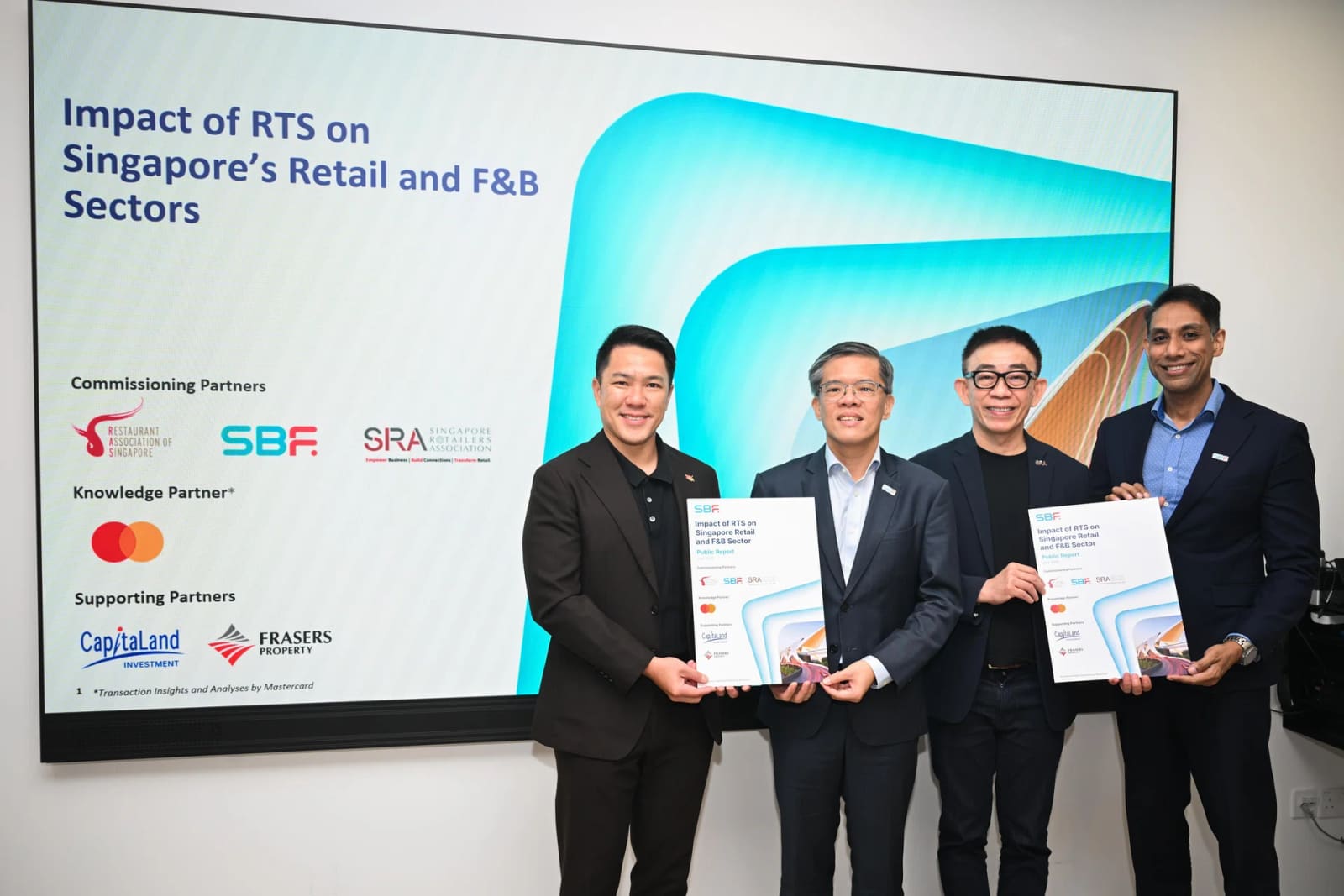
A study released July 16 by the Singapore Business Federation, Restaurant Association of Singapore, and Singapore Retailers Association projects that improved connectivity will push Singapore consumers to spend an additional S$1.05 billion annually across the causeway. Malaysian visitors, in turn, are expected to contribute S$756 million more to Singapore's retail and F&B sectors each year.
The rail link will add 11.2 million round trips from Singapore to Johor Bahru annually, alongside 3.3 million trips in the opposite direction. Daily ridership is estimated at 39,700 trips, marking a 51 per cent increase in outbound travel by Singapore consumers.
Regional Winners and Losers
Singapore's central business district stands to benefit disproportionately from the infrastructure upgrade. The study found that 78 per cent of incremental inbound spending from Malaysian visitors will concentrate in the city center, driven by demand for high-end retail, entertainment venues, hotels, and dining.
Other regions face a net outbound impact. The eastern corridor is expected to hold up relatively well due to retail anchors at Jewel Changi Airport, while areas already experiencing high cross-border spending before the rail link will see intensified pressure.
Kok Ping Soon, chief executive of the Singapore Business Federation, characterized the shift as structural rather than incremental. Retail and F&B contributed approximately S$16.6 billion to Singapore's gross domestic product in 2025, employed 17.5 per cent of the workforce, and accounted for 31 per cent of tourism receipts.
Spending Patterns Diverge
The research identified distinct consumption behaviors across the border. Singapore residents are expected to spend broadly across categories in Johor Bahru, with groceries accounting for the largest share, followed by drugstores, dining, and beauty products. Musa Fazal, chief policy and operating officer at the Singapore Business Federation, noted that Singaporeans behave like locals when shopping in Malaysia.
Malaysian visitors to Singapore, conversely, exhibit tourist spending patterns. Some 34 per cent of Johor Bahru respondents indicated they intend to visit Singapore for events after the rail link opens, up from 24 per cent currently. Their spending concentrates on city center shopping, tourist attractions, and event attendance.
The study surveyed approximately 1,700 respondents in Singapore and 400 in Johor during March, excluding Johor Bahru residents who commute for work in order to isolate leisure travel behavior. Analysis drew on Mastercard transaction data, government statistics, and industry consultations.
Industry Response
Focus group discussions revealed concerns that the rail connection will sharpen competition from Johor Bahru, particularly in price-sensitive categories. Businesses acknowledged they must differentiate through service quality, unique customer experiences, and locally distinctive offerings rather than competing solely on price.
Small and medium-sized enterprises expressed worry about adapting as quickly as larger operators, citing persistent manpower constraints, compliance burdens, and cost pressures that limit their ability to innovate and scale.
The three industry associations outlined ten policy recommendations across three priority areas. First, they called for stimulus to local spending through expanded voucher schemes and support for stronger offerings in categories and locations most exposed to cross-border substitution.
Second, they recommended measures to encourage longer stays and higher spending from rail-enabled tourists, including leveraging mega events, decentralizing event infrastructure, reinventing nighttime offerings, and extending tax refund programs.
Third, they urged action on structural cost pressures and support for new operating models, including targeted incentives for asset enhancements, facilitation of cross-border optimization, reviews of foreign manpower policies, and sustainable rental approaches.
Landlords and Collaboration
Ernie Koh, president of the Singapore Retailers Association, said his organization is in discussions with landlords operating in Johor Bahru and partnering with Malaysian retail associations to develop complementary rather than competitive offerings.
Benjamin Boh, president of the Restaurant Association of Singapore, emphasized that businesses require manpower agility and operational flexibility to capture both local and tourist spending effectively.
Koh added that retailers are pivoting toward experiential concepts while shopping centers curate tenant remixes. He anticipates government mitigation measures over the next three to five years as the market adjusts to the new connectivity reality.
The rail infrastructure represents the latest development in Singapore-Johor economic integration, a corridor that has deepened steadily through manufacturing clusters, logistics networks, and residential development. The study underscores the need for collaboration among trade associations, landlords, tourism stakeholders, and government agencies to help businesses navigate the structural shifts ahead.
RELATED STORIES

Singapore Targets High-Value Data Centre Workloads as Neighbors Scale Up Capacity
Cheng Wei-Lun · 3 min
CIMB Commits to 55% Dividend Floor as Regional Portfolio Offsets Indonesia Pressure
Priyanka V. Rao · 4 min

Singapore Eyes Global Investment Court as UN Talks Near Final Stage
Priyanka V. Rao · 3 min

Southeast Asian Firms Race to Raise Green Debt as Region Falls Behind on Renewables
Priyanka V. Rao · 3 min
Spot something wrong? Email editor@briefasia.com. We log every correction publicly.