Finance · Banking
CIMB Commits to 55% Dividend Floor as Regional Portfolio Offsets Indonesia Pressure
Malaysia's second-largest lender plans to maintain its shareholder payout despite margin compression and headwinds in its Indonesian operations, leveraging strength in Singapore and Thailand restructuring.
KEY TAKEAWAYS
- ·CIMB Group will maintain its dividend payout ratio above 55 percent despite operational challenges in Indonesia and net interest margin compression across the group.
- ·The bank projects group margins could stay flat or decline by up to 10 basis points year-over-year, but expects asset growth of five to seven percent to offset income pressure.
- ·CIMB is exiting loss-making auto finance in Thailand and refocusing the unit on wealth management and wholesale banking to improve regional profitability.
Regional Diversification as Shield
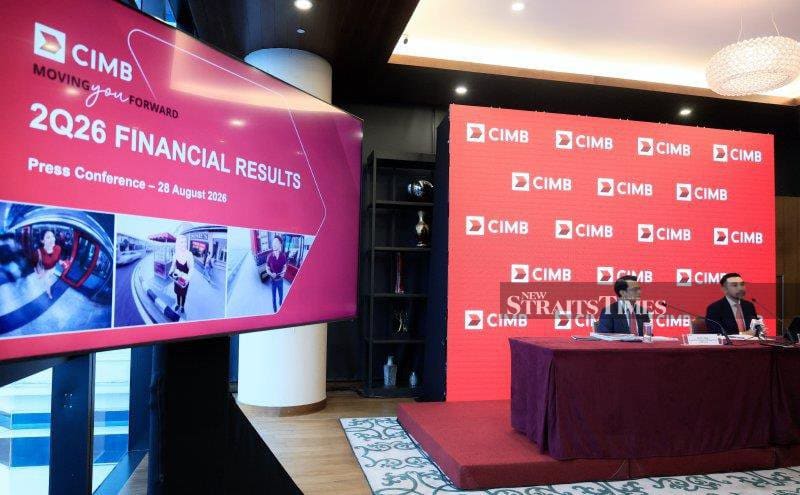
CIMB Group Holdings is standing firm on its commitment to return more than 55% of earnings to shareholders, a policy the Malaysian banking group has maintained for several years even as it navigates margin pressure and operational challenges in Indonesia. The reaffirmation came as the lender reported second-quarter results that underscored both the resilience of its diversified franchise and the complexities of operating across Southeast Asia's uneven economic landscape.
Group CEO Novan Amirudin outlined the bank's strategy at a results briefing this week, emphasizing that CIMB's geographic spread provides multiple avenues to support profitability when individual markets face headwinds. The bank, Malaysia's second-largest by total assets, operates across five ASEAN markets and maintains significant wholesale banking operations in key financial centers.
Indonesia, where CIMB has built a retail and commercial presence over two decades, is currently facing macroeconomic pressures that have dampened loan demand and squeezed net interest margins. Yet Amirudin made clear that the group's ability to generate consistent earnings from Malaysia and Singapore, combined with a strategic pivot in Thailand, gives management confidence that dividend policy will remain intact.
Margin Pressure Acknowledged
Group CFO Khairul Rifaie provided a granular view of the income dynamics underpinning the bank's outlook. Net interest income growth is being driven by a robust pipeline of new lending, with total assets expanding at a healthy clip across the franchise. However, the group is simultaneously experiencing compression in net interest margins, the gap between what banks earn on loans and pay on deposits.
Khairul projected that group-level margins could remain stable or contract by as much as 10 basis points on a year-over-year basis. The first half of the financial year already saw margin erosion, and management expects that trend to persist through the remainder of 2026. Despite this, the CFO expressed confidence that volume growth would more than compensate, resulting in moderate to solid net interest income expansion that translates into pre-tax profit gains.
The guidance reflects a broader trend across Asian banking, where central banks in several markets have either paused rate hikes or begun easing cycles, putting downward pressure on lending yields while deposit costs remain sticky. For a regional player like CIMB, the challenge is compounded by differing monetary policy trajectories in Malaysia, Indonesia, Thailand, and Singapore.
Asset Growth and Credit Quality
CIMB is targeting loan growth in the range of five to six percent for the full year, a measured pace that reflects cautious optimism about credit demand in its core markets. The bank's asset expansion guidance, set at five to seven percent on a constant-currency basis, suggests management is prioritizing quality over aggressive volume targets.
On credit quality, Khairul indicated that the gross impaired loan ratio should hold relatively steady, though he acknowledged pockets of potential deterioration. Certain sectors face indirect exposure to geopolitical tensions in the Middle East, while others are grappling with inflationary cost pressures that could strain borrowers' ability to service debt. The bank expects some uptick in impaired loans in these segments, but believes overall group metrics will remain stable.
Management maintained its financial year 2026 guidance for loan loss charges between 25 and 35 basis points, a range that implies the bank is provisioning conservatively while not anticipating a broad-based deterioration in asset quality. The common equity tier-one capital ratio target of 14% provides a comfortable buffer above regulatory minimums, giving the bank room to absorb credit losses and continue returning capital to shareholders.
Thailand Turnaround in Focus
A critical element of CIMB's earnings diversification strategy is the ongoing transformation of its Thai operations. The bank is in the process of disposing of a loss-making automotive financing portfolio, a transaction expected to close before year-end. Once complete, the Thai business will pivot toward wealth management and wholesale banking, segments where CIMB believes it can achieve better returns on capital.
The automotive finance exit marks a recognition that not all retail lending portfolios are created equal in Southeast Asia's fragmented markets. By concentrating resources on higher-margin wealth and corporate clients in Thailand, CIMB aims to improve profitability in a market where it has historically struggled to gain scale in mass-market retail.
Malaysia and Singapore as Anchors
The bank's confidence in sustaining its dividend policy rests heavily on the continued strength of its Malaysian and Singaporean operations. Malaysia, CIMB's home market, accounts for the largest share of group assets and profits, with a diversified book spanning consumer banking, SME lending, corporate finance, and investment banking. The domestic economy has shown resilience in 2026, supported by steady consumer spending and infrastructure investment.
Singapore, meanwhile, remains a high-return market for CIMB despite its smaller footprint. The city-state's status as a regional wealth hub and gateway for cross-border corporate banking generates fee income and treasury profits that help offset margin pressures elsewhere in the network.
Return Targets and Cost Discipline
CIMB's financial year 2026 guidance includes a return on equity target of 11 to 11.5%, a range that places the bank in the middle tier of Southeast Asian peers. Achieving that return in a margin-constrained environment will require disciplined cost management, and the bank has set a cost-to-income ratio ceiling of 47%.
For investors, the dividend commitment is a critical signal. Regional banks have faced pressure to demonstrate capital discipline and shareholder-friendly policies as growth slows and interest rate cycles turn. By holding the payout ratio above 55%, CIMB is betting that its diversified model can generate stable earnings even when individual markets underperform.
The strategy carries execution risk. If Indonesia's challenges deepen or if margin compression accelerates beyond current expectations, the bank may face difficult choices between sustaining dividends and preserving capital for growth. For now, management is signaling that the franchise's breadth gives it enough flexibility to navigate near-term turbulence without sacrificing returns to shareholders.
RELATED STORIES

Southeast Asian Firms Race to Raise Green Debt as Region Falls Behind on Renewables
Priyanka V. Rao · 3 min

Southeast Asian Factories Adopt Proximity Planning to Retain Workers and Investors
Lim Hui Ying · 3 min

Indonesian Petrochemical Giant Chandra Asri Expands Into Singapore, Malaysia Auto Markets
Priyanka V. Rao · 4 min

Chandra Asri Acquires Jardine's Singapore and Malaysia Dealerships for $265 Million
Priyanka V. Rao · 3 min
Spot something wrong? Email editor@briefasia.com. We log every correction publicly.