Asia · Business
Singapore Reopens Door to American Egg Imports After Two-Decade Gap
City-state aims to diversify suppliers as four US producers begin shipments, targeting eventual 10% market share
KEY TAKEAWAYS
- ·American eggs returned to Singapore in July 2026 after regulatory alignment, with four US producers now cleared to export and initial volumes reaching 1.2 to 1.5 million eggs monthly.
- ·A 2025 avian flu outbreak in the US triggered government support and subsequent oversupply in 2026, driving producers to seek offshore markets including Singapore at competitive pricing.
- ·Singapore imported over 2.2 billion eggs in 2025 with Malaysia as the dominant supplier, and SFA aims to diversify sources as domestic farms meet less than 35 percent of demand.
Regulatory Thaw Unlocks Market Access
American shell eggs have begun arriving on Singapore shelves after a twenty-year absence, following successful negotiations between the Singapore Food Agency and US agricultural authorities on export certification and disease-tracing protocols. The regulatory freeze dated to the early 2000s, when SFA raised its import requirements.
Air freight deliveries touched down in July 2026, with four US producers now cleared to ship product. Ocean freight remains an option despite the 30- to 45-day transit window, according to local importers who spoke to media at a July 31 event celebrating the reopening.
Initial volumes are modest. The USA Poultry and Egg Export Council projects monthly exports of 1.2 million to 1.5 million eggs, representing roughly 1 to 2 percent of Singapore consumption. Greg Tyler, the council's chief executive, said the goal is to eventually capture around 10 percent of the market, mirroring penetration levels achieved in Hong Kong, Taiwan, and South Korea.
Supply Glut Drives Export Push
The timing reflects conditions in the US domestic market. A 2025 avian influenza outbreak triggered government support for producers, and by 2026 the sector faced oversupply. Retail prices softened sharply, prompting farms to seek offshore buyers.
Tay Jing Yong, general manager at Sengkang Import and Export, placed an order with California-based Hidden Villa Ranch and described pricing as attractive. He requested more than one container but was allocated a single unit to start. "We wanted to buy more," Tay said.
Aloysius Lee, managing director of Kai Yong Huat Eggs, received his first consignment from Hillandale Farms and is now gauging retailer interest. He expects the product to appeal broadly, including to convenience stores, given competitive pricing. "Everything is about the consumer," Lee noted. "It is more expensive by a few cents, but for quality eggs, I think it's worth it."
Diversification Imperative
Singapore imported over 2.2 billion eggs in 2025, with Malaysia as the dominant supplier. Domestic farms cover less than 35 percent of demand. SFA chief executive Damian Chan framed the US entry as part of the city-state's broader food security strategy, which prioritizes supplier diversification given that more than 90 percent of food is imported.
In January 2026, SFA amended labelling rules to permit bulk packaging for eggs destined for manufacturers and food service operators, a step aimed at smoothing import logistics and strengthening resilience.
Emily Metz, president of the American Egg Board, noted at the July event that Singapore per capita consumption approaches one egg daily, among the highest globally. "We are honoured that this door has reopened after more than two decades, and we do not take that responsibility lightly," Metz said.
Product Differentiation and Demand
White eggs are a particular draw for some importers. Tay currently sources them from Ukraine but cited longer testing cycles due to radiation concerns linked to the ongoing conflict with Russia. "Because of the war, there is a lot of uncertainty. It's good to have another source, like the US," he said.
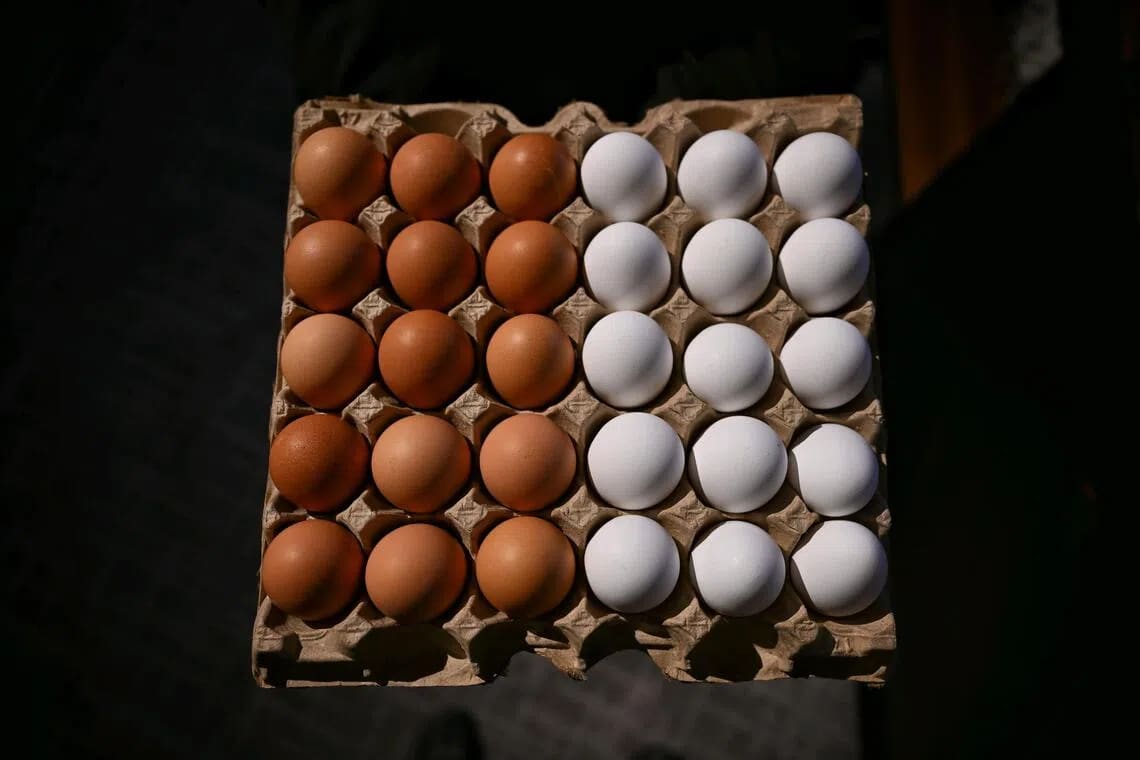
Lee, who sampled the Hillandale shipment, observed a more intense yolk color and richer flavor profile. At the launch event, Rose Acre Farms, the second-largest US producer, provided brown and white eggs for attendees. Wesley Ngoi, a chef at Jiak Kim House, described scrambled eggs prepared from the US product as "really nice" and "creamier than the usual ones we have."
Angela Low, who works for a food distributor not yet carrying US eggs, tasted sunny-side-up and found the yolk "richer." Both importers and distributors are now in early talks with supermarkets, hotels, and restaurants to finalize shelf placement and menu integration.
The sector will watch whether US producers maintain export commitment once domestic market dynamics shift, but for now Singapore's egg aisles are set to see a new flag on the carton.
RELATED STORIES
Southeast Asian Firms Overlook Digital Pact Worth USD 2 Trillion
Lim Hui Ying · 4 min

Five ASEAN Members Back Regional Oil Stockpile as Study Nears Completion
Tran Quoc Bao · 3 min
Singapore Economists Lift 2026 Growth Outlook to 5% as Chip Exports Surge
Priyanka V. Rao · 3 min

Addvalue Technologies Lands $5 Million in Space and Radio Contracts
Tran Quoc Bao · 3 min
Spot something wrong? Email editor@briefasia.com. We log every correction publicly.