Asia · Trade
Singapore's Gateway at Risk as Indonesia Eyes Strategic Waterway Control
A finance minister's proposal to charge fees on Malacca traffic signals growing tensions over who governs Asia's busiest shipping lane
KEY TAKEAWAYS
- ·Indonesia's finance minister proposed transit fees for the Strait of Malacca in 2026 before Malaysia and Singapore rejected the plan and Jakarta withdrew it.
- ·Over 25 percent of global seaborne oil shipments pass through Malacca, more than transit the Strait of Hormuz, with China relying on the corridor for 80 percent of crude imports.
- ·Indonesia controls not only part of Malacca but also the Sunda and Lombok Straits, giving Jakarta unique leverage over both the primary route and its alternatives.
A Trial Balloon Over Open Waters
When Indonesia's Finance Minister Purbaya Yudhi Sadewa proposed charging vessels for passage through the Strait of Malacca earlier this year, the suggestion lasted less than a week. Malaysia and Singapore rejected it outright, international shipping groups protested, and Jakarta withdrew the idea while reaffirming its commitment to existing maritime law.
Yet the episode exposed a shift in how coastal nations perceive strategic waterways. For decades, freedom of navigation through Malacca has been treated as a given, underpinned by the 1982 UN Convention on the Law of the Sea. Now, as geopolitical tensions rise and maritime chokepoints become weapons in regional conflicts, some governments are testing whether geography can be converted into leverage.
The Numbers Behind the Corridor
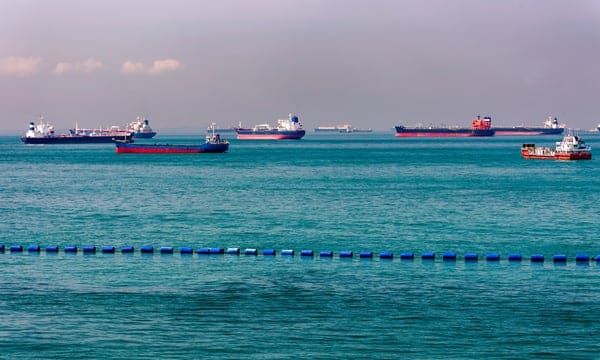
More than 20 percent of global maritime traffic moves through the 900-kilometer waterway separating Sumatra from the Malaysian Peninsula, according to shipping data. Over 25 percent of seaborne oil shipments pass through the channel, a higher share than transits the Strait of Hormuz. Much of that crude originates in the Persian Gulf and continues toward China, Japan, and South Korea.
The narrowest section, the Phillip Channel near Singapore, measures under three kilometers wide. That bottleneck handles container ships, oil tankers, and bulk carriers simultaneously, creating one of the most congested maritime zones on the planet. Heavy traffic raises collision risk, while piracy, though reduced from earlier decades, remains a recurring concern.
Three Governments, Competing Priorities
Indonesia, Malaysia, and Singapore share jurisdiction over the waterway under UNCLOS, which grants all nations the right of transit passage. Coastal states cannot suspend navigation, arbitrarily restrict access, or impose tolls without violating treaty obligations.
Since the 1970s, the three governments have coordinated naval patrols, counterpiracy operations, and traffic management. That cooperation has kept the strait open even as other chokepoints have faced prolonged disruption.
But strategic interests diverge. Singapore's port, the world's second-busiest container terminal, depends on uninterrupted flow; any closure would undermine the city-state's role as Southeast Asia's logistics and financial center. Malaysia relies on the strait to maintain the competitiveness of Port Klang, one of the region's largest gateways.
Indonesia holds a different card. Beyond controlling a significant stretch of Malacca's coastline, Jakarta also governs the Sunda and Lombok Straits, the main alternative routes through the Indonesian archipelago. President Prabowo Subianto has repeatedly described this geographic position as a strategic asset, and Indonesian officials have framed control over these passages as a way to amplify the country's influence across the Indo-Pacific.
When Alternatives Fall Short
Alternative routes exist, but none replicate Malacca's efficiency. The Sunda Strait imposes navigational constraints, while Lombok and Makassar can accommodate larger vessels but add days to sailing times, increasing fuel consumption and shipping costs.
A prolonged disruption would not trigger complete maritime paralysis, but it would impose substantial economic costs on Asian economies that depend on the corridor for energy imports and raw materials. For China, around 80 percent of crude oil imports transit Malacca, alongside a significant share of manufactured exports bound for Europe, the Middle East, and Africa.
Beijing has recognized this vulnerability since 2003, when then-President Hu Jintao labeled it the "Malacca Dilemma." Over the past decade, China's navy has expanded operations across the Indo-Pacific, while infrastructure investments, including pipelines through Myanmar and Pakistan, aim to create overland routes that bypass the strait entirely.
A Broader Pattern
Indonesia's transit fee proposal arrived in the wake of Iran's blockade of the Strait of Hormuz, which followed U.S. and Israeli strikes earlier this year. That closure interrupted roughly one-quarter of global oil trade and one-fifth of liquefied natural gas shipments, demonstrating how a single actor can exploit geography during conflict.
The Red Sea crisis in 2023, triggered by Houthi attacks on vessels passing through the Bab el-Mandeb Strait, had already shown how non-state actors can disrupt essential trade routes. Even without a full closure, threats and attacks drive up insurance premiums and force ships onto longer, more expensive paths.
Indonesia's proposal, though quickly abandoned, suggests that coastal states are beginning to view chokepoints not only as international public goods requiring protection but also as strategic assets capable of generating political and economic leverage. The legal framework established by UNCLOS makes a politically motivated closure of Malacca unlikely, but the conversation itself signals a shift.
What Comes Next
For now, cooperation among the three littoral states remains the foundation of Malacca's stability. None can secure the strait independently, and all benefit from keeping it open. But as maritime chokepoints become increasingly central to geopolitical competition, the assumptions that have governed these waterways for decades are under pressure.
Singapore and Malaysia have little incentive to change the status quo. Indonesia, with its unique position controlling both the primary corridor and its alternatives, may continue to test the boundaries of what regional cooperation can accommodate. How that tension resolves will depend not only on the three governments involved but also on the broader strategic rivalry between the United States and China, for whom Malacca remains a critical artery in any future regional crisis.
RELATED STORIES

Southeast Asian Firms Overlook Digital Pact Worth USD 2 Trillion
Lim Hui Ying · 4 min

Five ASEAN Members Back Regional Oil Stockpile as Study Nears Completion
Tran Quoc Bao · 3 min

CIMB Commits to 55% Dividend Floor as Regional Portfolio Offsets Indonesia Pressure
Priyanka V. Rao · 4 min

Singapore Targets High-Value Data Centre Workloads as Neighbors Scale Up Capacity
Cheng Wei-Lun · 3 min
Spot something wrong? Email editor@briefasia.com. We log every correction publicly.