Technology · Policy
Singapore Directors Get New AI Oversight Framework as Board Accountability Rises
The 116-page guide, developed with OpenAI and Microsoft, shifts AI governance from tech committee topic to core boardroom mandate as firms struggle to scale pilots into enterprise-wide deployment.
KEY TAKEAWAYS
- ·The Singapore Institute of Directors released a 116-page AI governance framework on July 31, developed with OpenAI and Microsoft, to help boards oversee AI strategy and risk as global spending approaches $2.52 trillion in 2026.
- ·Minister Josephine Teo emphasized that no board can afford to under-invest in AI understanding, noting Singapore faces significant competition from countries seeking to close the gap with top AI performers.
- ·The guide addresses a persistent challenge: while many organizations build successful AI pilots, most struggle to scale them enterprise-wide, with experts citing communication gaps and governance deficits as key barriers.
A Boardroom Imperative
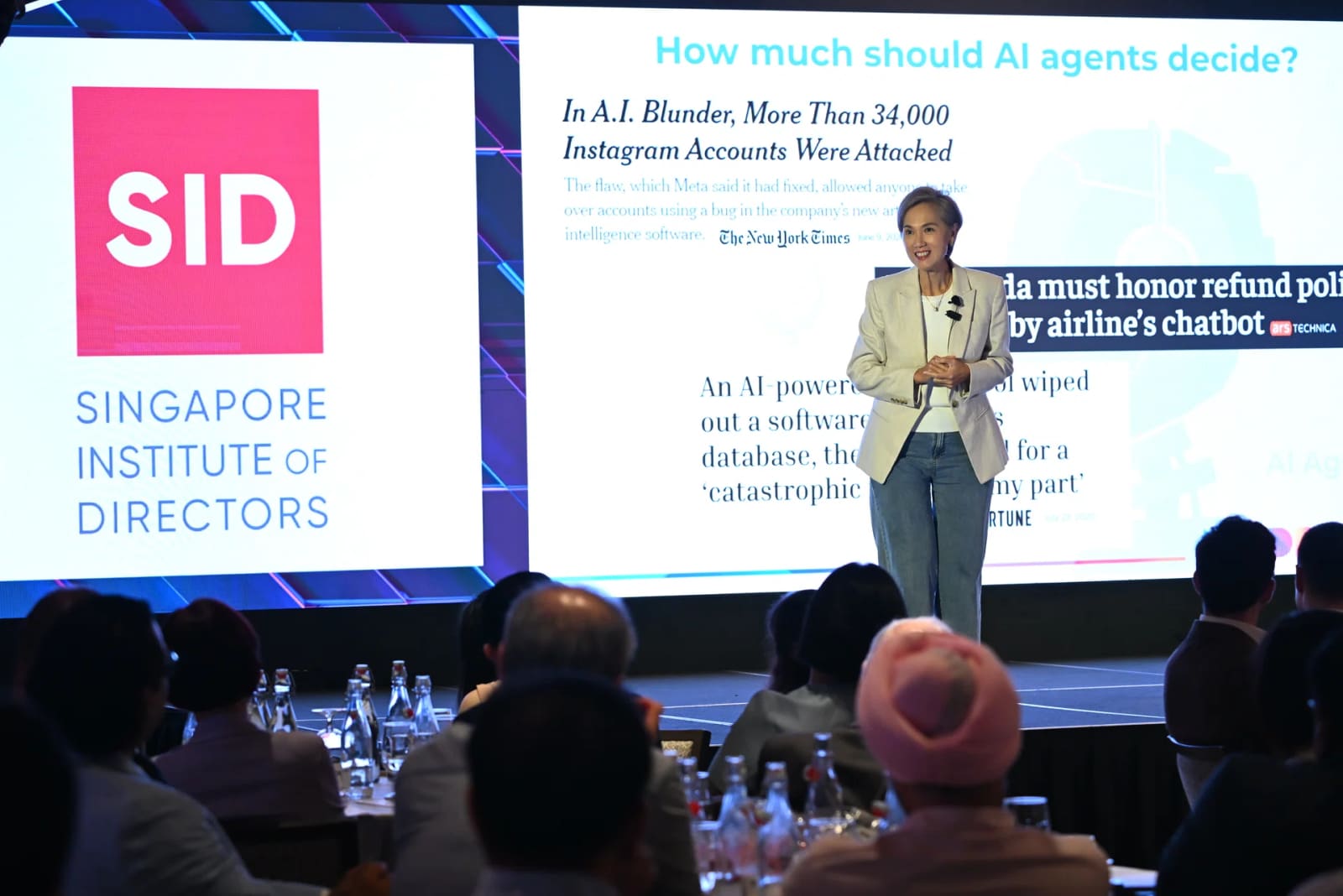
The Singapore Institute of Directors released its first comprehensive AI governance framework on July 31, designed to equip boards with practical tools for overseeing artificial intelligence strategy, risk and implementation. The AI Guide for Boards in Singapore runs 116 pages and was developed in partnership with OpenAI and Microsoft, with backing from the Infocomm Media Development Authority.
The framework arrives as organizations worldwide grapple with a persistent challenge: while many have successfully built AI proof-of-concept projects, few manage to scale them across the enterprise. Gartner projects global AI spending will hit $2.52 trillion in 2026, yet the translation from pilot to production remains a bottleneck for most firms.
SID chairman Yeoh Oon Jin framed the release in fiduciary terms. The guide aims to shift AI oversight from a passive technology committee agenda item into a core boardroom responsibility, he explained at the inaugural SID Digital & Tech Forum where the framework debuted.
The Investment Gap
Minister for Digital Development and Information Josephine Teo opened the forum with a pointed message: no board can afford to under-invest in understanding AI. She acknowledged Singapore's position among leading nations in AI investment and innovation but noted the gap between top performers and the city-state remains significant, with growing competition from other countries seeking to close the distance.
Teo highlighted a unique dynamic shaping AI adoption in organizations today. Unlike previous technology waves, many employees are already using AI tools on their own, often ahead of official company rollouts. She urged firms to harness that existing knowledge and create pathways for individual productivity gains to scale into broader workplace improvements.
Her caveat: companies should pursue AI deployment in ways that empower workers rather than replace them. She argued there remains substantial untapped human potential and creativity that AI cannot simply replicate.
From Strategy to Execution
The guide addresses a spectrum of boardroom concerns, from integrating AI into corporate strategy and identifying high-value opportunities to managing regulatory compliance, cybersecurity threats and ethical risks. It emphasizes that directors must build AI literacy at minimum, understanding how the technology reshapes industries, operating models and competitive dynamics.
The framework complements Singapore's National AI Strategy 2.0 by translating national-level ambitions into actionable boardroom guidance. It also leverages IMDA Model Governance Frameworks to strengthen oversight and accelerate responsible AI adoption, positioning Singapore as a hub for trusted AI.
At the forum, Andy Brown, head of go-to-market for Asia-Pacific at OpenAI, diagnosed a common pain point: organizations struggle to demonstrate returns on AI investments not because value is absent, but because of a communication gap. He pointed to a disconnect between leadership, boards and employees who are already extracting value from AI daily. Singapore Airlines' use of OpenAI models in its customer service mobile app served as one example.
Jasmine Begum, general manager of corporate external and legal affairs at Microsoft Asean, clarified the board's role in AI deployment. Boards should not pick specific AI models, she said, but rather establish the governance framework within which different use cases and models can operate. Different business needs demand different models, some requiring proprietary and regulated environments.
Governance That Scales
Jimmy Ng, a member of Keppel's board and its risk and audit committee, advised organizations to define desired outcomes before deciding how to deploy AI. Understanding the drivers and levers of AI outcomes must come first, he said, before conversations about governance, accountability and key performance indicators can be productive.
Dr. David Hardoon, former global head of AI enablement at Standard Chartered, offered a pragmatic take on governance evolution. While AI technologies, including agentic AI, are advancing rapidly, the core principles of governance remain stable. Existing governance frameworks and committees do not need wholesale replacement, he argued, but they do require upgrades to effectively oversee AI.
The guide's release reflects a broader shift in how boards are expected to engage with emerging technology. AI governance is moving from optional oversight to fiduciary imperative, with directors facing mounting pressure to demonstrate competence in a domain that touches strategy, operations, risk and compliance simultaneously.
What Boards Need to Know
The framework provides directors with critical questions to ask management, benchmarks for assessing AI maturity and structures for balancing innovation with risk management. It recognizes that AI is not a static technology issue but a dynamic board responsibility requiring ongoing attention and literacy development.
As Singapore positions itself in the global AI race, the guide serves as both a practical tool and a signal of the city-state's commitment to responsible, board-level AI governance. The challenge now lies in execution: whether directors will use the framework to close the gap between AI ambition and enterprise-wide impact, and whether organizations can move beyond pilots to scale AI in ways that deliver measurable value while maintaining trust and accountability.
RELATED STORIES

Singapore Targets High-Value Data Centre Workloads as Neighbors Scale Up Capacity
Cheng Wei-Lun · 3 min
Southeast Asian Firms Overlook Digital Pact Worth USD 2 Trillion
Lim Hui Ying · 4 min

Addvalue Technologies Lands $5 Million in Space and Radio Contracts
Tran Quoc Bao · 3 min

Singapore Tightens Stablecoin Rules to Separate Regulated Tokens From Crypto Claims
Priyanka V. Rao · 2 min
Spot something wrong? Email editor@briefasia.com. We log every correction publicly.