Asia · Business
Singapore Commits $4 Billion to Double Airspace Capacity by Mid-2030s
Aviation authority scales controller workforce 40% and deploys AI-driven traffic tools to match Terminal 5 ground expansion
KEY TAKEAWAYS
- ·Singapore's aviation authority will spend S$4 billion over 15 years to lift aircraft movement capacity to one million annually, double the current limit.
- ·The regulator is hiring 200 new air traffic controllers by the mid-2030s, offering S$20,000 sign-on bonuses and starting salaries around S$64,000.
- ·AI-driven planning tools entering trials in 2027 will enable single controllers to manage multiple airspace sectors and predict weather-related rerouting needs.
Matching Sky Infrastructure to Terminal Growth
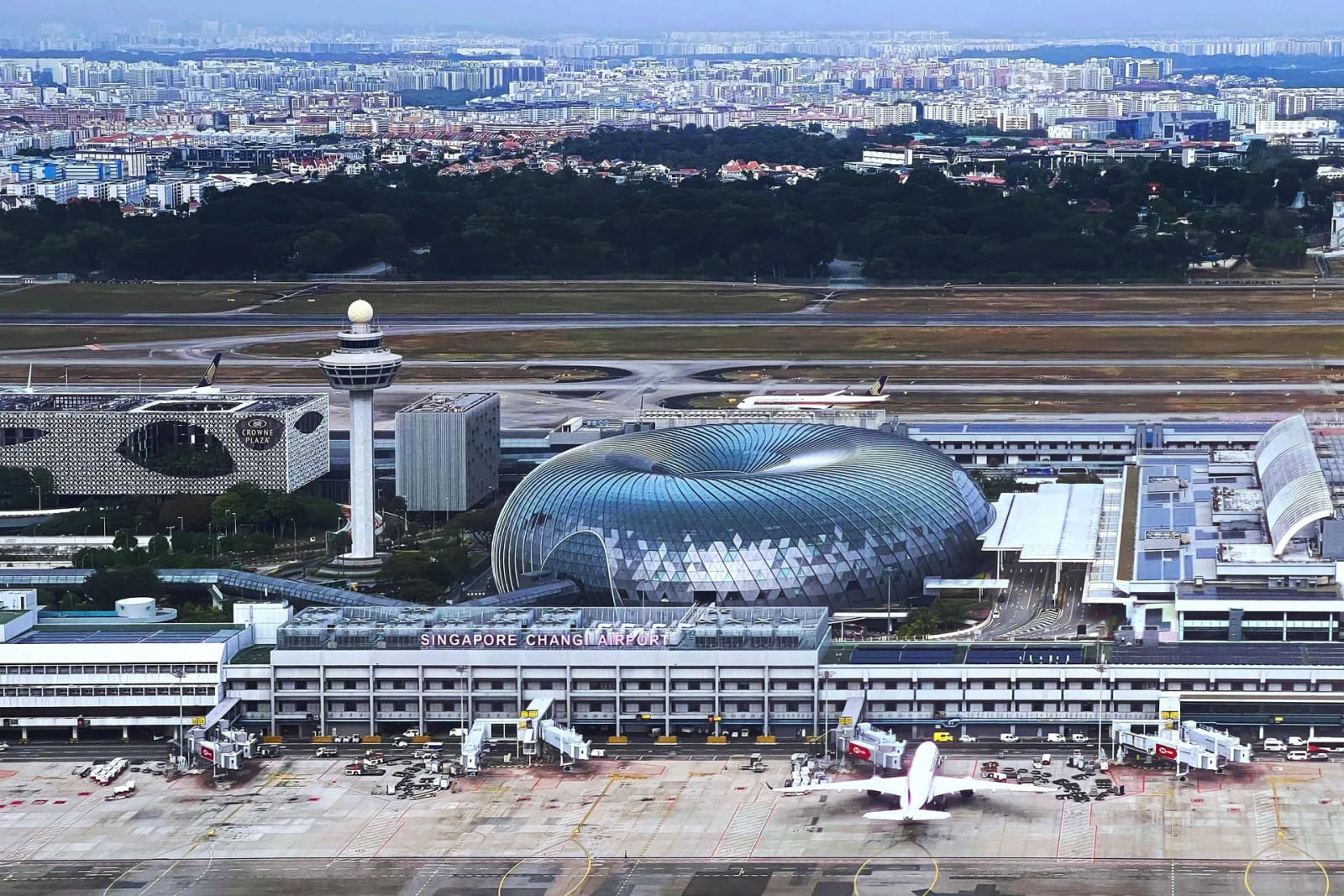
Singapore's aviation regulator has committed S$4 billion through 2040 to overhaul air navigation infrastructure, a move designed to prevent airspace bottlenecks as Changi Airport prepares to open its fifth passenger terminal.
The Civil Aviation Authority of Singapore announced on July 22 that the investment will lift annual aircraft movement capacity to one million, double the current operational ceiling. Director-general Han Kok Juan framed the initiative as essential synchronization between ground-level terminal expansion and overhead traffic management capability.
Changi processed 70 million passengers in 2025, surpassing pre-pandemic volumes. Terminal 5, scheduled for the mid-2030s, will add 50 million seats to the airport's existing 90 million-passenger capacity across four terminals.
Capital Allocation Breakdown
The S$4 billion package divides into three streams. Equipment procurement, facility construction, and long-term system maintenance account for S$3.2 billion. Workforce expansion, including recruitment incentives and training scholarships, receives S$500 million. The remaining S$300 million funds operational research, artificial intelligence prototypes, and cross-border coordination platforms.
CAAS awarded French aerospace firm Thales a contract in late June to deliver the core next-generation traffic management platform by 2030. Construction of an Integrated Digital Tower System begins in August, scheduled for completion alongside Terminal 5. The digital tower uses camera arrays and sensor networks to provide controllers with augmented aerodrome views, removing reliance on physical tower sightlines.
London City Airport became the first major commercial hub to operate entirely via remote digital control in 2020, using 16 high-definition cameras monitored 115 kilometers away. Western Sydney's upcoming airport is adopting a similar model.
Controller Workforce Expands by 200
CAAS will grow its air traffic control officer roster from approximately 500 to 700 by the mid-2030s, a 40 percent increase. To accelerate recruitment, the authority introduced a S$20,000 sign-on bonus effective June 1, disbursed in two stages during training and upon licensing.
Fresh university graduates entering the controller pipeline earn around S$64,000 annually, with salaries climbing to approximately S$120,000 after five years of service. CAAS is partnering with a local university to develop a specialized undergraduate degree in air traffic control, supplementing a scholarship program launched in March and a management associate track starting in August.
The authority is also establishing an Engineering Development Centre and contributing stipend top-ups to PhD candidates researching air traffic systems under an S$800 million Research, Innovation and Enterprise initiative.
AI Tools Target Weather Diversions
A multi-sector planner powered by artificial intelligence will enter trials in 2027, enabling a single planning controller to oversee two to three airspace sectors simultaneously. Current protocol assigns a two-person team to each sector.
CAAS is developing a Digital ATCO Assistant to convert meteorological data into flight vector recommendations, allowing controllers to reroute aircraft ahead of convective weather. The tool aims to reduce holding patterns and fuel emergencies. Weather-related diversions at Changi jumped from 15 in 2024 to 59 in 2025.
Han referenced the 2022 emergency diversion of Singapore Airlines flight SQ319, which circled Changi in multiple holding patterns during severe thunderstorms before landing in Batam with critically low fuel. Predictive AI could enable earlier rerouting decisions, preventing similar incidents.
An automated radio message read-back error detection system will enter live testing later in 2026 to eliminate miscommunication between pilots and controllers.
Regional Traffic Coordination
To manage cross-border airspace demand, CAAS is building an AI-enabled flow management tool that generates recommendations for neighboring air navigation providers. Daily operational coordination calls began with China and Hong Kong in late 2025, expanding to include South Korea, Thailand, and Vietnam.
The upgraded system will track up to 4,000 concurrent aircraft positions on the ground and in flight, double the current limit. All new navigation systems are designed with open modular architecture to accommodate future technology integration without wholesale replacement.
Terminal 5's opening will increase Changi's passenger throughput by roughly 55 percent at full capacity. The S$4 billion air navigation program ensures that airspace management scales in parallel with physical infrastructure, a prerequisite for maintaining Singapore's position as a regional aviation hub.
RELATED STORIES
Vietnam Draws $7.5 Billion From Singapore in Seven Months
Priyanka V. Rao · 3 min
Singapore Eyes Global Investment Court as UN Talks Near Final Stage
Priyanka V. Rao · 3 min

Singapore Fintechs Add Hundreds of Staff as AI Fuels Expansion
Priyanka V. Rao · 3 min
Singapore Economists Lift 2026 Growth Outlook to 5% as Chip Exports Surge
Priyanka V. Rao · 3 min
Spot something wrong? Email editor@briefasia.com. We log every correction publicly.