Finance · Markets
Seoul Market Slides 1.2% as Retail Investors Exit Tech Stocks
Korean equities extended losses for a third consecutive session as AI spending concerns and Fed uncertainty drove retail selling pressure
KEY TAKEAWAYS
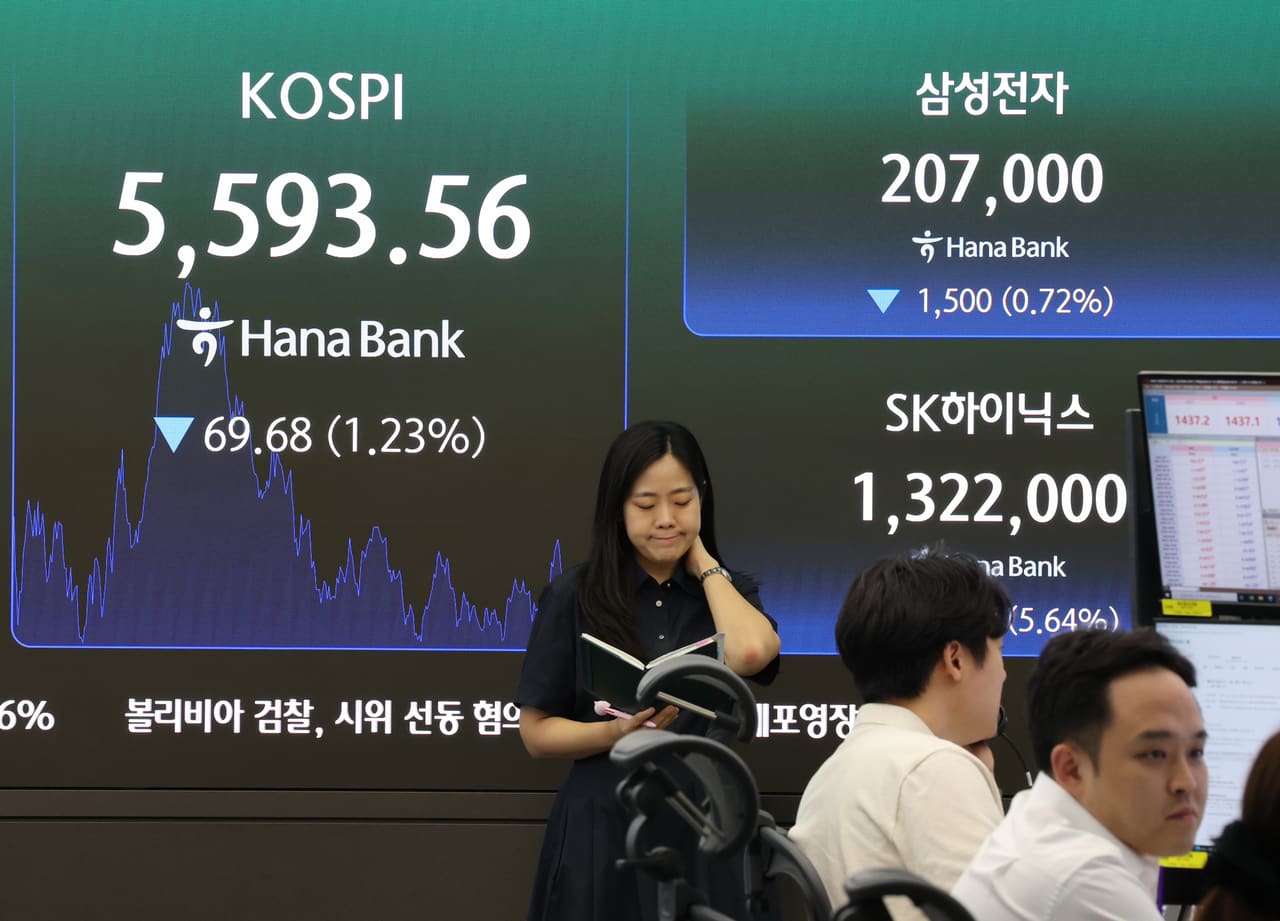
- ·The Korea Composite Stock Price Index dropped 69.68 points to 5,593.56, down 1.23 percent, marking a third consecutive session of losses.
- ·Retail investors led the selloff in technology stocks amid concerns over artificial intelligence spending sustainability and unclear Federal Reserve interest rate policy.
- ·The Korean won strengthened against the dollar during the session, but currency gains failed to offset broader risk-off sentiment in equities.
Third Day of Losses
The Korea Composite Stock Price Index shed 69.68 points to close at 5,593.56 on Thursday, extending a three-day sell-off that has rattled South Korean equities. The session marked a 1.23 percent decline, with the benchmark briefly touching an intraday low of 5,547.41 during volatile trading.
Retail investors drove the downturn, offloading technology holdings at a pace that underscored mounting anxiety over the sustainability of artificial intelligence infrastructure spending. The selling pressure follows two previous sessions of steep declines, building a pattern that signals deteriorating sentiment in one of Asia's most tech-heavy markets.
The Korean won strengthened against the dollar during the session, a move that typically offers some cushion to domestic equities but failed to reverse the broader trend. Currency gains often attract foreign flows into local assets, yet Thursday's trading showed that macro concerns outweighed any tactical advantage from exchange rate movements.
AI Spending Questions
Questions surrounding the pace and profitability of AI-related capital expenditure have begun to weigh on technology valuations across global markets, and Seoul is no exception. South Korea's equity market carries significant exposure to semiconductor manufacturers, display makers, and electronics firms that have positioned themselves as key suppliers to the AI infrastructure buildout.
The current pullback reflects investor recalibration of earnings expectations for companies betting heavily on sustained demand from hyperscale data center operators and AI model developers. Recent earnings reports from major US technology firms have highlighted ballooning capital expenditure budgets, prompting questions about return timelines and the risk of overinvestment.
For South Korean exporters, the stakes are particularly high. Chipmakers and component suppliers have enjoyed robust order books over the past year, but any slowdown in AI-related spending could translate directly into weaker revenue guidance and margin pressure.
Fed Uncertainty Adds Pressure
The lack of clarity around the Federal Reserve's interest rate trajectory added another layer of uncertainty to Thursday's session. Market participants remain divided on whether the US central bank will resume rate cuts in the coming months or maintain its current stance amid persistent inflation signals.
Higher rates in the United States tend to draw capital away from emerging and developed Asia, compressing valuations for growth-oriented stocks. The technology sector, which trades on elevated multiples tied to future earnings, is especially sensitive to shifts in the discount rate applied by investors.
Seoul's market has historically shown tight correlation with Fed policy signals, given the heavy weight of export-oriented industrials and tech firms in the KOSPI. Any delay in rate cuts or hints of prolonged restrictive policy can trigger rapid repricing in Korean equities, particularly when combined with sector-specific headwinds.
Retail Sentiment Shifts
The intensity of retail selling on Thursday stands out. Individual investors in South Korea have been active participants in equity markets, often providing liquidity during institutional selloffs. The reversal in retail sentiment suggests that the recent declines have breached key psychological levels, prompting stop-loss exits and profit-taking after a period of gains earlier in the year.
Retail flows are closely watched in Seoul, where individual investors account for a significant share of daily trading volume. A sustained retreat by this cohort could amplify downward momentum, especially if foreign institutional investors remain cautious about re-entering the market.
The three-day rout has erased a portion of the gains accumulated during the first half of the year, when optimism around AI demand and expectations of Fed easing had lifted the KOSPI above the 5,800 mark. The current level of 5,593 represents a technical retreat from those highs, and market participants will be watching whether support holds or gives way to further declines.
Regional Context
Seoul's struggles mirror broader unease across Asian equity markets, where technology-heavy indices have faced pressure from the same confluence of AI spending doubts and rate uncertainty. Taiwan's benchmark has similarly retreated from recent peaks, and Hong Kong's Hang Seng Tech Index has experienced heightened volatility.
The regional pattern suggests that the current selloff is not driven by Korea-specific factors but rather by a reassessment of risk across the Asian technology supply chain. Investors are recalibrating exposure to the sector as they await clearer signals on both demand fundamentals and the macro policy environment.
For now, the path forward depends on two key variables: whether AI infrastructure spending stabilizes at current levels or contracts, and whether the Federal Reserve provides more definitive guidance on its rate path. Until those uncertainties resolve, Seoul's market may remain under pressure, with retail investors continuing to reduce risk exposure in the face of near-term volatility.
RELATED STORIES
Seoul Stocks Drop on Mideast Tensions and Oil Price Surge
Tran Quoc Bao · 3 min

Samsung Electronics Drops 8% as Market Questions Buyback Strategy
Cheng Wei-Lun · 2 min
South Korea Extends Trading Hours to Attract Foreign Capital
Anand Sundaram · 2 min

MBK Partners Chair Questioned Over Homeplus Debt Issuance Ahead of Collapse
Anand Sundaram · 3 min
Spot something wrong? Email editor@briefasia.com. We log every correction publicly.