Finance · Markets
Seoul's Kospi Plunges 10 Percent as China Chip Report Triggers Asia Tech Rout
SK hynix and Samsung shed 13 percent each while Tokyo's semiconductor stocks tumble, extending a global sell-off that has erased trillions in market value since mid-June.
KEY TAKEAWAYS
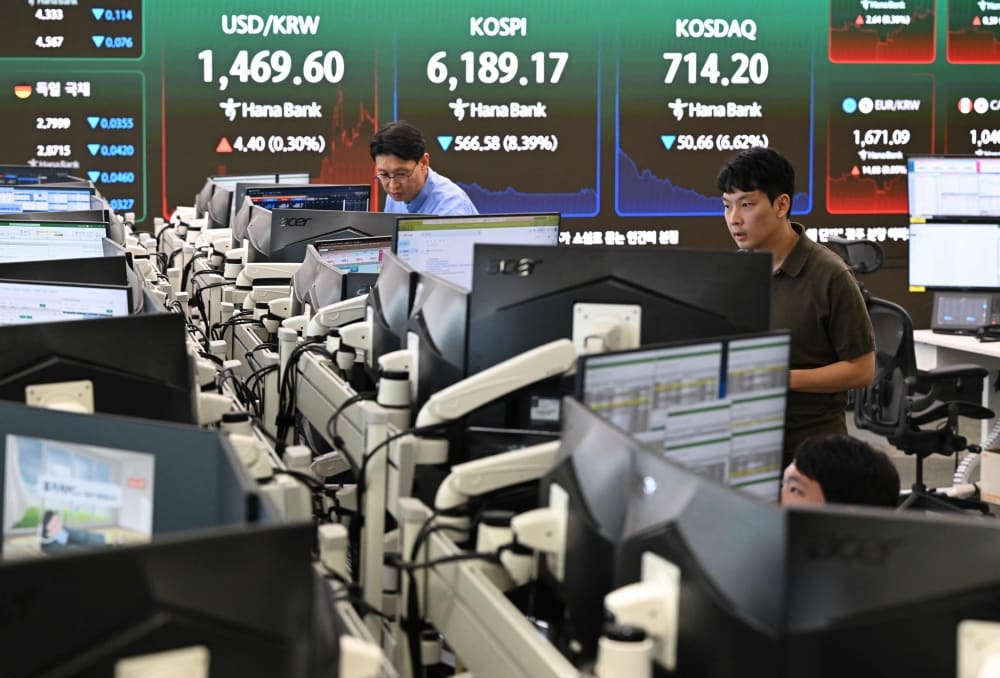
- ·South Korea's Kospi index fell 10.2 percent to 6,066.21, with SK hynix and Samsung each losing 13 percent after a report that Shanghai Yuliangsheng began mass producing advanced lithography equipment.
- ·The two chipmakers have declined nearly 50 percent from June highs, while Tokyo's Kioxia dropped 18 percent and TSMC also retreated as investors reassessed AI infrastructure spending.
- ·Earnings reports this week from SK hynix, Samsung, Kioxia, Microsoft, Meta, Apple, and Amazon will test whether demand fundamentals justify current valuations.
Circuit Breakers Triggered in Seoul
South Korea's Kospi index collapsed 10.2 percent on Monday, closing at 6,066.21 after trading was briefly halted by a circuit breaker. The sell-off was led by semiconductor manufacturers SK hynix and Samsung, which each dropped approximately 13 percent as investors fled technology stocks across Asia.
The two Seoul-listed chipmakers have now fallen nearly 50 percent from all-time highs reached in June, while the Kospi itself is down more than 30 percent from its peak. Trading was paused for 20 minutes earlier in the session as losses accelerated.
Tokyo's Nikkei 225 fell 4.3 percent to 62,159.48, with memory chipmaker Kioxia shedding 18 percent. Equipment makers Advantest and Tokyo Electron both dropped 11 percent. In Taipei, the market declined more than four percent as TSMC, the world's largest contract chipmaker, took losses alongside smaller technology firms.
China Report Compounds AI Valuation Concerns
The immediate catalyst for Monday's rout was a report by The Information that Shanghai Yuliangsheng had begun mass production of advanced lithography equipment, a technology category long dominated by Netherlands-based ASML. The development raised questions about the durability of Western semiconductor firms' competitive advantages in manufacturing equipment.
The news arrived as investors were already reassessing the sector following a two-year rally that pushed valuations to extremes. The Philadelphia Semiconductor Index dropped 2.2 percent in the prior US session, with Sandisk falling 11 percent and both Advanced Micro Devices and Nvidia losing around five percent. ASML shares declined more than eight percent in Amsterdam trading.
Concerns have mounted in recent weeks over the scale of capital investment in artificial intelligence infrastructure and when those expenditures will translate into returns. Several hyperscale cloud providers have committed tens of billions of dollars to AI-related buildouts, but revenue growth has not yet matched the pace of spending.
Demand Fundamentals Remain Intact
Market participants note that underlying demand for high-bandwidth memory and advanced chips has not collapsed. Hyperscale data center operators continue to place orders, and major technology companies have maintained capital expenditure guidance through year-end.
What has shifted is the market's willingness to pay premium multiples for future earnings. Equity valuations in the semiconductor sector had reached levels that assumed flawless execution and sustained growth, leaving little room for disappointment or competitive pressure.
The sector had operated in a self-reinforcing cycle: rising stock prices enabled companies to fund expansion, which in turn justified higher earnings forecasts and pushed valuations further. That dynamic has now reversed, with declining share prices prompting investors to question whether projected returns can be achieved.
Earnings Tests Ahead
Investors are awaiting a wave of quarterly results this week from SK hynix, Samsung, and Kioxia, along with US technology giants Microsoft, Meta, Apple, and Amazon. The reports will provide updated guidance on AI-related spending and demand visibility for the second half of the year.
Analysts will scrutinize commentary on order backlogs, pricing trends for high-bandwidth memory, and any shifts in capital expenditure plans. Guidance for the September quarter will be particularly important given the sharp repricing of growth expectations over the past month.
Geopolitical Backdrop Stabilizes
The technology sell-off overshadowed more positive developments in the Middle East, where the United States and Iran paused retaliatory strikes for a third consecutive day. Former President Donald Trump, speaking aboard Air Force One, suggested there was a "good chance" that renewed diplomacy could resolve the crisis that began in late February.
Reports indicated that Oman and Iran were working toward an agreement to restart shipping through the Strait of Hormuz, through which roughly one-fifth of global oil and liquefied natural gas typically flows. International benchmark Brent crude fell more than eight percent on Monday and continued to decline 1.7 percent in Asian hours to $86.89 per barrel. West Texas Intermediate dropped 1.8 percent to $81.15.
Currency markets showed limited movement, with the dollar edging up to 163.73 yen and the euro rising slightly to $1.1378. The pound traded at $1.3301.
Hong Kong's Hang Seng Index remained flat at 25,204.90, while the Shanghai Composite declined 0.6 percent to 3,836.53. Losses were widespread across Southeast Asian markets as well, though more contained than in Northeast Asia's technology-heavy bourses.
The coming days will determine whether Monday's declines mark a further leg down in the sector's correction or a capitulation point from which stabilization can occur. Much depends on whether earnings reports validate current demand assumptions or reveal cracks in the AI investment thesis that has underpinned technology stocks for two years.
RELATED STORIES
Samsung Electronics Drops 8% as Market Questions Buyback Strategy
Cheng Wei-Lun · 2 min

Japan Deploys $96.5 Billion in Currency Intervention to Halt Yen's Slide
Aiko Nakamura · 3 min
Seoul Stocks Drop on Mideast Tensions and Oil Price Surge
Tran Quoc Bao · 3 min

LG Pivots to AI-Defined Vehicle Platform as Korea Chases China's Self-Driving Lead
Jun-ho Seo · 3 min
Spot something wrong? Email editor@briefasia.com. We log every correction publicly.