Real Estate · Homes
Sentosa Cove Owners Locked in Billion-Dollar Paper Loss Spiral
Singapore's only foreign-accessible landed enclave sees median resale losses widen as high stamp duties and decay on 99-year leases erode appeal
KEY TAKEAWAYS
- ·64.5 per cent of Sentosa Cove resales between May 2023 and June 2026 closed below purchase price, with average losses reaching $1.28 million.
- ·Landed homes showed marginally better performance, with half of transactions profitable, compared to only one-third of condominium resales.
- ·Transaction volume collapsed from 68 non-landed deals in H1 2021 to 35 in H1 2026 as stamp duty hikes and lease decay deterred foreign buyers.
Underwater Equity on the Island
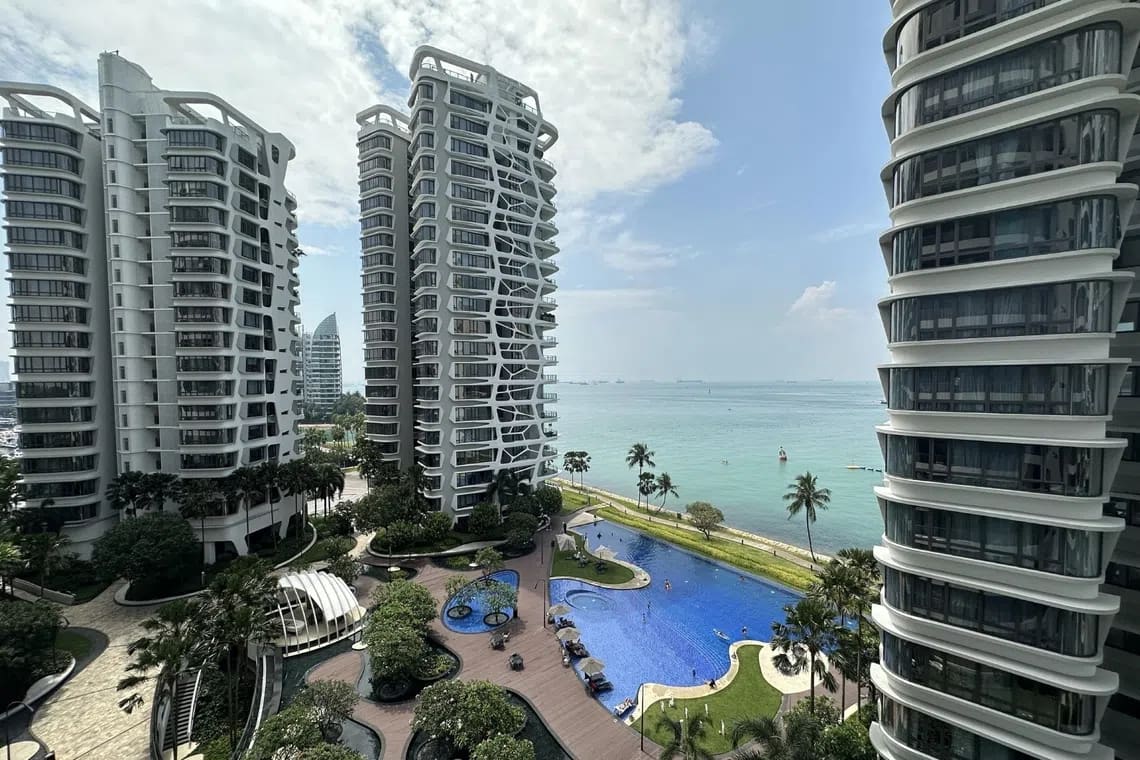
Owners who bought into Sentosa Cove's promise of waterfront exclusivity are now discovering an uncomfortable truth: exit comes at a steep discount. Analysis of transactions between May 2023 and June 2026 reveals that 64.5 per cent of resales closed below purchase price, according to Mogul.sg. The average loss on those deals reached $1.28 million, while sellers who did manage a profit saw median gains collapse 62 per cent to $655,590 compared with the prior three-year window.
The enclave, Singapore's sole location where non-citizens can apply to own landed property, houses approximately 392 landed homes and 1,766 condominium units. Yet that regulatory quirk has not been enough to sustain values. Nicholas Mak, chief research officer at Mogul.sg, put it plainly: overall conditions for property owners remain poor.
Landed Versus Strata: A Narrow Margin
Detached and semi-detached homes on the island have fared marginally better than apartment towers. Cushman & Wakefield tracked 47 landed resales between 2021 and mid-2026, finding 23 profitable and 24 underwater. By contrast, only 83 of 244 condominium resales over the same span closed in the black.
Wong Xian Yang, head of research for Singapore and Southeast Asia at Cushman & Wakefield, noted that landed stock tends to hold value more stubbornly, yet even that segment saw more than half of deals result in a loss. Newmark's figures echo the trend: landed resales between May 2023 and June 2026 posted a median profit of $677,500, a reversal from a median loss of $380,444 in the preceding period. The sample, however, was small, with only ten transactions split evenly between winners and losers.
For condominiums, the picture darkened further. Median losses widened from $269,520 to $377,500 across the same windows, even as the share of loss-making deals edged down slightly to 65.5 per cent.
Policy and Geography Squeeze Demand
Stamp duty hikes targeting foreign purchasers have thinned the buyer pool since 2023. Shanting Wong, head of research for Singapore at Newmark, described Sentosa as a lifestyle-driven location that resonates far more with expatriates than with Singaporean families, who typically prioritize proximity to schools and urban amenities over resort-style waterfront living.
Alan Cheong, executive director of research and consultancy at Savills, pointed to a shift in buyer demographics. Early Sentosa Cove purchasers included newly wealthy entrepreneurs drawn to the enclave's novelty. As business cycles turned, some of those owners faced liquidity pressures and offloaded properties at a discount.
The enclave's 99-year leasehold tenure adds another layer of concern. High-net-worth individuals increasingly compare Sentosa offerings against freehold or 999-year projects in the Core Central Region, and the ticking lease clock weighs on resale appetite. Cheong cautioned that lease decay will become a more visible drag on pricing in coming years, though he expects the effect to remain muted near term.
Price Recovery Without Volume
Despite widespread losses, non-landed resale prices at Sentosa Cove climbed 5.7 per cent quarter-on-quarter and 7.5 per cent year-on-year in the second quarter of 2026, citing Realis data. Over the same period, comparable properties in the broader Core Central Region slipped 2.4 per cent and 1.2 per cent respectively.
From the first quarter of 2021 through mid-2026, Sentosa Cove non-landed prices rose 18.1 per cent on a per-square-foot basis. Yet transaction volume tells a different story: 68 non-landed deals closed in the first half of 2021, compared with just 35 in the first half of 2026.
Cheong suggested that prices hovering below $2,000 per square foot may eventually attract catch-up demand if mainland valuations continue rising. Wong Xian Yang at Cushman & Wakefield agreed that Sentosa's relative value proposition could strengthen, provided the broader private residential market sustains its uptrend.
Supply Freeze and the Relaunch Gambit
No new residential land has changed hands at Sentosa Cove since 2008, when a Ho Bee Land and IOI Properties joint venture acquired the site that became Cape Royale, a 302-unit condominium completed in 2013. Ho Bee, the enclave's pioneer developer, delivered eight projects starting with The Berth by the Cove in 2004. Transactions peaked at 522 in 2006, then cratered after the global financial crisis and successive rounds of additional buyer's stamp duty.
City Developments relaunched The Residences at W Singapore Sentosa Cove in April 2024, fourteen years after an initial offering that sold only 20 of 228 units. The relaunch priced units at an average of $1,780 per square foot, 36 per cent below the $2,793 average achieved in 2010. Buyers faced an immediate disadvantage: no progressive payment scheme, effectively treating the purchase as a resale transaction. Sixty-five units sold.
The Greater Sentosa Master Plan, unveiled in July, will fold the 120-hectare Brani Island into the precinct over the next two decades, introducing new attractions, hotels, beaches, and an Island Heart transport hub. Yet Newmark's Wong expects limited impact on residential demand absent the release of fresh land parcels. She anticipates resale volumes and prices will continue to trail the mainland.
What Comes Next
Sentosa Cove's trajectory hinges on whether policymakers ease stamp duty burdens for foreign buyers, whether new supply enters the market, and whether the enclave can reposition itself as more than a niche play for expatriates seeking oversized apartments at a discount to traditional prime districts. Until then, owners face a choice: hold and hope for a policy shift, or exit at a loss that now averages seven figures.
RELATED STORIES
Sentosa Cove Resales Record S$1.28 Million Average Loss as Foreign Buyer Curbs Bite
Priyanka V. Rao · 5 min
Singapore's En Bloc Market Stirs as Kingsford Group Closes S$950 Million Warehouse Deal
Lim Hui Ying · 4 min
Digital Core REIT Pivots to Asia With $316 Million Portfolio Shake-Up
Priyanka V. Rao · 3 min
Frasers Property Calls Shareholder Vote on Hospitality Portfolio Shake-Up
Priyanka V. Rao · 3 min
Spot something wrong? Email editor@briefasia.com. We log every correction publicly.