Real Estate · Homes
Sentosa Cove Resales Record S$1.28 Million Average Loss as Foreign Buyer Curbs Bite
Nearly two-thirds of Singapore's luxury enclave transactions closed underwater since 2023, with landed homes showing marginally better performance than condominiums
KEY TAKEAWAYS
- ·64.5 percent of Sentosa Cove resales between May 2023 and June 2026 closed at a loss, with average losses reaching S$1.28 million per transaction.
- ·Gains on profitable resales collapsed 62 percent to S$655,590, down from S$1.75 million in the prior period, as foreign buyer stamp duty hikes curtailed demand.
- ·No new residential land has been sold in the enclave since 2008, and analysts expect limited impact from the Greater Sentosa Master Plan without fresh supply releases.
A Deepening Slump in Singapore's Luxury Island
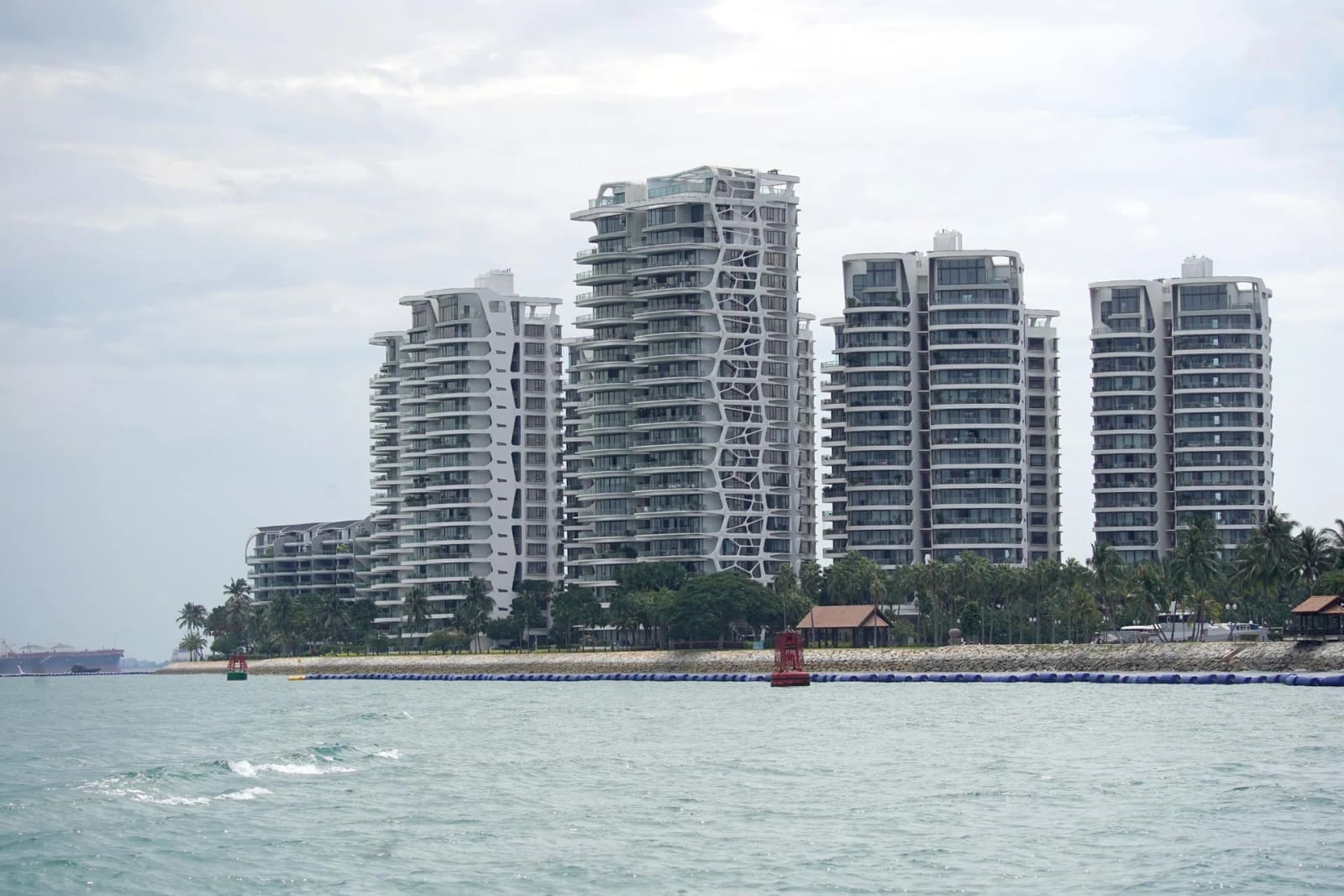
Singapore's Sentosa Cove, once marketed as a playground for the ultra-wealthy, has seen nearly two-thirds of property resales close at a loss over the past three years. Between May 2023 and June 2026, 64.5 percent of transactions recorded negative returns, with sellers absorbing an average loss of S$1.28 million per deal, according to data compiled by Mogul.sg.
The figures mark a troubling deterioration for owners in the 99-year leasehold enclave. While average losses narrowed slightly from S$1.56 million in the preceding period, gains on profitable transactions collapsed by roughly 62 percent, dropping to S$655,590 from S$1.75 million. The data covers both landed and non-landed homes and excludes transaction costs such as stamp duties, legal fees, and agent commissions.
Nicholas Mak, chief research officer at Mogul.sg, described the outlook bluntly. The performance of Sentosa Cove properties has been consistently weak, with pricing pressures affecting both condominium and landed segments.
Landed Homes Hold Value Marginally Better
Separate analyses by Cushman & Wakefield and Newmark confirm the trend, though landed properties have fared marginally better. Cushman & Wakefield tracked 244 non-landed resales between 2021 and the first half of 2026, finding that only 83 transactions closed above their purchase price. For landed homes, 23 out of 47 deals were profitable during the same window.
Wong Xian Yang, head of research for Singapore and Southeast Asia at Cushman & Wakefield, noted that landed homes generally retained value better than apartments. Still, more than half of landed resales remained loss-making, indicating that pricing pressures extended across property types.
Sentosa Cove is the only location in Singapore where foreigners can purchase landed property with government approval, a factor that has historically supported demand for its roughly 392 landed homes. The enclave also contains about 1,766 non-landed units.
Newmark's data showed that median losses for all resales widened 36.3 percent, from S$271,225 in the period from March 2020 to April 2023, to S$369,640 in the subsequent three years. Resale volume fell sharply, dropping to 126 transactions from 208 over the same comparison periods.
A Niche Market Narrowed by Policy
The weakness in Sentosa Cove stems from a combination of structural and policy-driven factors. Shanting Wong, head of research for Singapore at Newmark, pointed to the enclave's lifestyle-driven appeal, which resonates more with foreign buyers than local purchasers. Singaporean households, she noted, tend to prioritize proximity to schools and mainland amenities over waterfront exclusivity.
Successive rounds of cooling measures have sharply curtailed foreign demand. Additional buyer's stamp duty hikes introduced since 2023 have effectively priced out many international buyers, shrinking an already niche pool. The enclave's appeal was built on its status as a luxury destination with lower per-square-foot pricing than traditional prime districts, but policy headwinds have undercut that value proposition.
Alan Cheong, executive director of research and consultancy at Savills, observed that the buyer profile has shifted over time. Early purchasers included newly wealthy individuals whose fortunes fluctuated with business cycles, prompting later distressed sales. The decaying lease tenure on 99-year leasehold properties also poses a long-term drag on pricing, though Cheong expects that concern to become more acute only in future years.
Price Recovery Without Transaction Volume
Despite the weak resale performance, non-landed prices at Sentosa Cove have posted recent gains. Data from the Urban Redevelopment Authority showed that non-landed resale prices rose 5.7 percent quarter-on-quarter in the second quarter of 2026 and 7.5 percent year-on-year. Over the five-year period from the first quarter of 2021 to the second quarter of 2026, prices climbed 18.1 percent on a per-square-foot basis.
The gains stand in contrast to the broader Core Central Region, where non-landed resale prices fell 2.4 percent quarter-on-quarter and 1.2 percent year-on-year during the same period. However, transaction volumes at Sentosa Cove remain anemic. Non-landed deals dropped to 35 in the first half of 2026, down from 68 in the first half of 2021.
Cheong suggested that prolonged pricing below S$2,000 per square foot could position Sentosa Cove for eventual outperformance relative to mainland properties, provided overall private residential prices continue their uptrend. Cushman & Wakefield's Wong echoed the view, noting that the enclave's relative value proposition could strengthen if it benefits from catch-up demand.
High-net-worth buyers, however, may remain cautious. The decaying lease tenure on non-landed homes compares unfavorably with freehold or 999-year projects in the Core Central Region, according to Newmark's Wong. For landed properties, foreign buyers retain access, though policy uncertainty and limited liquidity continue to weigh on sentiment.
No New Supply on the Horizon
Sentosa Cove's longer-term trajectory hinges on supply dynamics. No new residential land has been sold in the enclave since 2008, when a joint venture between Ho Bee Land and IOI Properties acquired the site for Cape Royale. Completed in 2013, the 302-unit condominium remains the last major new development in the area.
City Developments relaunched The Residences at W Singapore Sentosa Cove in April 2024, 14 years after its initial offering. The 228-unit project was repriced at an average of S$1,780 per square foot, 36 percent below the S$2,793 per square foot recorded at its 2010 launch. A total of 65 units sold at the relaunch, though buyers could not access progressive payment schemes typically available for projects under construction.
The Greater Sentosa Master Plan, unveiled last month by Sentosa Development Corporation, outlines a two-decade transformation that will integrate the 120-hectare Brani island into the Sentosa precinct. The plan includes new attractions, hotels, rejuvenated beaches, and improved connectivity via a new Island Heart transport hub linking Sentosa and Brani. Implementation is scheduled to begin in the early 2030s.
Newmark's Wong expects the plan to have limited impact on residential demand unless new land parcels are released. Without fresh supply, resale volumes and prices are likely to continue trailing mainland Singapore.
Early sales at Sentosa Cove were brisk, with transactions peaking at 522 in 2006, according to ERA. Volumes collapsed after the 2008 global financial crisis and have remained subdued through successive rounds of cooling measures. The enclave's pioneer developer, Ho Bee Land, built eight projects in the area, starting with the 200-unit The Berth by the Cove in 2004.
For now, Sentosa Cove remains a test case for luxury real estate exposed to policy risk and narrow demand. Whether the enclave can recover depends on a mix of pricing adjustments, policy shifts, and the execution of long-term infrastructure plans.
RELATED STORIES
Frasers Property Calls Shareholder Vote on Hospitality Portfolio Shake-Up
Priyanka V. Rao · 3 min
Deloitte's Move to Orchard Central Signals Growing Corporate Interest in Singapore's Shopping District
Lim Hui Ying · 4 min
City Plaza Owners Launch Third Collective Sale Attempt at S$970 Million
Lim Hui Ying · 3 min
Digital Core REIT Pivots to Asia With $316 Million Portfolio Shake-Up
Priyanka V. Rao · 3 min
Spot something wrong? Email editor@briefasia.com. We log every correction publicly.