Travel & Dining · Trends
Scoot Adds Six Indonesian Cities as Southeast Asia Becomes Core Growth Market
Singapore's low-cost carrier now connects 85 destinations across 18 countries, with Malaysia remaining its largest network at 12 cities and 130 weekly flights.
KEY TAKEAWAYS
- ·Scoot carried 2.2 million passengers on Malaysia routes in the year ended March 2026, up 14 percent, and now serves 12 Malaysian cities with 130 weekly flights.
- ·The carrier launched six new Southeast Asian destinations between January and June, including Chiang Rai, Palembang, Medan, Belitung, and Pontianak, and ordered 11 additional Airbus A320neo jets for 2028 delivery.
- ·Singaporean visitors made 3.4 million trips to Malaysia in the first two months of 2026, nearly half of all international arrivals, supporting demand on one of the world's busiest cross-border air corridors.
Malaysia Network Anchors Regional Strategy
Scoot operates 130 weekly flights across 12 Malaysian cities, making it the foreign carrier with the most destinations in the country. The Singapore Airlines subsidiary carried 2.2 million passengers on Malaysia routes in the financial year ended March 31, 2026, a 14 percent increase year-on-year, according to Calvin Chan, the airline's chief commercial officer.
Malaysia accounts for a significant share of Scoot's point-to-point traffic and serves as a key feeder market into the broader SIA Group network via Singapore. Kuala Lumpur-Singapore remains one of the busiest international air corridors globally, with demand spread across leisure and business segments.
Singaporean visitors made 3.4 million trips to Malaysia in the first two months of 2026, representing nearly half of all international arrivals, Chan noted. The Visit Malaysia 2026 campaign has added momentum, prompting Scoot to enter a three-year marketing partnership with Tourism Malaysia in August 2025 that runs through 2028 and targets travelers in Singapore, China, Australia, and Indonesia.
Six New Destinations in Six Months
Scoot launched flights to Chiang Rai and Palembang in January, followed by Medan and Tokyo Haneda in February and March. Belitung and Pontianak joined the network in May and June. The airline also raised frequencies to Bali, Jakarta, Labuan Bajo, Lombok, Manado, Phuket, Sibu, Changsha, Okinawa, and Vienna.
The carrier now reaches 85 destinations across 18 countries and territories, up from a smaller footprint a year earlier. Southeast Asia remains the primary growth engine, driven by rising disposable incomes, expanding airport infrastructure, and traveler preference for affordable short-haul options, Chan said.
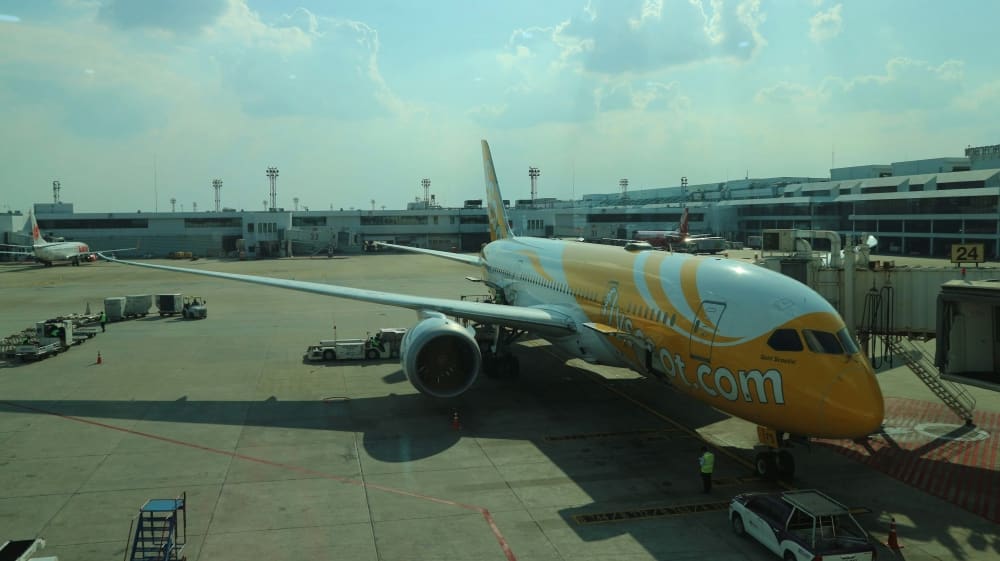
Scoot's fleet of more than 60 aircraft includes 24 Boeing 787 Dreamliners, 30 Airbus A320 family jets, and nine Embraer E190-E2 regional planes. The Brazilian aircraft enable service to secondary cities and airports with runway or terminal constraints that cannot accommodate larger narrowbodies.
Fleet Order Supports 2028 Expansion
In May, Scoot placed a firm order for five Airbus A320neo family aircraft and exercised options for six more, bringing its total A320neo orderbook to 20 planes. Deliveries begin in 2028 and will provide capacity to open new routes, increase frequencies, and strengthen connectivity into the SIA Group network, according to Chan.
The airline has no immediate plans to expand its widebody fleet. The 787 Dreamliners cover medium- and long-haul operations to Australia, North Asia, North India, the Middle East, and Europe.
Scoot continues to add seven weekly flights to Subang using A320 family aircraft and will evaluate further Malaysia expansion based on demand, operational factors, and network strategy, Chan said.
Digital Tools and AI Investment
Beyond aircraft and routes, Scoot is investing in digital and artificial intelligence systems to improve operational efficiency and customer experience. Initiatives include upgrades to Marvie, the airline's AI-powered virtual assistant, expanded airport self-service kiosks, AI-supported customer service functions, and technology platforms designed to enhance productivity and disruption management.
The focus on Southeast Asia reflects broader aviation trends in the region, where low-cost carriers have captured market share by connecting secondary cities and offering point-to-point service at lower fares than legacy airlines. Scoot's dual role as a standalone budget carrier and a feeder into Singapore Airlines' long-haul network gives it flexibility to compete on price while offering connections that pure low-cost operators cannot match.
The airline's Malaysia footprint spans Ipoh, Kota Bahru, Kota Kinabalu, Kuala Lumpur, Kuantan, Kuching, Langkawi, Melaka, Miri, Penang, Sibu, and Subang. Chan emphasized that the carrier will pursue demand-led expansion while maintaining a commercially sustainable and diversified network across short, medium, and long-haul markets.
RELATED STORIES

Southeast Asian Firms Overlook Digital Pact Worth USD 2 Trillion
Lim Hui Ying · 4 min

CIMB Commits to 55% Dividend Floor as Regional Portfolio Offsets Indonesia Pressure
Priyanka V. Rao · 4 min

Singapore Targets High-Value Data Centre Workloads as Neighbors Scale Up Capacity
Cheng Wei-Lun · 3 min

Southeast Asian Firms Race to Raise Green Debt as Region Falls Behind on Renewables
Priyanka V. Rao · 3 min
Spot something wrong? Email editor@briefasia.com. We log every correction publicly.