Asia · Trending
Philippines Jobs Crunch Deepens as Graduate Wave Meets Sluggish Hiring
Nearly half of 650,000 first-time labor market entrants in June failed to secure work, pushing unemployment to 4.9% and underscoring a mismatch between graduate supply and job creation.
KEY TAKEAWAYS
- ·The Philippines recorded 4.9 percent unemployment in June, with 2.59 million jobless as 650,000 first-time entrants joined the labor force.
- ·Only 328,000 of the 650,000 new entrants found work, leaving 322,000 unemployed, most of them aged fifteen to twenty-four.
- ·Fishing and aquaculture shed 467,000 jobs year-on-year, driven by higher diesel costs that squeezed small-scale operators.
A Surge of New Workers, Too Few Roles
The Philippines recorded a jobless rate of 4.9 percent in June, a monthly increase that reflects a sharp seasonal influx of school leavers and university graduates stepping into the labor market for the first time. The Philippine Statistics Authority counted 2.59 million unemployed Filipinos, up from 2.50 million the previous month and a marked rise from the 3.7 percent rate a year earlier.
National Statistician Dennis Mapa explained that 650,000 people joined the labor force in June, the majority of them first-time job seekers. Within that cohort, 592,000 were aged fifteen to twenty-four, a demographic fingerprint that points squarely to the annual graduation cycle. Only 310,000 of those young entrants secured employment; 282,000 did not. Across the entire pool of new entrants, 328,000 found work while 322,000 remained on the sidelines, a near-even split that illustrates the scale of the absorption problem.
The data underscores a familiar tension in emerging Asian economies: education systems produce graduates faster than labor markets can accommodate them, particularly when growth slows or concentrates in capital-light sectors. The Philippines has long grappled with this dynamic, exacerbated by an economy that leans heavily on services and remittances rather than manufacturing or other employment-intensive industries.
Labor Force Expands Faster Than Job Creation
Over the twelve months to June, the number of Filipinos participating in the labor market grew by approximately 822,000. Yet employment rose by only 184,000 during the same period, a gap that pushed the unemployment rate higher. The employed population stood at 50.66 million, while the labor force participation rate held at 65.1 percent, indicating that a stable share of working-age Filipinos remains active in the job market or actively searching.
Mapa attributed the divergence to an economy that has not generated positions at the pace required to match demographic momentum. The Philippines has one of the youngest populations in Southeast Asia, with a median age below thirty, and each graduation season delivers hundreds of thousands of new entrants who compete for a limited set of openings. Employers, meanwhile, face their own constraints: slower export demand, elevated input costs, and in some sectors regulatory uncertainty that discourages rapid expansion.
Underemployment also remains stubbornly high. The June figure of 12.1 percent translates to 6.11 million workers who want additional hours or a second job, a sign that many employed Filipinos are earning below subsistence or working part-time involuntarily. This cohort often overlaps with informal sectors where social protection is weak and wage enforcement limited.
Sectoral Winners and Losers
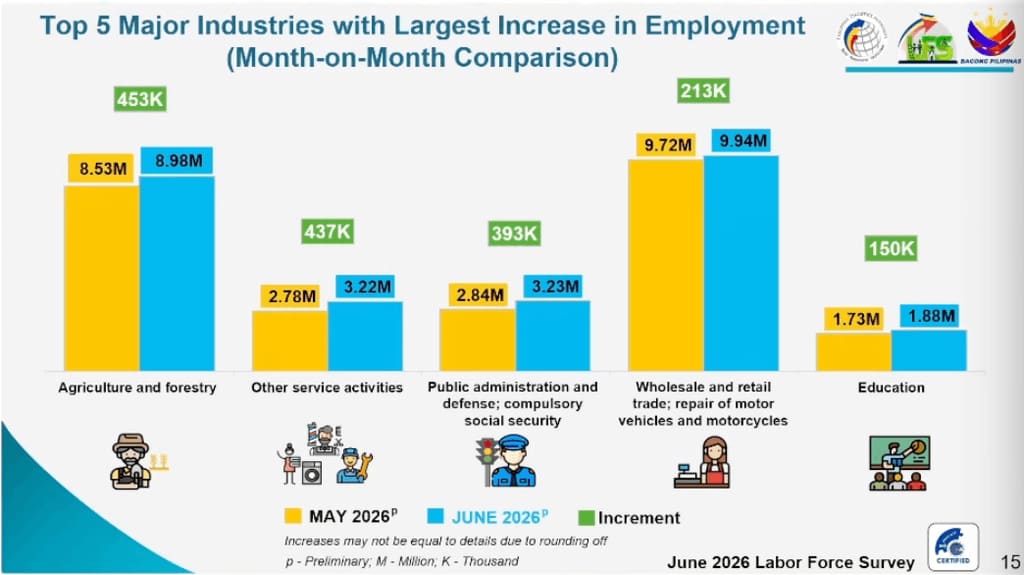
The statistics authority identified agriculture and forestry, other service activities, and public administration and defense, including compulsory social security, as the sectors posting the largest month-on-month employment gains. Public hiring often ticks up in mid-year cycles tied to budget releases, while agricultural labor can fluctuate with planting and harvest calendars.
Conversely, fishing and aquaculture shed roughly 467,000 jobs year-on-year, spanning freshwater fishing, fishpond operations, and marine fishing. Mapa singled out higher diesel prices as a direct culprit, noting that municipal marine fisherfolk face rising operating costs each time they take boats out. Fuel is a significant line item for small-scale operators who lack the bargaining power or capital reserves to hedge against price swings, and sustained increases can render trips uneconomical, prompting layoffs or exit from the sector altogether.
Manufacturing also recorded steep losses, as did mining and quarrying. The contraction in manufacturing reflects both domestic demand softness and headwinds in global supply chains, where Philippine electronics assembly and garment production compete with lower-cost neighbors. Mining, though a smaller employer, is sensitive to commodity price volatility and regulatory shifts, and any downturn ripples quickly through communities dependent on extraction.
Regional Context and Policy Pressure
The Philippine labor market snapshot arrives at a moment when central banks across Asia are weighing inflation control against growth support. Higher fuel costs feed into transport, logistics, and food prices, compressing household purchasing power and dampening consumption, which accounts for more than two-thirds of Philippine GDP. That demand weakness, in turn, discourages businesses from expanding payrolls.
The absorption challenge is not unique to Manila. Across Southeast Asia, Indonesia, Vietnam, and Thailand are managing similar youth bulges and skills mismatches, though each has pursued different strategies. Indonesia has leaned into labor-intensive manufacturing and infrastructure mega-projects; Vietnam has attracted foreign direct investment in electronics and textiles; Thailand has emphasized automation and upskilling. The Philippines, by contrast, has historically relied on overseas employment to relieve domestic labor market pressure, with remittances from ten million overseas Filipino workers acting as both safety valve and growth engine.
Yet that model faces its own constraints. Destination markets in the Middle East, North America, and Europe have tightened visa and work permit regimes, and the pandemic demonstrated the fragility of remittance flows when borders close. Policymakers in Manila are under pressure to accelerate domestic job creation, particularly in sectors that can absorb mid-skill workers without requiring years of retraining.
What Comes Next
The June figures will intensify scrutiny on government employment programs and incentives for private sector hiring. Tax breaks for companies that take on fresh graduates, expanded technical and vocational training, and public works spending are all tools in the policy toolkit, though each carries fiscal trade-offs at a time when debt servicing consumes a rising share of the budget.
For the hundreds of thousands of graduates now navigating their first job search, the data is a sobering reminder that credentials alone do not guarantee placement. Networking, internships, and geographic mobility matter as much as degree titles, and many will spend months in informal work or unpaid family roles before securing formal employment. The broader risk is that prolonged joblessness early in a career can depress lifetime earnings and erode human capital, a cost that compounds across cohorts if the mismatch persists.
RELATED STORIES
Philippine Economy Stalls as Investment Collapse Drags Growth to Pandemic Lows
Priyanka V. Rao · 3 min

Philippines GDP Growth Slows to 2.3 Percent, Lowest in 17 Years Outside Pandemic
Priyanka V. Rao · 3 min
Philippine Economy Slows to 2.3% as Energy Crisis and Spending Cuts Bite
Mariel D. Santos · 3 min
Philippine Economy Slows to 2.3% Growth in Second Quarter
Priyanka V. Rao · 2 min
Spot something wrong? Email editor@briefasia.com. We log every correction publicly.