Asia · Trending
Philippines Cuts Poverty to 9.7% as 6.5 Million Rise Above Line
The milestone masks fragility: 28% of the population lives barely above the threshold and remains vulnerable to price shocks and job losses.
KEY TAKEAWAYS
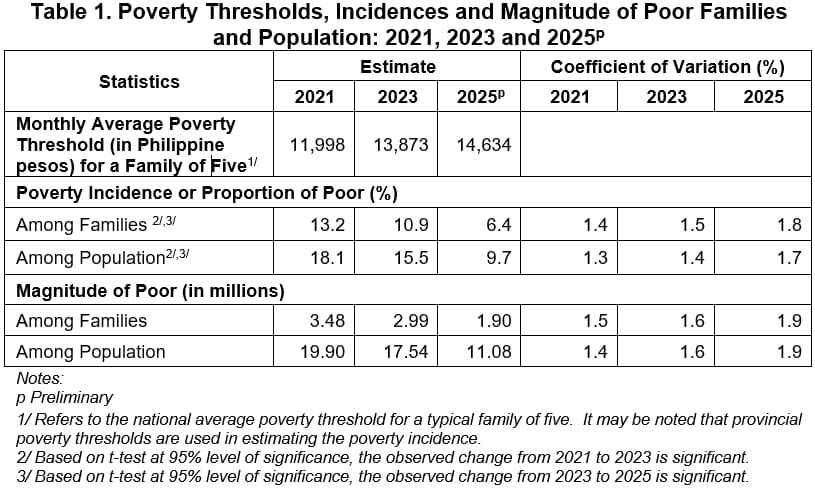
- ·The Philippines cut its poverty rate to 9.7% in 2025, lifting 6.5 million people above the threshold in two years.
- ·Around 28% of Filipinos live just above the poverty line of P2,927 per person monthly, leaving them vulnerable to price spikes and job losses.
- ·GDP growth has slowed sharply in 2026, with economic managers cutting the target to 3.5% to 4.5% amid rising inflation and structural weaknesses.
A Statistical Victory with Fragile Foundations
The Philippines recorded its lowest poverty rate on record in 2025, with 9.7% of the population living below the official poverty line, down from 15.5% in 2023, according to the Philippine Statistics Authority. That translates to 11 million Filipinos classified as poor, compared to 17.5 million two years earlier.
The decline marks the first time fewer than one in ten Filipinos fall below the poverty threshold. Arsenio Balisacan, the country's chief economist, said the milestone demonstrates that expanding economic opportunities paired with social protection can deliver measurable results.
Yet the achievement rests on a narrow definition. The PSA pegs the national poverty threshold at P35,121 per person annually, or roughly P2,927 per month. For a family of five, that works out to about P14,634 a month. A household earning marginally more would no longer be classified as poor, even if it has little buffer for emergencies, savings, or quality-of-life improvements.
Millions Remain One Shock Away
The World Bank estimates that roughly 28% of Filipinos live just above the poverty line, leaving them exposed to price spikes, job losses, natural disasters, and other economic shocks. The bottom 30% of households are particularly sensitive to volatility in food, utilities, and transport costs, which consume a disproportionate share of their budgets.
During the August 3 launch of the Philippines Economic Update, World Bank senior country economist Jaffar Al-Rikabi noted that targeted interventions such as the 4Ps conditional cash transfer program and the UPLIFT scheme have helped cushion the impact of this year's energy price surge. He estimated that without these measures, nearly 2 million people would be at risk of falling back into poverty from the shock alone.
Balisacan acknowledged that many of those who crossed the threshold remain close to it. A serious flood, a spike in rice prices, or a sudden loss of income could reverse their gains. The priority now, he said, is to make those improvements durable.
Structural Weaknesses Persist
Sustaining progress will require more than social transfers. Balisacan argued that the Philippines must keep inflation in check, invest in health and education, generate better-quality jobs, and restore investment levels. But he also pointed to a deeper structural problem: the economy's heavy reliance on household consumption, remittances, and services, with relatively weak export and manufacturing sectors.
In contrast to regional peers that built robust industrial bases, the Philippines has underinvested in manufacturing, according to Balisacan. That leaves the economy exposed when external conditions shift.
The vulnerability is already visible in 2026. Inflation has climbed on higher food, fuel, and electricity costs, while GDP growth has slowed sharply, particularly in the second quarter. Economic managers have cut the growth target for 2026 to 3.5% to 4.5%, down from earlier projections, and lowered the 2027-2030 range to 5% to 6%.
The downgrade came only weeks after the World Bank formally reclassified the Philippines as an upper-middle-income economy, a status that reflects rising average incomes but does not capture the fragility beneath the headline numbers.
What Comes Next
The poverty rate decline is significant, but the composition of that decline matters as much as the headline figure. With millions of households clustered just above the threshold and the economy facing headwinds, the government's ability to protect recent gains will depend on its capacity to deliver stable prices, resilient social safety nets, and a shift toward more diversified, higher-value growth.
The challenge is no longer just lifting people out of poverty. It is ensuring they do not fall back in.
RELATED STORIES

Dominion Holdings Prepares to Control Tampakan, the Philippines' Largest Copper-Gold Project
Priyanka V. Rao · 3 min
Philippine Court Restores Villar Power Firm's License on Due Process Grounds
Priyanka V. Rao · 3 min
Philippines Dairy Imports Rise 2% as Domestic Production Stalls
Priyanka V. Rao · 2 min
Philippines Rice Self-Sufficiency Climbs to 78% as Import Ban Reverses Multi-Year Decline
Priyanka V. Rao · 3 min
Spot something wrong? Email editor@briefasia.com. We log every correction publicly.