Asia · Business
Philippine Two-Wheeler Demand Holds Steady Despite Second-Quarter Slowdown
Industry data shows 939,528 motorcycles sold in the first half of 2026, with automatic models capturing nearly 70 percent of the market as commuters prioritize fuel efficiency.
KEY TAKEAWAYS
- ·Philippine motorcycle sales reached 939,528 units in the first half of 2026, up 4 percent year-on-year, driven by strong first-quarter demand of 496,868 units.
- ·Automatic-transmission models captured 655,004 units, nearly 70 percent of total sales, reflecting urban commuter preference for fuel efficiency and ease of use.
- ·Second-quarter volume declined 4 percent to 442,660 units, signaling softer consumer spending and tighter dealer inventory management heading into the second half.
Steady Growth Masks Mid-Year Weakness
The Philippine motorcycle market posted modest growth in the first half of 2026, with total sales reaching 939,528 units compared to 907,054 in the same period last year. The Motorcycle Development Program Participants Association, which represents Honda, Kawasaki, Suzuki, and Yamaha operations in the country, released the figures that underscore persistent demand for two-wheeled transport across the archipelago.
The aggregate figure obscures a sharp deceleration between quarters. Sales jumped 12 percent year-on-year in the opening three months, totaling 496,868 units. That momentum reversed in the second quarter, when volume fell 4 percent to 442,660 units against the prior-year comparison of 462,007. The contrast suggests dealer inventories were drawn down in early 2026 after a strong finish to 2025, followed by a correction as consumer spending cooled.
Automatic Transmission Dominates Buyer Preferences
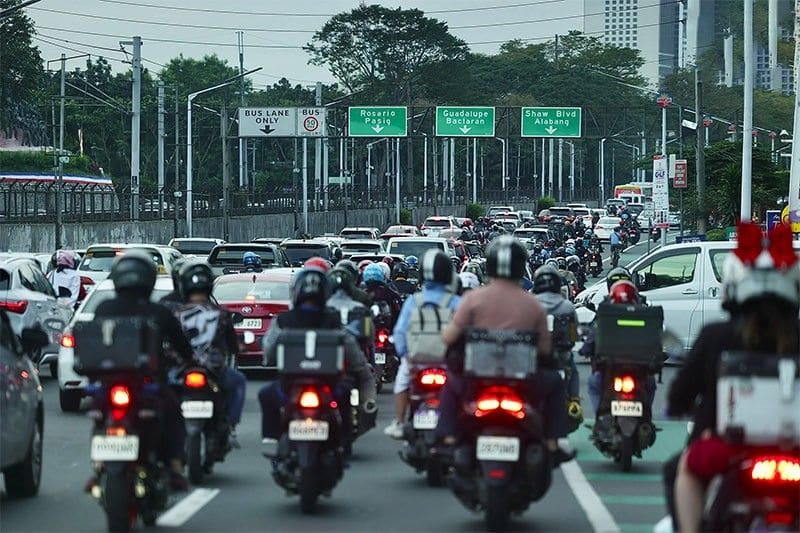
Segment data reveals a pronounced tilt toward automatic-transmission motorcycles, which accounted for 655,004 units in the first six months. That share reflects the preference among urban and peri-urban commuters for scooters that eliminate the need for manual clutch operation in stop-and-go traffic. Fuel economy and ease of use have made automatics the default choice for riders navigating Manila's congested arterials and the provincial highways that link manufacturing hubs to port cities.
Business-class motorcycles, typically small-displacement models used for delivery and light commercial work, captured 148,989 units. Mopeds contributed 107,632 units, serving the entry-level segment and rural markets where lower upfront cost remains paramount. Street motorcycles, which include sport and naked-bike configurations, accounted for 24,346 units, while the premium big-bike category added 2,994 units. Residual categories contributed 563 units to the half-year total.
The segment mix underscores the role of motorcycles as utility assets rather than discretionary purchases for most Filipino households. Affordability and running-cost efficiency drive replacement cycles, particularly in provinces where public transport options remain limited and ride-hailing services have yet to achieve deep penetration.
Industry Outlook and Regional Context
MDPPA president Erwin Estrada characterized the first-half performance as evidence of resilience, noting that market conditions have become more challenging relative to the exceptionally strong baseline set in 2025. He emphasized that motorcycles continue to serve as critical mobility infrastructure, enabling workers to reach job sites, entrepreneurs to operate micro-logistics businesses, and families to access education and healthcare facilities dispersed across the country's 7,641 islands.
The Philippines sits within a broader Southeast Asian two-wheeler market that has shown uneven recovery patterns since the pandemic. Indonesia and Vietnam, the region's largest motorcycle markets by volume, have each reported single-digit growth rates in recent quarters, constrained by elevated financing costs and softer consumer sentiment. Thailand's domestic market has contracted as manufacturers shift production toward export channels, while Malaysia has seen stable replacement demand but limited expansion in first-time buyer cohorts.
In the Philippine context, motorcycle ownership remains far below saturation levels seen in Vietnam or Indonesia. Population density in Metro Manila and secondary cities continues to rise, and public transport capacity has not kept pace. The Land Transportation Office reported 18.2 million registered motorcycles at the end of 2025, a figure that implies roughly one motorcycle for every six residents. That ratio leaves substantial headroom for market growth, particularly as infrastructure projects open access to previously underserved provincial areas.
Financing and Policy Considerations
Dealer financing terms have tightened modestly over the past year as the Bangko Sentral ng Pilipinas maintained its benchmark policy rate at elevated levels to anchor inflation expectations. Monthly installment plans remain the dominant purchase mechanism, with down payments typically ranging from 10 to 20 percent of the vehicle's retail price. Lenders have increased scrutiny of borrower income documentation, which has lengthened approval timelines and filtered out marginal applicants.
Regulatory developments also weigh on market dynamics. Local government units in Metro Manila have discussed zoning restrictions that would limit motorcycle access to certain thoroughfares during peak hours, citing congestion and road-safety concerns. Implementation has been inconsistent, but the specter of access restrictions has prompted some commuters to delay purchases or consider alternative transport modes.
The national government has signaled interest in accelerating the shift toward electric motorcycles as part of broader decarbonization commitments. Tariff exemptions and registration-fee waivers for battery-electric two-wheelers took effect in late 2025, but charging infrastructure remains sparse outside Metro Manila and Cebu. Domestic assembly of electric models has yet to achieve scale, leaving the segment dependent on imports priced above the threshold most Filipino buyers are willing to pay.
What Dealers Are Watching
Dealer networks are monitoring remittance flows from overseas Filipino workers, which historically correlate with motorcycle sales in provincial markets. Remittances grew 3.1 percent year-on-year in the first quarter of 2026, a deceleration from the 5.8 percent pace recorded in 2025. Any sustained softness in inbound transfers would likely weigh on replacement demand in regions where remittances fund a significant share of household capital expenditures.
Inventory management has become more conservative after the second-quarter slowdown. Dealers are balancing the need to maintain model variety on showroom floors against the carrying cost of unsold units. Manufacturers have adjusted production schedules to reflect the tempered outlook, prioritizing high-turnover automatic models while scaling back shipments of niche street and sport configurations.
The second half of 2026 will test whether the industry can sustain positive year-on-year comparisons. Seasonal patterns typically favor stronger sales in the final quarter, driven by year-end bonuses and holiday spending. However, macroeconomic headwinds, including persistent inflation in food and energy categories, may constrain discretionary outlays and delay purchase decisions for households at the margin.
Industry participants expect long-term growth to remain intact, underpinned by demographic trends and the structural undersupply of affordable mass transit. The question is whether near-term volatility will compress margins and force consolidation among smaller distributors, or whether demand stabilizes at a level that supports the current dealer footprint across the archipelago.
RELATED STORIES

Philippine Water Operator Earmarks $400 Million for Southeast Asia Expansion
Mariel D. Santos · 2 min

Philippines Energy Budget Climbs 26% as Electric Vehicle Funding Surges
Priyanka V. Rao · 3 min

Five ASEAN Members Back Regional Oil Stockpile as Study Nears Completion
Tran Quoc Bao · 3 min
Philippine Manufacturing Expands at Fastest Pace Since 2016
Priyanka V. Rao · 3 min
Spot something wrong? Email editor@briefasia.com. We log every correction publicly.