Finance · Fintech
OCBC Brings Platinum and Palladium Trading to Retail Clients in Singapore
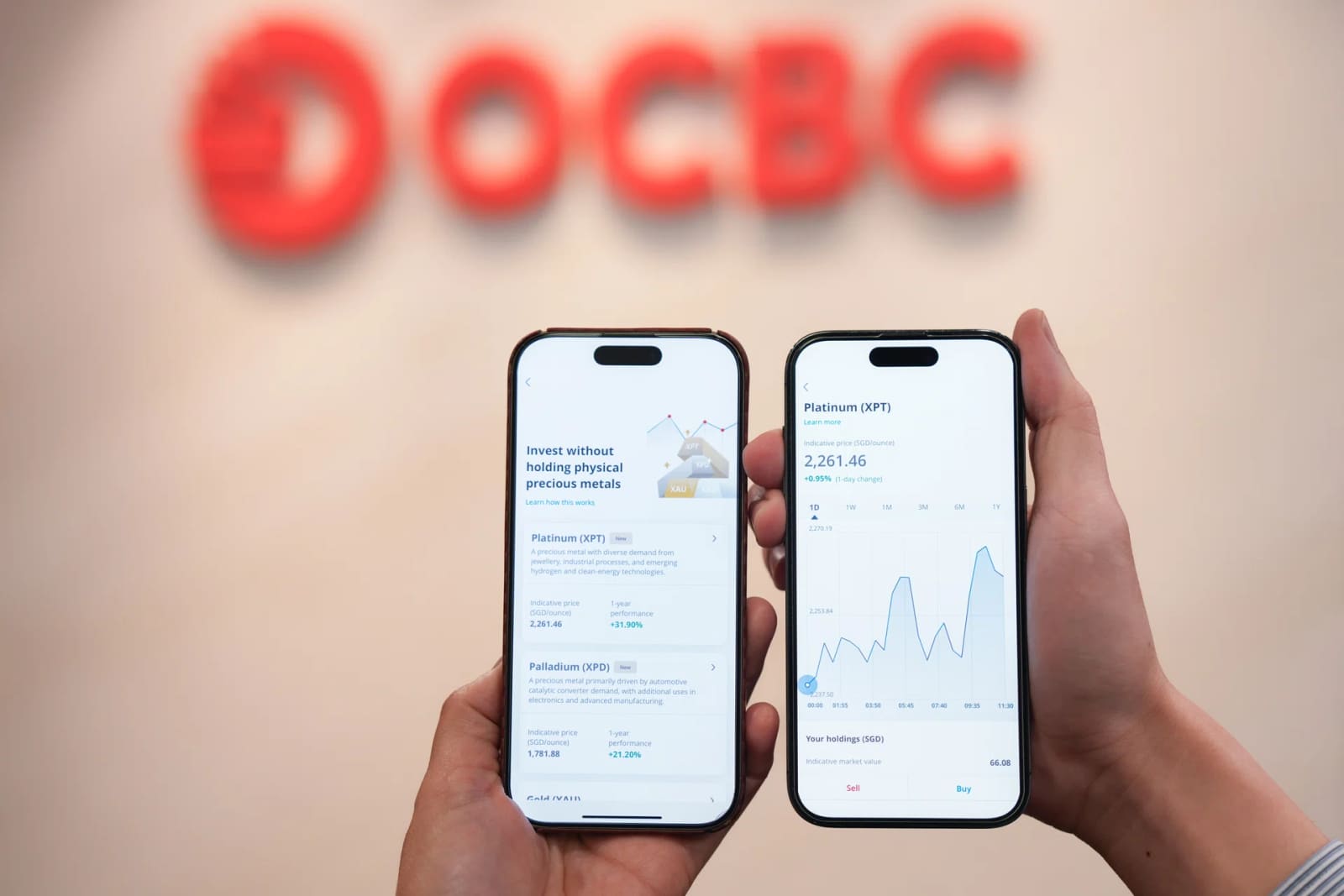
The bank's mobile app now offers fractional access to industrial metals starting at 0.01 ounce, extending its digital precious metals platform beyond gold and silver.
KEY TAKEAWAYS
- ·OCBC launched in-app platinum and palladium trading for retail clients on August 11, with a minimum investment of 0.01 ounce translating to approximately S$18 to S$23.
- ·The bank forecasts platinum to exceed US$2,000 and palladium to top US$1,500 by H1 2027, driven by industrial demand from automotive and clean energy sectors.
- ·Adoption of OCBC's digital gold and silver platform grew 2.5 times year-on-year in 2025, signaling strong retail appetite for fractional precious metals access.
Breaking the Wealth Barrier
Singapore's second-largest bank has cracked open a corner of the precious metals market that institutional and private banking clients have long kept to themselves. OCBC announced that retail customers can now buy and sell platinum and palladium bullion directly through its mobile application, with positions as small as 0.01 ounce - roughly S$23 for platinum and S$18 for palladium at current pricing.
The move, effective August 11, marks a calculated expansion of the bank's digital metals suite. OCBC introduced gold and silver trading for retail clients in October 2021, and the latest additions push the platform into territory where volatility runs higher and fundamentals diverge sharply from the safe-haven narrative that dominates gold.
Industrial Metals, Not Store-of-Value Plays
Platinum and palladium occupy a different niche in the commodities landscape. While central banks hoard gold and investors treat it as portfolio insurance, these two metals derive most of their value from industrial demand. Platinum feeds automotive manufacturing, catalytic processes, and the hydrogen fuel cell supply chain. Palladium is embedded in emissions-control systems across the global vehicle fleet.
That industrial tether introduces a different risk profile. Price swings track manufacturing cycles, regulatory shifts in emissions standards, and supply disruptions from a handful of mining regions. South Africa and Russia dominate platinum and palladium output, respectively, so geopolitical friction and labor disputes can send prices lurching.
OCBC Group Research expects spot platinum to cross US$2,000 per ounce and palladium to surpass US$1,500 by the first half of 2027, according to the bank. As of end-June 2026, platinum traded at US$1,833 and palladium at US$1,389.
Fractional Access, Amplified Volatility
Tan Siew Lee, head of group wealth management at OCBC, framed the launch as part of a broader push to lower investment thresholds. "We are strengthening our position as a leading wealth management player and as the go-to bank for precious metals," she said.
But Tan also flagged the reality that many retail investors may not fully appreciate: platinum and palladium are high-beta assets. Investors who can stomach larger price swings might use them to capture themes around resource scarcity, manufacturing activity, and the energy transition. Those hunting for portfolio stability should look elsewhere.
The bank's existing digital metals platform has seen strong uptake. OCBC reported that the number of customers investing in gold and silver through the app in 2025 rose 2.5 times year-on-year, with demand holding steady through volatile stretches in 2026.
The Asia Angle
Singapore's retail wealth market has matured rapidly over the past five years, driven by rising affluence, digital adoption, and a regulatory environment that encourages product innovation within guardrails. Banks compete on convenience and minimum ticket size, aware that younger investors expect fractional access and mobile-first interfaces.
OCBC's move also fits a broader regional pattern. As Asia's middle class deepens its engagement with capital markets, banks are unbundling products once reserved for private banking. Fractional shares, robo-advisory, and now industrial precious metals reflect a democratization that mirrors trends in fintech hubs from Jakarta to Mumbai.
Yet the introduction of high-volatility commodities to mass retail clients will test how well digital platforms communicate risk. Platinum and palladium lack the cultural familiarity that gold enjoys across Asian households. Education, transparent pricing, and clear disclosure around concentration risk and liquidity will determine whether this expansion builds lasting adoption or simply invites speculative churn.
For now, OCBC has handed retail investors a new lever. Whether they pull it wisely depends on how well they understand what drives these metals - and how much turbulence they are prepared to endure.
RELATED STORIES
Singapore Banks Hit Record Highs on Wealth Management Surge
Priyanka V. Rao · 2 min
Singapore's Big Three Banks Post Solid First-Half Gains as Wealth Offsets Margin Pressure
Priyanka V. Rao · 3 min
Singapore Banks Split as DBS and OCBC Hit Record Highs While UOB Lags
Priyanka V. Rao · 3 min
OCBC Lifts Dividend as Wealth Management Drives 22% Profit Jump
Priyanka V. Rao · 2 min
Spot something wrong? Email editor@briefasia.com. We log every correction publicly.