Technology · AI
Nvidia Commits $500 Billion Partnership With SK Group During Presidential Summit
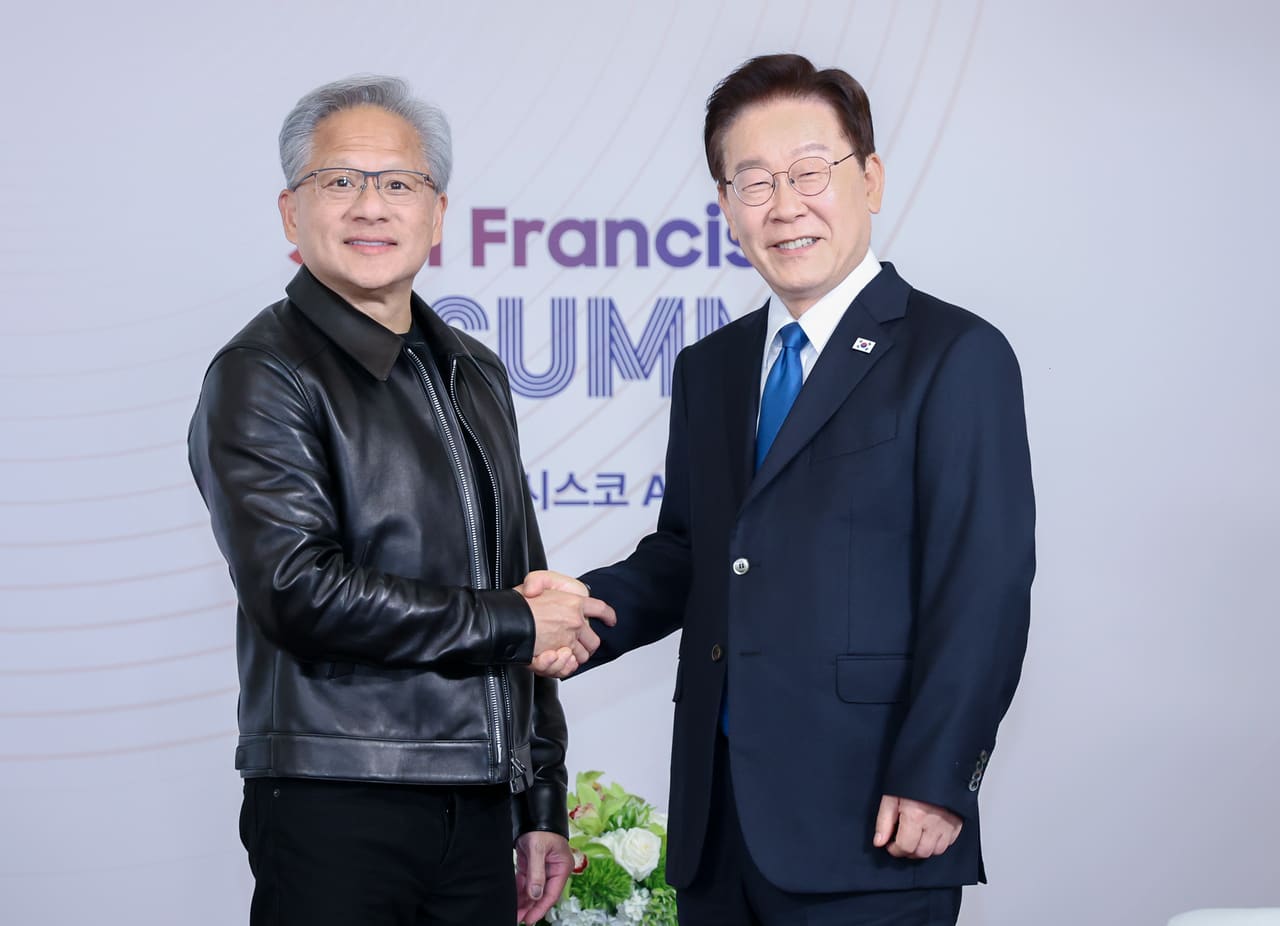
Jensen Huang announces sweeping South Korean collaboration as President Lee Jae-myung courts Silicon Valley investment in San Francisco
KEY TAKEAWAYS
- ·Nvidia CEO Jensen Huang announced a $500 billion partnership with SK Group during a meeting with South Korean President Lee Jae-myung in San Francisco.
- ·The collaboration aims to deepen ties across memory chips, AI infrastructure, and data centers as South Korea seeks to secure its role in the global semiconductor supply chain.
- ·Details remain sparse on whether the figure represents direct investment or multi-year procurement and licensing agreements spanning SK Hynix, SK Telecom, and other units.
Silicon Valley Courtship
President Lee Jae-myung opened a two-day San Francisco investment tour Friday with a high-stakes meeting that delivered immediate results: Nvidia CEO Jensen Huang committed to a $500 billion partnership with SK Group, one of South Korea's largest conglomerates. The announcement positions Seoul at the center of Nvidia's Asia expansion as competition intensifies for AI infrastructure investment.
The partnership figure dwarfs previous technology tie-ups in the region and signals Nvidia's intent to deepen manufacturing and research relationships beyond Taiwan and Japan. SK Group operates businesses spanning semiconductors, telecommunications, and energy - sectors critical to Nvidia's data center and AI accelerator ambitions.
Strategic Timing
Lee's trip comes as South Korea faces mounting pressure to secure its position in the global semiconductor supply chain. The country supplies roughly 20 percent of the world's memory chips, but has lagged in advanced logic chip manufacturing and AI-specific silicon - areas where Nvidia holds commanding market share.
Nvidia's partnership with SK Group could help close that gap. SK Hynix, the conglomerate's memory chip unit, already supplies high-bandwidth memory (HBM) for Nvidia's H100 and upcoming Blackwell GPU platforms. Expanding cooperation into logic chip packaging, data center infrastructure, and AI software development would deepen interdependence and reduce Seoul's reliance on competing ecosystems.
The timing also reflects Nvidia's need to diversify its Asian manufacturing footprint. Geopolitical friction around Taiwan and tightening U.S. export controls on advanced chips have pushed American tech firms to cultivate alternative production hubs. South Korea offers advanced fabrication capabilities, a skilled workforce, and a government eager to subsidize strategic industries.
Broader Investment Push
The San Francisco meeting is the opening salvo in Lee's broader effort to attract global AI investment. His itinerary includes roundtables with venture capital firms, meetings with executives from hyperscale cloud providers, and site visits to AI research labs. The administration has signaled interest in luring data center construction, semiconductor R&D facilities, and AI model training operations to South Korea.
Seoul has already committed tens of billions of dollars in tax incentives, infrastructure spending, and regulatory fast-tracking for chipmakers and AI companies. The government views artificial intelligence as a national priority, with implications for defense, manufacturing competitiveness, and export revenue.
Huang's commitment offers political validation for Lee's economic strategy. A half-trillion-dollar partnership headline provides tangible evidence that South Korea remains attractive to the world's most valuable chipmaker, even as rivals like Japan, Singapore, and India roll out competing incentive packages.
What the Partnership Entails
Details of the $500 billion figure remain sparse. Huang did not specify whether the sum represents direct capital investment, joint venture commitments, or multi-year procurement and licensing agreements. Industry observers note that such large partnership announcements often bundle diverse activities - equipment purchases, intellectual property licenses, co-development projects, and long-term supply contracts - into a single headline number.
SK Group's portfolio suggests multiple collaboration vectors. SK Hynix could expand HBM production and co-develop next-generation memory architectures. SK Telecom might deploy Nvidia AI platforms across its 5G and edge computing networks. SK Innovation's battery and materials divisions could supply components for Nvidia's data center power infrastructure.
Nvidia has used similar partnership frameworks in other markets. In Japan, the company works with SoftBank on AI-RAN (radio access network) infrastructure. In India, it collaborates with Reliance Industries on AI cloud services. The South Korea deal appears designed to create a comprehensive ecosystem spanning hardware, software, and services.
Regional Implications
The partnership reshapes competitive dynamics across Northeast Asia. Taiwan's TSMC remains Nvidia's primary foundry partner for cutting-edge logic chips, but South Korea's entry into deeper collaboration introduces a second pillar in the region. That diversification benefits Nvidia by reducing single-point risk and gives Seoul leverage in negotiations over technology transfer and local content requirements.
China's AI ambitions also loom in the background. U.S. export restrictions have curtailed Nvidia's ability to sell advanced GPUs to Chinese customers, opening a strategic opportunity for South Korea to capture market share in AI infrastructure and services across Southeast Asia and other regions where Chinese tech firms previously competed.
Japan, meanwhile, has pursued its own Nvidia partnerships and government-backed semiconductor initiatives. The South Korea deal intensifies the regional race for AI leadership and underscores the degree to which American tech giants now play kingmaker roles in Asian industrial policy.
Execution Risks
Translating a $500 billion commitment into operational reality will require sustained coordination across multiple business units, regulatory approvals in both countries, and alignment on technology roadmaps. Previous mega-deals in the semiconductor industry have faltered when partners disagreed over intellectual property rights, profit-sharing, or strategic direction.
South Korea's domestic politics add another variable. Lee's administration faces scrutiny over economic policy and must demonstrate that headline-grabbing partnerships yield jobs, exports, and technological advancement - not just photo opportunities. Nvidia, for its part, will need to balance commitments in South Korea with obligations to partners in Taiwan, Japan, and the United States.
The partnership's success will ultimately depend on execution. If SK Group and Nvidia can align on HBM roadmaps, data center deployment, and AI software integration, the collaboration could cement South Korea's role as a critical node in the global AI supply chain. If not, the $500 billion figure may remain a diplomatic talking point rather than a transformative industrial shift.
RELATED STORIES
South Korea Taps Three Telecom Giants to Deliver Free AI Services Nationwide
Cheng Wei-Lun · 3 min
Samsung Display Restarts Asan OLED Campus as Foldable Phones Stage Recovery
Cheng Wei-Lun · 4 min
Samsung Workers Plan Protest Over Pay Gap Between Chip and Device Units
Jun-ho Seo · 3 min
Samsung's Device Division Reports First Quarterly Loss as Chip Costs Surge
Cheng Wei-Lun · 3 min
Spot something wrong? Email editor@briefasia.com. We log every correction publicly.