Technology · AI
Nvidia to Announce $500 Billion Partnership With SK Group
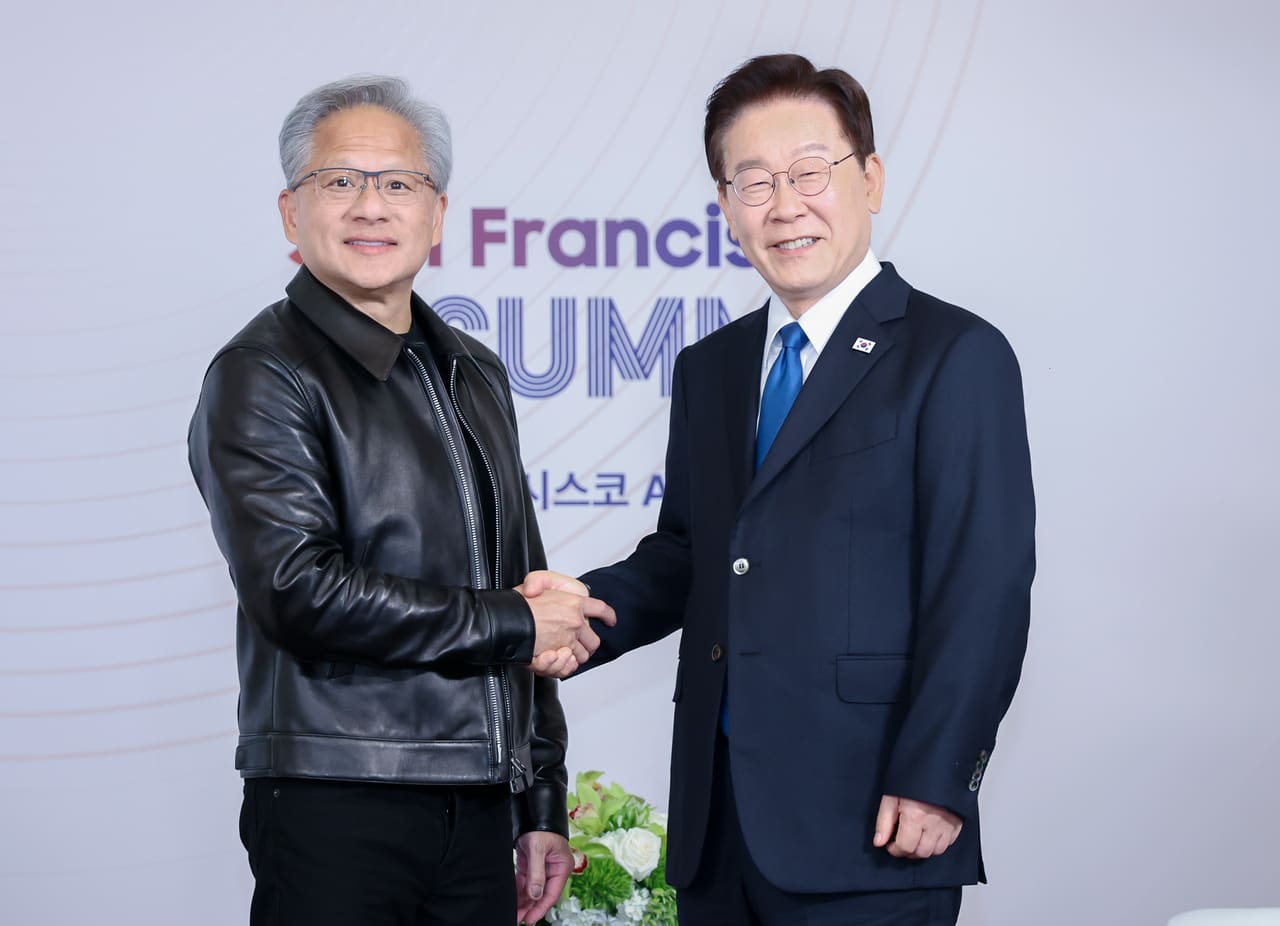
Jensen Huang disclosed the deal during a meeting with South Korea's president in San Francisco, part of a broader push to deepen AI collaboration between Silicon Valley and Seoul.
KEY TAKEAWAYS
- ·Nvidia will announce a $500 billion partnership with SK Group, CEO Jensen Huang disclosed during a meeting with South Korea's president in San Francisco.
- ·The deal, if confirmed, would be among the largest cross-border technology agreements and includes plans to develop a self-driving Genesis sedan.
- ·The partnership underscores deepening U.S.-Korea ties in AI infrastructure as export controls push American chipmakers closer to Asian allies.
A Half-Trillion-Dollar Bet on Korea
Nvidia will announce a $500 billion business partnership with SK Group, CEO Jensen Huang disclosed during a meeting with South Korean President Lee Jae-myung in San Francisco on Friday. The figure, if confirmed, would rank among the largest cross-border technology agreements in history and underscore the deepening ties between U.S. chipmakers and Korean conglomerates racing to secure AI infrastructure.
Huang made the announcement on the opening day of Lee's two-day visit to the Bay Area, a trip designed to attract investment from global technology companies and strengthen cooperation on artificial intelligence. The meeting brought together one of the world's most valuable semiconductor companies and one of South Korea's largest chaebol groups, which spans energy, telecommunications, and semiconductors through affiliates including SK hynix.
Self-Driving Ambitions
Beyond the SK partnership, Huang also announced plans to jointly develop a self-driving Genesis sedan, according to Nvidia. Genesis is the luxury vehicle brand owned by Hyundai Motor Group, suggesting the collaboration extends beyond SK's portfolio into Korea's automotive sector. Details on the autonomous vehicle project, including timelines and technical specifications, were not provided.
The pairing of Nvidia's computing platforms with Korean manufacturing and automotive expertise reflects a broader industry pattern. Seoul has positioned itself as a critical node in the AI supply chain, with SK hynix already a leading supplier of high-bandwidth memory chips used in Nvidia's data center GPUs. Hyundai, meanwhile, has been investing heavily in software-defined vehicles and electrification, areas where Nvidia's Drive platform has gained traction with automakers globally.
Strategic Context
The timing of the announcement is notable. U.S. export controls on advanced chips to China have pushed American semiconductor companies to deepen relationships with allies in Asia, particularly South Korea, Japan, and Taiwan. SK hynix has emerged as a major beneficiary, with its HBM3E memory chips in high demand for training large language models and running inference workloads.
For SK Group, a partnership of this scale would cement its role as a cornerstone of Nvidia's supply chain and potentially open doors to co-development of next-generation AI accelerators or data center infrastructure. The conglomerate has been expanding its AI ambitions, with SK Telecom investing in large language models and SK hynix ramping production of advanced memory technologies.
President Lee's visit comes as South Korea seeks to maintain its competitive edge in semiconductors amid intensifying rivalry between the U.S. and China. Seoul has announced tens of billions of dollars in subsidies for chip manufacturing and is courting foreign investment to build out domestic AI capabilities. Lee's itinerary in San Francisco likely includes meetings with other Silicon Valley executives, though details have not been made public.
What Remains Unclear
Nvidia and SK Group have not yet issued formal statements detailing the structure, scope, or timeline of the $500 billion partnership. It is unclear whether the figure represents committed capital expenditure, the projected value of business over a multi-year period, or a combination of joint ventures across multiple SK affiliates. Industry observers will be watching for clarity on how the partnership intersects with existing supply agreements, particularly SK hynix's role as a memory supplier.
The autonomous vehicle collaboration with Genesis also raises questions about integration with Hyundai's existing partnerships. Hyundai Motor Group has previously worked with other technology providers on self-driving systems, and it remains to be seen how Nvidia's platform will fit into the automaker's broader software strategy.
As Asia's technology landscape grows more crowded, deals of this magnitude signal that access to cutting-edge AI hardware and the capital to build it out will define the next decade of competition. For Nvidia, Korea offers both a reliable supply base and a testbed for deploying AI across industries. For Seoul, the partnership is a validation of its bet on memory, manufacturing, and the infrastructure that powers machine learning at scale.
The formal announcement is expected in the coming days.
RELATED STORIES
Samsung Workers Plan Protest Over Pay Gap Between Chip and Device Units
Jun-ho Seo · 3 min
Memory Makers Gain Leverage as AI Server Costs Climb
Cheng Wei-Lun · 3 min
South Korean Chip Materials Suppliers Ride AI Boom to Profit Surge
Cheng Wei-Lun · 3 min
South Korea Taps Three Telecom Giants to Deliver Free AI Services Nationwide
Cheng Wei-Lun · 3 min
Spot something wrong? Email editor@briefasia.com. We log every correction publicly.