Asia · Business
Malaysia Directs $12.6 Billion Toward Infrastructure in 2027 Spending Blueprint
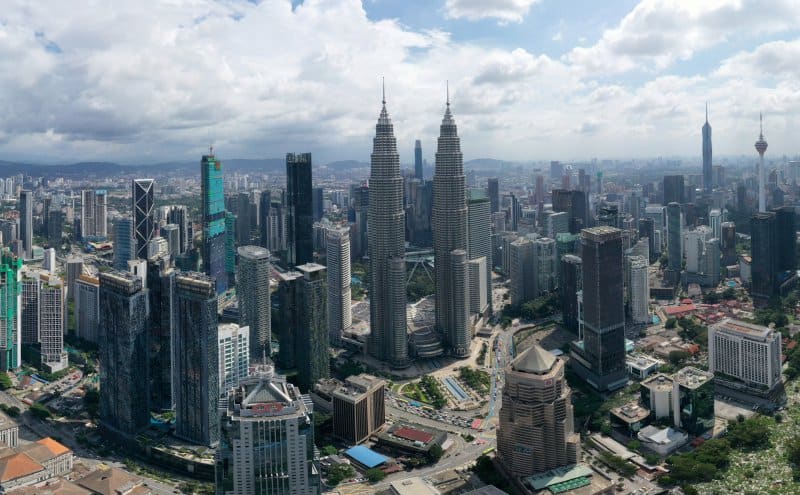
Kuala Lumpur's Economy Ministry proposes concentrating three-quarters of next year's capital budget on roads, schools, and utilities as global uncertainty weighs on export demand
KEY TAKEAWAYS
- ·Malaysia's Economy Ministry seeks RM58 billion for capital projects in 2027, representing 70 percent of development spending and a modest increase from RM57.6 billion in 2026.
- ·The allocation prioritizes roads, schools, healthcare facilities, water networks, and flood defenses to sustain economic momentum while global trade conditions remain volatile.
- ·Economists expect the government to leverage state-linked investment companies for commercial projects, reducing reliance on borrowing while maintaining infrastructure focus.
Capital Allocation Holds Steady
Malaysia's Economy Ministry is seeking RM58 billion ($12.6 billion) for capital projects in 2027, a figure that would claim 70 percent of development spending under the Second Rolling Plan and mark a marginal rise from the RM57.6 billion deployed this year. The proposal, pending Finance Ministry review ahead of the 2027 budget cycle, channels funds into roads, schools, healthcare facilities, water networks, and flood-control works rather than launching fresh ventures.
Economy Minister Akmal Nasrullah Mohd Nasir told a ministry assembly in Putrajaya that the selection process favors projects ready to break ground. Implementation readiness, he said, trumps approval convenience. The Second Rolling Plan sits within the Thirteenth Malaysia Plan framework and relies on screening by the Economy Ministry before funds flow.
Development expenditure climbed from RM55.67 billion in 2025, when it accounted for 65 percent of the capital envelope, to RM57.6 billion and 71 percent in 2026. The 2027 figure would extend that trajectory by roughly RM400 million, underscoring continuity over expansion.
Multiplier Effects in Focus
Bank Muamalat Malaysia chief economist Mohd Afzanizam Abdul Rashid expects the allocation to sustain an expansionary fiscal posture. Contractors and suppliers stand to capture immediate orders, feeding payrolls and business revenue that ripple through domestic demand. Infrastructure outlays, he noted, generate multiplier effects that amplify initial spending into broader economic activity.
Schools, clinics, roads, flood barriers, and water pipes remain the backbone of the pipeline. These assets deliver long-term productivity gains and meet urgent public needs, making them less vulnerable to shifting political winds or external shocks.
Sunway University economist Oh Ei Sun interprets the modest increase as a signal that Kuala Lumpur intends to finish what it started rather than gamble on untested schemes. Launching new initiatives amid trade friction and commodity volatility, he said, would have raised execution risk. Malaysia's export orientation leaves it exposed to supply-chain disruptions and swings in energy or food prices, despite first-half growth that exceeded many forecasts.
Oh argues that the 2027 budget should tilt more heavily toward energy grids, water systems, and digital networks in Peninsular Malaysia to attract high-technology investors, while raising living standards in Sabah and Sarawak. He also warned that development spending will only unlock private investment if projects align with industry requirements and avoid the waste that has plagued past white-elephant ventures.
Fiscal Discipline and GLIC Leverage
Economist Geoffrey Williams views the proposal as a conservative approach that balances infrastructure needs with debt constraints. By holding the line near 2026 levels, the government reduces its borrowing appetite and relies instead on government-linked investment companies and the GEAR-uP reform program to mobilize capital. That shift offloads commercial opportunities to state-backed entities, freeing the budget to concentrate on roads, schools, and clinics that the private sector will not fund.
Williams expects Malaysia's economy to outpace Bank Negara's 4.0 to 5.0 percent forecast range in the second half of the year, driven by resilient business activity despite global headwinds. He credited the administration's decision to hold petrol and diesel prices steady after an oil-price surge, shielding consumers while subsidy rationalization improved the fiscal position. Without the revenue hit from higher crude costs, he said, the budget would be in robust shape.
Looking toward the 2027 budget cycle, Williams anticipates higher transfers under the Sumbangan Tunai Rahmah and Sumbangan Asas Rahmah cash-assistance programs, alongside a possible non-contributory pension and additional cost-of-living relief. With wage growth stagnant and a general election on the horizon, household income support is likely to feature prominently.
Consolidation Versus Growth
Oh cautioned that fiscal consolidation will require new revenue measures and tighter governance. Raising taxes risks dampening business expansion, while plugging leakages through anti-corruption efforts remains essential to ensure that development funds reach their intended targets. He said the government must walk a tightrope between maintaining capital spending and meeting medium-term deficit targets.
The trajectory of development expenditure over the past three years shows a government committed to infrastructure-led growth even as global conditions deteriorate. Whether that commitment translates into higher productivity and stronger private investment will depend on execution quality, project alignment with industrial needs, and the ability to avoid cost overruns and graft.
Malaysia's bet on roads, clinics, and flood defenses reflects a pragmatic calculus: in an uncertain world, finishing what you started beats the allure of the new. For now, Kuala Lumpur is banking that incremental capital spending, disciplined project selection, and state-enterprise leverage will keep growth above four percent without blowing out the deficit. The Finance Ministry's response in the coming weeks will reveal whether that bet survives budget negotiations.
RELATED STORIES

Selangor Pulls RM70 Billion in Six Months as Services and Manufacturing Drive Malaysia's Richest State
Anand Sundaram · 4 min

Five ASEAN Members Back Regional Oil Stockpile as Study Nears Completion
Tran Quoc Bao · 3 min

Southeast Asian Firms Overlook Digital Pact Worth USD 2 Trillion
Lim Hui Ying · 4 min
Penang Captures 34% of Malaysia's Manufacturing Investment in First Half
Anand Sundaram · 2 min
Spot something wrong? Email editor@briefasia.com. We log every correction publicly.