Finance · Markets
Mainland China Stocks Hit One-Year Premium Peak Over Hong Kong on AI Rally
State backing and artificial intelligence enthusiasm push A-share valuations to 23 percent above H-share counterparts in dual-listed firms
KEY TAKEAWAYS
- ·Dual-listed Chinese companies now trade at a 23 percent premium on mainland exchanges versus Hong Kong, the widest gap in nearly one year.
- ·State-backed market support and artificial intelligence sector momentum have driven A-share valuations higher, while H-shares in Hong Kong lag.
- ·The premium spread serves as a sentiment gauge, with technology and industrial firms showing the widest valuation gaps between the two markets.
Premium Gap Widens to Yearly High
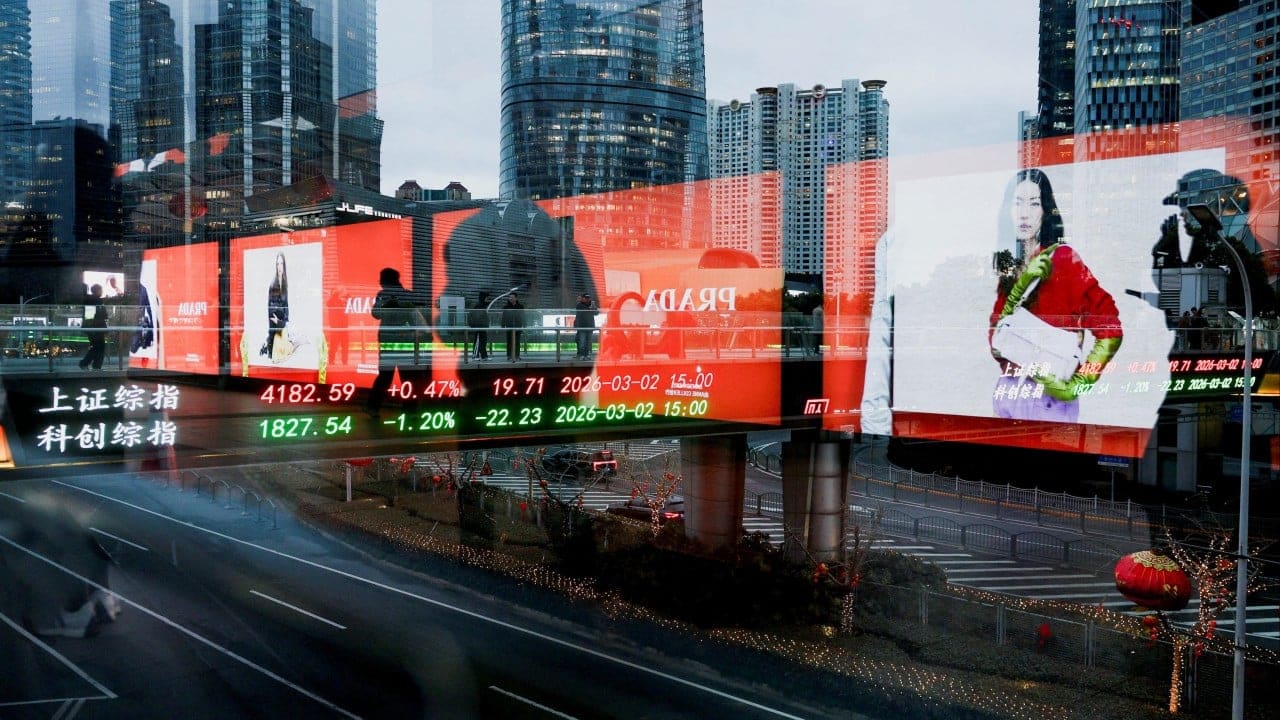
The valuation gap between mainland China and Hong Kong listings of the same Chinese companies has reached its widest point in nearly twelve months. Shares traded on Shanghai and Shenzhen exchanges now command an average 23 percent premium over identical stocks listed in Hong Kong, according to the Hang Seng gauge that tracks these price differentials across 202 dual-listed firms.
The divergence reflects sharply different investor sentiment between the two markets. Mainland A-shares, denominated in yuan and accessible primarily to domestic Chinese investors, have benefited from a confluence of government support measures and sector-specific momentum in artificial intelligence. Hong Kong's H-shares, priced in Hong Kong dollars and open to international capital, have not kept pace.
State Support and AI Momentum Drive Divergence
Government intervention in mainland equity markets has played a measurable role in the premium expansion. Beijing's recent initiatives to stabilize domestic bourses, including liquidity injections and regulatory guidance encouraging institutional buying, have lifted sentiment among yuan-traded equities. These measures disproportionately affect A-shares, which remain partially segmented from global markets despite gradual opening through Stock Connect programs.
Artificial intelligence stocks have amplified the trend. Chinese technology firms with dual listings have seen their mainland shares surge as retail and institutional investors chase exposure to the AI supply chain. Semiconductor designers, cloud infrastructure providers, and enterprise software companies have posted double-digit gains on Shanghai and Shenzhen boards, while their Hong Kong counterparts lag amid concerns over export controls and slower international demand.
The premium metric offers a real-time gauge of relative optimism. When A-shares trade above H-shares, it signals that domestic investors are willing to pay more for the same earnings stream. The current 23 percent spread sits near the upper range of historical norms; sustained premiums above 30 percent have historically preceded corrections as arbitrage pressures mount.
Historical Context and Market Segmentation
Dual-listing premiums are a structural feature of China's bifurcated equity market. A-shares and H-shares represent identical ownership stakes, yet price discovery occurs in separate ecosystems with distinct investor bases, liquidity profiles, and regulatory frameworks. Mainland exchanges enforce tighter capital controls, limit foreign participation, and operate under different disclosure standards than Hong Kong's internationalized bourse.
The premium has fluctuated considerably over the past decade. During periods of mainland market exuberance, such as the 2015 equity bubble, A-shares traded at premiums exceeding 40 percent. Conversely, during risk-off episodes or when Beijing tightened leverage rules, the gap has compressed to single digits or even briefly inverted.
Stock Connect schemes launched in 2014 and expanded since have allowed limited cross-border flows, enabling Hong Kong and international investors to buy A-shares through a quota system. These channels have narrowed but not eliminated the premium, as capital controls and differing tax treatments maintain friction.
Sector Breakdown and Investor Behavior
The current premium is not uniform across sectors. Technology and industrial firms show the widest spreads, with some AI-related names trading at 40 percent or greater premiums in Shanghai versus Hong Kong. Traditional sectors like financials and utilities exhibit narrower gaps, reflecting more stable earnings expectations and less speculative fervor.
Retail investor participation on the mainland amplifies volatility. Individual traders account for a larger share of daily turnover on Shanghai and Shenzhen exchanges than in Hong Kong, where institutional investors dominate. This retail presence can drive momentum chases and sharper swings in valuation spreads, particularly when themes like artificial intelligence capture public attention.
International investors watching the premium gauge it as a sentiment indicator. A widening spread suggests domestic confidence is outpacing global caution, often a precursor to policy shifts or market interventions. Portfolio managers use the metric to time entries into H-shares, betting that premiums will eventually compress as fundamentals reassert or as mainland enthusiasm cools.
Implications for Cross-Border Capital
The premium's rise to a near one-year high arrives as Beijing seeks to attract long-term foreign capital into domestic markets. Policymakers have signaled intentions to further open A-share access and harmonize regulatory standards with international norms. Yet the persistent valuation gap underscores the challenges: domestic sentiment remains heavily influenced by policy signals and thematic trading, while offshore investors demand liquidity, transparency, and alignment with global risk appetites.
For companies with dual listings, the premium creates strategic considerations. Firms may favor mainland fundraising when A-share valuations are elevated, issuing new equity at a premium to book value. Conversely, share buybacks or privatization moves may target cheaper H-shares, exploiting the arbitrage opportunity.
The sustainability of the current premium hinges on whether AI sector gains prove durable and whether state support continues. If earnings from technology firms meet elevated expectations, the premium could stabilize at current levels. If momentum fades or policy support withdraws, historical patterns suggest a swift compression toward long-term averages near 15 to 20 percent.
Traders and analysts will watch upcoming earnings reports from dual-listed tech giants and any shifts in Beijing's market stabilization efforts. The premium's trajectory offers a window into the tug-of-war between domestic optimism and the caution that still defines offshore China exposure.
RELATED STORIES
USD-CNY Overtakes Hong Kong Dollar Trading in Historic Shift
Cheng Wei-Lun · 3 min

Jim Rogers Signals Yuan Preference Over Dollar as US Debt Concerns Mount
Cheng Wei-Lun · 3 min
Hong Kong Life Insurers Eye 8-10% Premium Growth Despite Beijing Tax Rule Changes
Cheng Wei-Lun · 2 min

Hong Kong Extends Insurance Chief's Term Amid Beijing Tax Pressure
Cheng Wei-Lun · 3 min
Spot something wrong? Email editor@briefasia.com. We log every correction publicly.