ExclusivePerspectives · Interviews
Linh Nga, ten years away and a technique brought home
She is one of very few Vietnamese dancers trained entirely abroad who came back. The question now is no longer how well she dances.
KEY TAKEAWAYS
- ·Linh Nga is one of very few Vietnamese dancers trained entirely abroad who came home, and the question this profile asks is not how well she dances but what a top talent becomes once it leaves the floor: a repertoire, a generation of students, a method others can pick up, or only the memory of those in the room.
- ·She has already answered it, moving from star soloist to teaching, choreographing and running her parents' school, while the fashion runway stays the rare place her conservatory technique earns measurable money, using her presence without commissioning a single new work.
- ·The structural turn comes in November, when Vietnam's national student competition adds, for the first time, a category for choreography rather than performance, scoring makers instead of dancers at exactly the point where Linh Nga now stands.
In November, for the first time, a national dance competition in Vietnam will judge choreographers in a category of their own. That is precisely where Meritorious Artist Linh Nga's career has been pointing.
This is not a biography. It asks the question every dance culture in the region has to answer: what does an individual talent turn into once it reaches the top.
In 1998 a twelve year old left her family in Ho Chi Minh City for Guangdong. Ten years later she came home with a degree from the Beijing Dance Academy in ethnic and folk dance. The striking part is not that she studied abroad. It is that she chose a technical system her own parents did not have. People's Artist Dang Hung and People's Artist Vuong Linh are ballet dancers, trained in Moscow, married in 1983 in a university dormitory hall there. Their daughter took an entirely different route, then brought what she learned home and applied it to Vietnamese material. People's Artist and Meritorious Artist are Vietnam's two state honors for performers, the first ranking above the second.
The results came quickly. In 2009, aged twenty three, Linh Nga held a Hanoi stage for more than a hundred minutes across fifteen pieces in a program called Vu. In a country where dance rarely gets a ticketed evening of its own, a single performer sustaining an auditorium for that long was close to unprecedented. Two years later came Sen, staged as the lotus was being designated the national flower. In 2015, in the eighth round of state honors, all three members of the household were named at once: her parents as People's Artists, she as a Meritorious Artist at twenty nine.
It is a rare record, and it settles one question. Vietnam can produce a dancer who holds up at regional level. The question for the next decade is harder, and it is not Vietnam's alone. What does an individual talent turn into once that person spends less time on the floor. A repertoire that can be revived. A generation of students. A working method the next people can pick up. Or only the memory of those who happened to be in the room.

A formation route that crosses borders
Map this family's movements and you have most of the story of how professional dance in Vietnam was assembled. Dang Van Hung was born in 1958 in Hoang Hoa, Thanh Hoa province, entered the Vietnam Dance School in 1972 as a teenager, and met Vuong Linh there. Both were sent to the Soviet Union to train. They returned in 1986, worked at the Vietnam National Opera and Ballet, and in 1988 moved south to join the Bong Sen company.
Linh Nga was born in Moscow on January 12, 1986, in the middle of that arc. From 1995 to 1998 she trained in the Little Stars children's dance class attached to the Bong Sen Theatre. Then she left. Guangdong Dance School first, the Beijing Dance Academy after. In 2003 she took an outstanding performer prize at the national Taoli Cup competition. She graduated in 2008 and came back.
Readers across the region will recognize the shape of this. An artist is sent to a major training center, stays long enough for the technique to settle into the body rather than the memory, and returns carrying something the home art form did not already have. It is the route a number of Asian performing cultures have used to compress decades of accumulation.
The difficulty is in the return. A body drilled for ten years to conservatory standard is that individual's asset. Turning it into an art form's asset requires things no individual can build alone: a standing company, a repertoire, a reliable performance calendar, and someone whose job is to write it all down.
Vu, Sen, and the ceiling of the solo artist
Vu, in 2009, was essentially a report on ten years of schooling. Most of the numbers that night were pieces she had competed with abroad. Putting a competition program on stage as a ticketed evening was a gamble, and it paid.
Sen, in 2011, was a different proposition. It marked the Bong Sen Theatre's fiftieth anniversary and coincided with the lotus being named the national flower. She both danced and worked on the choreography. The press of the day cast her as the star of the evening. She declined the role.
I only appear in six numbers. (Ngoi Sao, August 2011)
It was the whole theatre's program with sixty dancers, she added in the same interview, funded from the annual production budget rather than from any separate source. A twenty five year old being called a star was actively demoting herself to one member of an ensemble, and putting the money question back where it belonged.
A body drilled for ten years to conservatory standard is an individual's asset. Turning it into an art form's asset requires four things no individual can build alone.
The detail is worth holding on to, because it shows something the admiring coverage tends to skip. She understands the ceiling of the solo model precisely. One person can hold an auditorium for a hundred minutes. One person cannot generate a season.
The honor, and a number that needs correcting
In 2015 three members of one family appeared in the same round of state honors. The case was unusual enough that the press covered it as an event in itself.
One widely circulated detail needs correcting. A great many Vietnamese reports, including recent ones, state that Linh Nga was named a Meritorious Artist in 2016 at the age of twenty five. Those two figures cannot both be reconciled with a birth date of January 12, 1986, and neither is right. She was honored in 2015, at twenty nine. The correction takes nothing away from the record. Under the applicable rules, dance and circus require ten years of professional practice rather than the fifteen demanded of most other disciplines, and she qualified almost as soon as she was eligible.
A trained body and the fashion runway
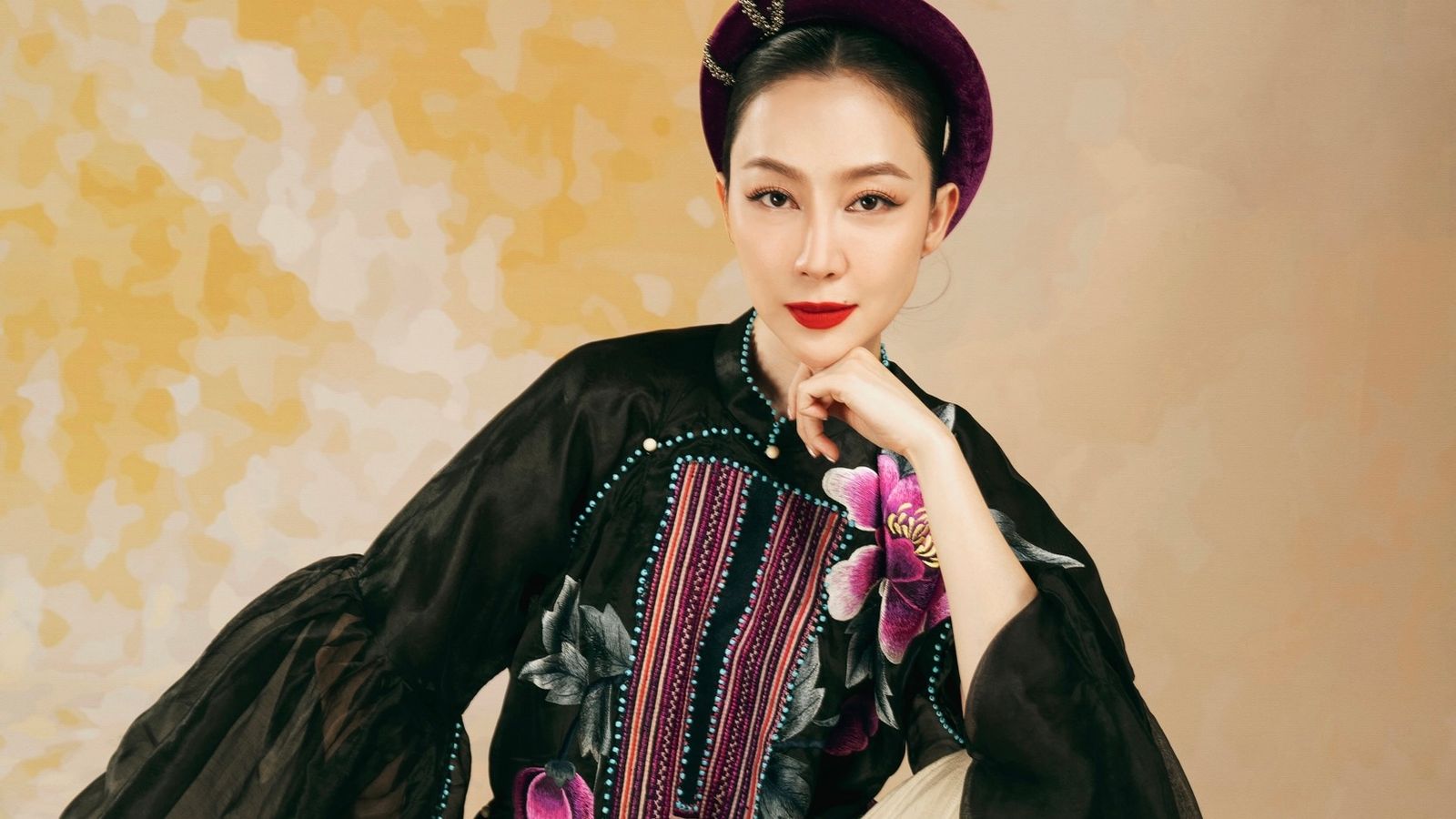
Since the middle of the last decade her name has appeared densely in a place few would predict for a conservatory dancer: fashion. Lotus silk and banana fiber ao dai by Vu Viet Ha. A Do Manh Cuong collection. Designs by Thuy Nguyen. Patterned ao dai by La Sen Vu. At a show by the designer Minh Hanh, staged without a vedette slot and without beauty queens, she opened as first face.
Resist the instinct to read this as decline. It is not. A designer who can put a body with ten years of conservatory training in front of a collection has a genuine professional advantage, and it has visibly raised the standard of Vietnamese fashion presentation. The benefit runs down the chain: the designers, the craft villages supplying lotus and banana silk, the audience. It is one of the few places where Vietnamese dance technique generates measurable economic value.
It should still be named correctly. A runway consumes physique and presence. It does not commission a forty minute dance work, does not sustain a company, does not produce something revivable next season. The technique gets used and gets paid. No new work gets made.

From dancer to maker
She answered this article's question years ago; nobody read the answer that way. In an interview with ELLE Vietnam she said she had joined the Bong Sen Theatre's permanent staff, was concentrating on the theatre's own performances, was teaching and choreographing for younger dancers, and was helping run her parents' dance school.
The big shows I used to do, I don't do anymore. (ELLE Vietnam)
In the same conversation she said she would never stop dancing because it was the path she chose as a child, and that if she could no longer perform she would choreograph and teach. She also observed that young people were more interested in dance than before, and that dance now mixes traditional forms with contemporary ones.
This is a deliberate change of role, and it is the right one. A performing career in dance is shorter than in almost any other art. Those who understand that early and prepare for it leave more behind than those who try to extend it.
November, and the choreography category
On September 5, 2026, Vietnam's Ministry of Culture, Sports and Tourism published the approved plan for this year's National Dance Talent Competition for students. The first round runs November 3 to 6 in Ho Chi Minh City, the second November 10 to 12 in Hanoi. Entries close at 5pm on October 10.
There are four categories. A for European classical and modern ballet, B for contemporary, C for ethnic, folk and traditional forms, D for choreography. The last one is the news. The draft plan the ministry posted on August 11 had three categories, all of them for performers. The choreography category appears in the approved version, along with a widened age range.
It sounds like a small edit. It is the most consequential line in the document. For years the domestic competition system has scored dancers. It is now beginning to score makers. The bottleneck in Vietnamese dance has never been a shortage of capable bodies. It is the shortage of people who turn those bodies into work that survives several seasons, and the absence of any mechanism that credits that labor.
Put differently, the rules have just opened at exactly the point where an artist like Linh Nga now stands: half in performance, half in making, with ten years of conservatory technique to hand on.
What stays open
Two things this piece will not tidy away.
The first is the question of identity. Linh Nga came home with a technical system learned abroad and used it to build programs organized around the lotus and Vietnamese folk forms. If the technique comes from one school and the material from another, what exactly is the result, and who has the authority to define it. The question will show up very concretely in category C in November, where the stated criterion is drawing on folk material and creating on a foundation of national identity, two phrases the rules leave the entrants to define for themselves.
The second is the record. In art forms whose works do not already exist as text, the way literature or a musical score does, writing them down is the precondition for reviving them. The artist page the Bong Sen Theatre keeps for her, accessed on September 7, 2026, lists professional history up to 2010 and names no works. This is ordinary at performing arts institutions and says nothing about the quality of the daily work inside, but it is a small sign that recording has not yet become a habit of the profession.
And one question this piece has no sources to answer: who pays for the missing infrastructure, the state, private capital, or audiences through ticket prices. The desk is not going to guess.
On November 3 the first round opens in Ho Chi Minh City, not far from the Bong Sen Theatre at 108 to 110 Hai Ba Trung, where a girl once trained in the Little Stars class thirty years ago. Some entrants will dance very well. This time a few of them will compete in the category for people who make the work.
Sources and method
Details of the 2026 National Dance Talent Competition for students come from two postings on the website of Vietnam's Ministry of Culture, Sports and Tourism, dated August 11 and September 5, 2026. Where the two versions differ on the number of categories and the eligible age range, this piece follows the approved plan of September 5. If publication falls after October 10, the wording about the entry deadline needs updating.
Date of birth and training record are taken from the artist page on the Bong Sen Song and Dance Theatre website, accessed September 7, 2026. Biographical detail on People's Artist Dang Hung and People's Artist Vuong Linh follows Dan Viet, January 16, 2024. Quotations come from an interview published by Ngoi Sao in August 2011 and an interview published by ELLE Vietnam. No quotation appears here without a published source attached.
On the state honor, this piece uses 2015, the eighth round, when the subject was twenty nine, in place of the widely repeated Vietnamese press claim that she was honored in 2016 at twenty five; both details conflict with her birth date. The record the Bong Sen Theatre received in 2013 was a Vietnamese national record awarded by the Vietnam Records Organization, not a Guinness World Record, although much of the coverage uses the word Guinness.
Three items in the original briefing material were excluded for lack of independent sourcing: job offers from foreign cities the subject is said to have declined; participation in a Romeo and Juliet production by a French dance company, which belongs to a different person of the same name; and her age when she began training, given variously as five and as eight in secondary sources. At least three women named Linh Nga work in the Vietnamese arts, a dancer, a film director and a fashion designer, and several newspaper archives conflate them.
The piece does not address the subject's private life, which has no bearing on the question asked here, and does not compare the subject, her work or Vietnamese performance conditions with any foreign artist, institution or market. Before publication the desk will put the relevant findings to Linh Nga and to the Bong Sen Theatre, including the correction to the year of her state honor and the state of the artist page, with the specific links, and will publish their responses alongside.
RELATED STORIES
Seven in the morning by Hoan Kiem Lake
Manh Khang · 7 min
Indonesia's Defense-First Economy Overlooks Its Real Engine of Growth
Anand Sundaram · 7 min

Why Taiwan's LCD Giants Can't Escape the Commodity Trap
Cheng Wei-Lun · 5 min

Selling Hours, Losing Value: Isabelle Miaja on What Owners Actually Pay a Design Practice For
Tu C. Nguyen · 8 min
Spot something wrong? Email editor@briefasia.com. We log every correction publicly.