ExclusivePerspectives · Essays
Seven in the morning by Hoan Kiem Lake
Chu Viet Ha photographs what an entire city walks past without seeing. Ten years of that work adds up to a visual diary of Hanoi, and to a distinctly East Asian way of looking at the ordinary.
KEY TAKEAWAYS
- ·For a decade Chu Viet Ha, a self-taught architect turned street photographer, has stood on the same handful of Hanoi streets photographing what the city walks past, the ordinary morning rather than the dramatic event, in a distinctly East Asian way of seeing.
- ·With no gallery, agency or local market to carry his work, the routes out ran through regional platforms and a camera maker: features on Invisible Photographer Asia, an X-Photographers file syndicated across roughly forty Fujifilm editions, jury seats, and shows from Hanoi to Berlin.
- ·The missing step, a photobook and a curated solo show, is being taken this year just as Hanoi builds the institutions to receive it, with the Photo Hanoi biennale (three editions since 2021, the next in 2027) aiming to make the city a photography centre for Asia.
A man asleep on the pavement at noon. A bus passenger sitting beside a rooster. Two adjacent windows holding two stories with nothing to do with each other. Figures in smoke, and in rain.
This is what Chu Viet Ha photographs. None of it is an event. That is the whole argument.
Street photography is the most patient art form a person can choose. No props, no lighting rig, no right to ask anyone to stand still. The photographer has two things: a place to stand, and time. Everything else has to arrive on its own.
Chu Viet Ha was born in 1987 in Bac Ninh, trained as an architect at the Hanoi Architectural University, and began taking street photography seriously around 2014. He is self-taught. On Fujifilm’s official site, where his artist file is syndicated across roughly forty national editions, from Japan, Korea and Indonesia to Germany, Brazil and New Zealand, he still describes himself in modest terms: a photography enthusiast specializing in street photography.
In the same passage he writes the line many people now remember him by: that photography is a religion, a bridge connecting him to the world outside.

A way of seeing the ordinary
Photography is a religion, a bridge that connects myself and the outer world.
There is a real difference between Western and East Asian street photography, and it is not technical.
The Western tradition, from Robert Frank to Garry Winogrand, tends to look for the abnormal inside the normal: a paradox, a dissonance, a moment that exposes something unsettled in a society. A good deal of Asian street photography moves the other way. It looks for what is worth keeping in what was never considered worth photographing. A morning identical to yesterday’s morning. A vendor who has stood in the same spot for twenty years. The persistence of habit rather than its rupture.
That way of seeing runs much deeper than photography. It belongs to the same family as haiku, as ink painting that leaves most of the paper empty, as the idea that beauty does not have to be rare in order to deserve recording.
His pictures sit inside that lineage. The two series on his Fujifilm page are called 365 Days Hanoi and Fleeting Encounters, one about repetition and one about what passes. Both are diaries rather than reportage with a thesis. Both demand the same thing: being there, every day, where nothing is happening.
Many layers, one instant
Compositionally he works in layers. Foreground, middle and background each carry their own incident, three small stories locking into place for a thousandth of a second and dissolving immediately afterward. It is the hardest construction in the genre, because it cannot be waited for: if one layer shifts half a step, the picture is gone.
Cartier-Bresson shows in the way he talks about the decisive moment; Alex Webb shows in the layering and the color. But the material is entirely Hanoi. The density of the Old Quarter produces the overlaps that a spacious city never offers. Balconies, awnings, shop signs, motorbikes, wing mirrors, glass. The city is already a structure in tiers.
His architectural training probably ends there rather than going further: someone used to reading sections and elevations sees a street in layers without having to think about it.
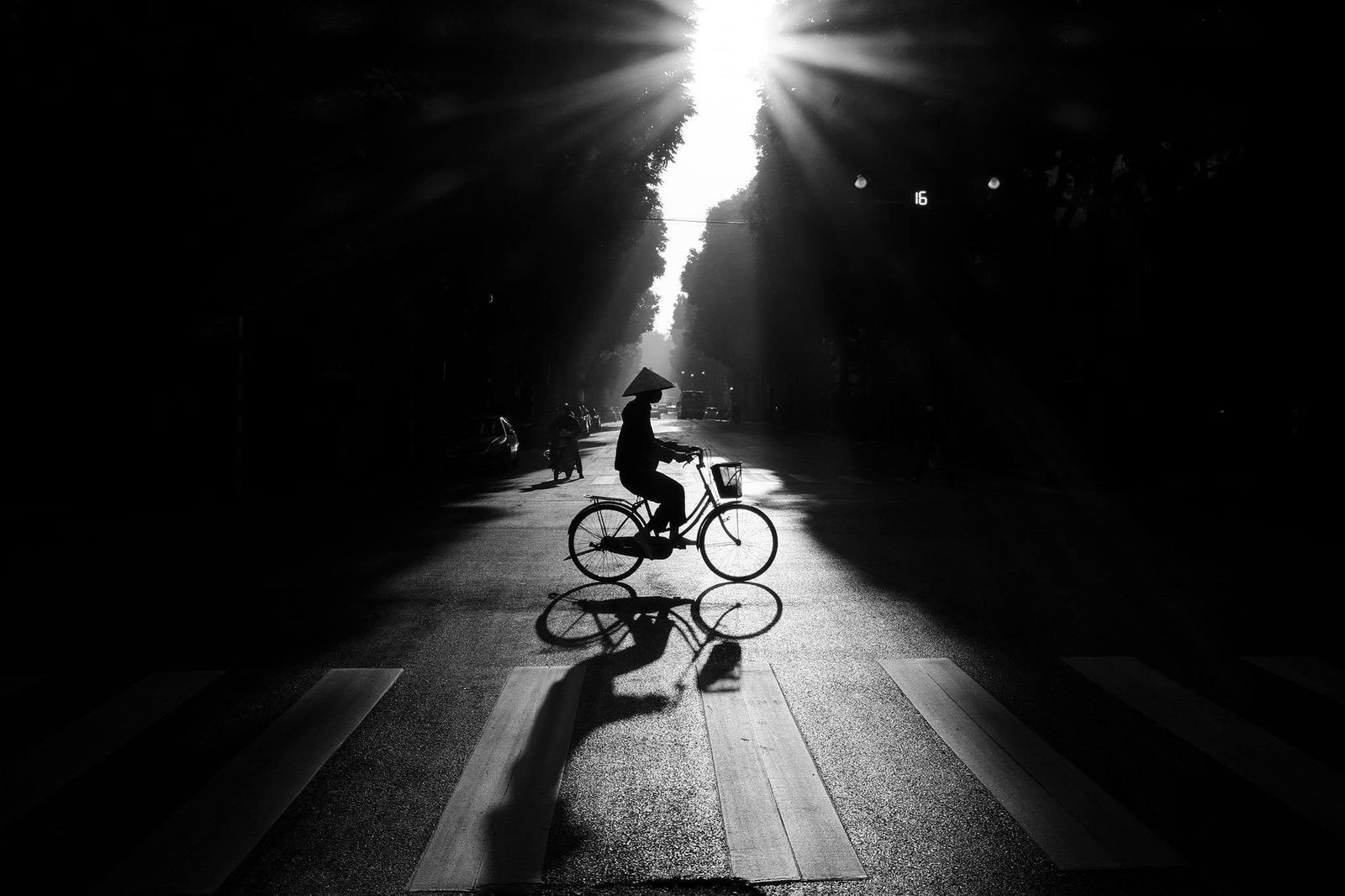
He also chooses difficult light. Seven in the morning by Hoan Kiem Lake, when Hanoians do tai chi and morning exercise and the sun is still low and the shadows long. Harsh midday on the pavement, the light most photographers avoid. In rain. In smoke.
-400x303.jpg?prefix=brief-asia)
How a self-taught photographer got out
He went to no photography school, has no gallery representing him and no agency. The routes that carried his work out of Vietnam therefore ran through other doors.
The first was regional platforms. His pictures have appeared on IPA, Invisible Photographer Asia, founded in Singapore in 2010 by the photographer Kevin WY Lee to fill the information gap around contemporary photography in the region, and which has run workshops and events in Singapore, Hong Kong, Malaysia, Thailand, the Philippines, Vietnam, Myanmar and Indonesia. His work has also run on 121Clicks and Streethunters.
The second was a camera manufacturer. He is on Fujifilm’s X-Photographers list, which is what put his file onto forty national editions of the company’s site.
The third was the jury table. He has judged Fujifilm Vietnam’s Photo Talk competition and the London Festival of Street Photography. In 2016 he exhibited a series called Like a Life in Hanoi. In 2018 his Dong Xuan market pictures were shown in Berlin, a city whose Vietnamese community is associated with that same name.
None of those is an old door. Agencies, newspaper picture desks, galleries and the print market, the things that once paid for street photography in the West, have thinned everywhere and never existed in Vietnam at all. A photographer in Hanoi today has to build the route himself, and Chu Viet Ha is among the few Vietnamese who have finished building one.
Teaching by walking
He teaches too, in the only way this subject can be taught: by walking together.
A Hanoi photo tour company sells a workshop he leads himself, five and a half hours and about four kilometers. It starts at seven in the morning at Hoan Kiem Lake. Then Dinh Liet, Ta Hien, Hang Buom, through the O Quan Chuong gate, out to Dong Xuan market, then Hang Dong and Hang Thiec. It ends with nearly two hours in an Old Quarter cafe going through every frame the participants have just made.
That last detail is the important part. Street photography cannot be taught in theory, only by showing why this frame lives and that one died, while the student still remembers where he was standing.
The gap that is closing
Until recently the gap was clear. There was no photobook, and no record of a solo exhibition in a museum or a properly curated space. That was the step still missing if a ten-year visual diary was to become a work that is kept rather than a stream of images that passes.
That step is now being taken. In 2026 Chu Viet Ha is completing his first personal photobook — a distillation of more than a decade of standing on the same streets, of the same patient looking. An accompanying solo exhibition is planned to mark the book’s release. Both are scheduled for the final months of this year.
The timing is not accidental. The institution that can receive such a work has started to exist. Photo Hanoi, the international photography biennale initiated by the Institut français in Vietnam with the Hanoi Department of Culture and Sports, has run three editions, in 2021, 2023 and 2025. The November 2025 edition gathered more than 170 artists, photographers, curators and specialists from 21 countries, with 22 exhibitions and 29 side events across more than 20 venues, including portfolio reviews where a photographer brings work and sits down in front of curators and editors. The organizers’ stated aim is to make Hanoi a photography center for Asia. The next edition falls in 2027.
A self-published or independently produced book, paired with a carefully staged exhibition, is precisely the kind of object that can travel through those new channels. It is also the form that suits the nature of the work: a long, quiet accumulation rather than a single dramatic project.
What remains
In an age producing more images than ever and looking at fewer of them, spending ten years standing and waiting on the same handful of streets is a position, not just a method.
Tomorrow morning, by Hoan Kiem Lake, the exercisers will come out again. They have been coming out like that for decades and will keep coming. That someone thinks this deserves close attention, and returns to look at it every day, is the entire content of the work.
The book and the exhibition will not change that content. They will only give it a form that can be held, shown, and kept.
RELATED STORIES

The Peacock Who Carries No Archive: Linh Nga and the Stage Vietnam Never Built
Manh Khang · 5 min
Indonesia's Defense-First Economy Overlooks Its Real Engine of Growth
Anand Sundaram · 7 min
Why Taiwan's LCD Giants Can't Escape the Commodity Trap
Cheng Wei-Lun · 5 min

Selling Hours, Losing Value: Isabelle Miaja on What Owners Actually Pay a Design Practice For
Tu C. Nguyen · 8 min
Spot something wrong? Email editor@briefasia.com. We log every correction publicly.