Asia · Trade
Kumamoto Earthquake Exposes Kyushu's Auto Supply-Chain Fragility
Toyota, Honda, and Nissan halt production across multiple prefectures as July 28 quake reveals tight coupling risks in Japan's southwestern automotive corridor
KEY TAKEAWAYS
- ·A July 28 earthquake in Kumamoto forced Toyota, Honda, and Nissan to halt vehicle and component production across Kumamoto, Fukuoka, and Oita prefectures.
- ·The stoppages revealed the fragility of Kyushu's tightly sequenced just-in-time supply chain, where a single seismic event disrupted multiple manufacturing tiers simultaneously.
- ·Restart timelines depend on structural inspections, parts availability from tier-one suppliers, and restoration of damaged road and rail logistics networks.
Production Halts Ripple Across Three Prefectures
The July 28 earthquake centered in Kumamoto prefecture triggered immediate production suspensions at Toyota Motor Kyushu, Honda Motor, and Nissan Motor facilities, with disruption spreading into neighboring Fukuoka and Oita. The shutdowns underscore the brittleness of just-in-time manufacturing in a region where automakers and their tier-one suppliers operate within hours of each other.
Toyota Motor Kyushu halted assembly lines to inspect structural integrity and confirm parts inventory, while Honda and Nissan implemented similar precautionary stoppages. Major component manufacturers in the affected zone also paused operations, creating a cascading effect through the supply chain as downstream assembly plants lost access to critical inputs.
Sequenced Manufacturing Under Stress
Kyushu's automotive cluster relies on tightly synchronized logistics, with parts moving from supplier to assembly line within narrow delivery windows. The earthquake disrupted this choreography at multiple nodes simultaneously. Factories assessing building damage, power stability, and workforce availability could not commit to restart schedules, leaving downstream partners without visibility into parts flow.
The region produces a significant share of Japan's compact vehicles and components for export markets across Asia. Any extended stoppage translates quickly into missed shipments to dealerships in Thailand, Indonesia, and the Philippines, where Japanese brands hold dominant positions.
Infrastructure and Logistics Assessment Ongoing
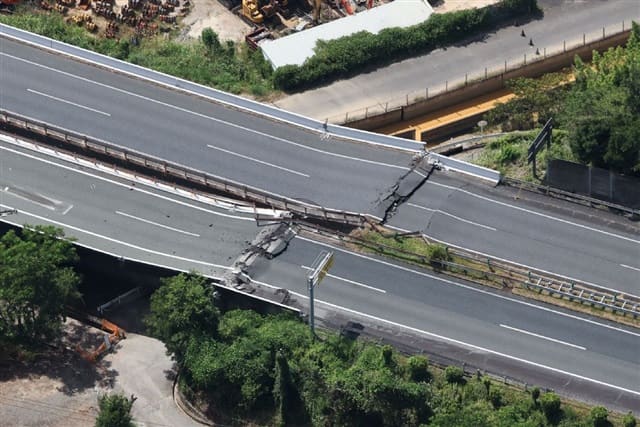
Beyond factory floors, the earthquake damaged road networks and rail links used to move finished vehicles and components. Automakers dispatched engineering teams to evaluate not only their own facilities but also the transport corridors connecting them to ports in Fukuoka and Kagoshima.
Suppliers reported difficulty reaching plants to conduct inspections, with some access roads blocked by debris or closed for safety checks. The logistics bottleneck compounded uncertainty around restart timelines, even for facilities that sustained minimal structural damage.
Regional Concentration as Strategic Liability
Kyushu's automotive footprint grew over decades as manufacturers sought lower land costs and proximity to Southeast Asian export markets. The concentration delivered efficiencies in supplier coordination and logistics, but the earthquake revealed the downside: a single seismic event can simultaneously disrupt multiple tiers of the supply chain.
Toyota, Honda, and Nissan have diversified production geographically in recent years, building capacity in Thailand, China, and North America. Yet Kyushu remains a critical node for specific vehicle lines and components that cannot be easily substituted from other regions. The quake will likely accelerate internal reviews of geographic risk and buffer inventory strategies.
What Restart Depends On
Resumption of full production hinges on three factors: structural clearance from engineers, restoration of parts supply from tier-one and tier-two vendors, and stabilization of logistics networks. Automakers indicated they would restart lines in phases, prioritizing models with the highest export demand and the least complex supply chains.
Component suppliers face their own calculus. Smaller vendors with single-site operations in the affected zone have limited ability to shift production elsewhere, creating potential long-tail disruptions even after major assembly plants come back online.
The earthquake arrives at a sensitive moment for Japan's auto sector, which is navigating slower demand in China and intensifying competition from Korean and Chinese EV makers in Southeast Asia. Prolonged supply-chain disruption in Kyushu could erode market share in price-sensitive segments where delivery delays matter.
Automakers have not yet disclosed estimated production losses or revised shipment forecasts. Industry observers expect clearer timelines to emerge within days as damage assessments conclude and suppliers report their own restart schedules.
RELATED STORIES

Berkshire Hathaway Eyes Larger Stakes in Japan's Top Trading Houses
Cheng Wei-Lun · 3 min
Honda Demands 30% Price Cuts From Suppliers in $9.4 Billion Cost Plan
Cheng Wei-Lun · 3 min
Japan's August Exports Rise 19.3% on Semiconductor Demand
Aiko Nakamura · 3 min
China Imposes Anti-Dumping Measures on Japanese Semiconductor Chemical Imports
Jun-ho Seo · 3 min
Spot something wrong? Email editor@briefasia.com. We log every correction publicly.