Technology · AI
KT Partners With DeepX and Sesol to Build NPU-Powered Edge AI Systems
South Korean telecom giant joins forces with chip and edge computing specialists to deploy on-device AI in transport and industrial infrastructure
KEY TAKEAWAYS
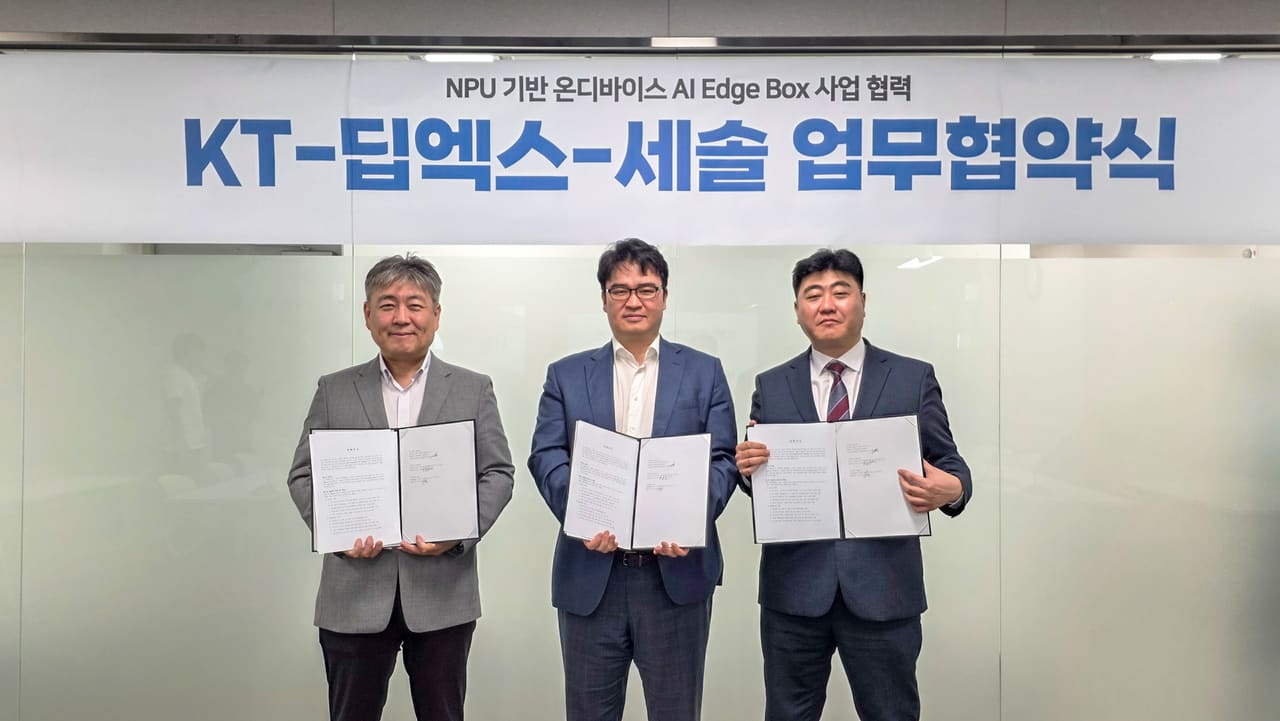
- ·KT has formed a partnership with chipmaker DeepX and edge computing firm Sesol to develop NPU-based AI systems for electric vehicle charging stations, mobile surveillance, and industrial facilities.
- ·The AI Edge Box will use low-power neural processing units to run machine learning workloads locally, reducing latency and keeping sensitive operational data on-premises rather than in the cloud.
- ·Initial deployments will focus on pilot programs within KT's existing infrastructure, with commercial viability depending on whether edge hardware costs are justified by performance and data sovereignty benefits.
A New Edge Computing Play
South Korea's telecommunications incumbent KT announced a partnership with two domestic technology firms to build artificial intelligence systems that process data locally rather than in the cloud. The collaboration brings together KT's network infrastructure, DeepX's neural processing unit chipsets, and Sesol's edge computing platform.
The three companies will co-develop what they are calling an AI Edge Box, designed to run machine learning workloads on-site at electric vehicle charging stations, mobile surveillance deployments, and industrial facilities. According to KT, the system will use low-power, low-heat NPU architecture to enable real-time AI inference without relying on constant connectivity to centralized data centers.
Why NPUs Matter for On-Device Intelligence
Traditional AI deployments in Asia have leaned heavily on cloud infrastructure, routing sensor data to remote servers for analysis before sending instructions back to the field. That round-trip introduces latency, consumes bandwidth, and raises privacy concerns when sensitive operational data leaves the premises.
Neural processing units address these constraints by accelerating matrix operations and tensor calculations directly on edge hardware. DeepX, a Seoul-based semiconductor startup, has focused on designing NPU chips optimized for inference rather than training, prioritizing energy efficiency over raw compute power. This makes them suitable for battery-powered or thermally constrained environments where traditional GPUs would be impractical.
KT's interest in edge AI aligns with broader infrastructure trends across the region. Electric vehicle charging networks are proliferating in South Korea, China, and Southeast Asia, creating demand for intelligent management systems that can balance grid load, predict maintenance needs, and optimize charging schedules in real time. Running those algorithms on-device rather than in the cloud reduces operational costs and improves response times.
Industrial and Surveillance Applications
Beyond EV infrastructure, the partnership targets mobile surveillance systems and industrial sites. Mobile surveillance typically involves camera arrays mounted on vehicles or temporary installations, where reliable connectivity cannot be guaranteed. On-device AI allows these systems to filter relevant events, flag anomalies, and store only actionable footage rather than streaming raw video continuously.
Industrial applications include predictive maintenance, quality control inspection, and safety monitoring. Factories and logistics hubs in Asia are increasingly deploying computer vision and sensor networks, but many remain reluctant to send operational data off-site due to intellectual property and security concerns. Edge AI offers a middle path, keeping data local while still benefiting from machine learning capabilities.
Sesol, the third partner in the agreement, specializes in edge computing platforms that manage distributed deployments. The company's software layer will handle device orchestration, model updates, and data synchronization across fleets of Edge Boxes, a critical function as installations scale from pilot projects to production rollouts.
The Competitive Landscape
KT is not the only telecom operator in Asia pursuing edge AI. SK Telecom and LG Uplus have both announced similar initiatives, often in partnership with domestic chip designers and system integrators. The race reflects a strategic calculation: as connectivity becomes commoditized, operators are seeking differentiation through value-added services that leverage their physical infrastructure and customer relationships.
The choice of NPU-based architecture also positions the partnership against solutions built on GPU or general-purpose processors. NVIDIA dominates the AI accelerator market globally, but its chips are designed primarily for data center workloads and carry price and power profiles that can be prohibitive at the edge. Regional players like DeepX are betting that purpose-built, lower-cost NPUs can capture the long tail of edge deployments where cloud connectivity is intermittent or uneconomical.
What Comes Next
The three companies have not disclosed a commercial launch timeline or pricing structure for the AI Edge Box. KT indicated that initial deployments will focus on pilot programs within its own service portfolio, likely starting with EV charging stations where it already operates infrastructure.
Success will depend on whether the partnership can deliver meaningful cost savings and performance gains over cloud-based alternatives. Edge AI hardware carries upfront capital costs and requires local maintenance, trade-offs that only make sense if latency, bandwidth, or data sovereignty concerns justify the investment. The South Korean market, with its dense urban networks and high EV adoption rates, offers a favorable testing ground. Whether the model scales across the rest of Asia will hinge on how well the technology adapts to less predictable connectivity and more fragmented industrial ecosystems.
RELATED STORIES
Samsung and SK Hynix Turn Down KEPCO's Multibillion-Dollar Prepayment Demand
Cheng Wei-Lun · 4 min
South Korea Taps Three Telecom Giants to Deliver Free AI Services Nationwide
Cheng Wei-Lun · 3 min

South Korea Records Highest September Export Start on Semiconductor Demand
Tran Quoc Bao · 3 min
LG Pivots to AI-Defined Vehicle Platform as Korea Chases China's Self-Driving Lead
Jun-ho Seo · 3 min
Spot something wrong? Email editor@briefasia.com. We log every correction publicly.