Asia · Business
KPJ Healthcare and SingHealth Launch Cross-Border Clinical Alliance
Malaysia's largest private hospital group partners with Singapore's premier academic healthcare cluster to develop talent, advance research, and share specialist expertise across Southeast Asia.
KEY TAKEAWAYS
- ·KPJ Healthcare and SingHealth have signed a memorandum establishing collaboration on clinical research, medical education, healthcare innovation, and simulation training across Malaysia and Singapore.
- ·Initial programs include fellowship placements, specialist attachments, academic exchanges, joint research projects, and co-management of complex clinical cases requiring multidisciplinary expertise.
- ·The partnership positions KPJ to accelerate development of its academic health system while giving SingHealth access to clinical data and patient populations in a neighboring market with rising specialist care demand.
A Regional Healthcare Hub Takes Shape
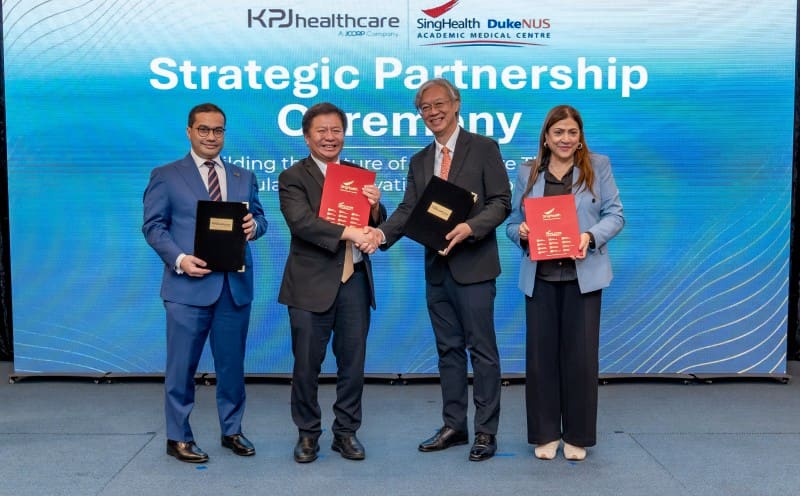
KPJ Healthcare Bhd has formalized a strategic partnership with SingHealth, Singapore's largest healthcare cluster, establishing a framework for collaboration that spans clinical research, medical education, healthcare innovation, and simulation training.
The agreement brings together KPJ's nationwide network of specialist hospitals and Malaysia's first private Academic Health System with an institution that operates across more than 40 clinical and surgical specialties throughout Singapore. SingHealth runs an integrated network that includes acute hospitals, community hospitals, national specialty centers, and polyclinics.
Datuk Dr Hanafiah Harunarashid, KPJ Healthcare's chief medical director, and Prof. London Lucien Ooi, group director of international collaborations at SingHealth and director of the SingHealth Duke-NUS Global Health Institute, exchanged the memorandum of understanding at a ceremony attended by senior executives from both organizations.
Building Cross-Border Capabilities
The partnership is designed to leverage what each institution does well. KPJ brings its extensive hospital footprint across Malaysia and its academic health system infrastructure. SingHealth contributes deep specialist expertise, established research programs, and a track record in medical simulation and training.
Initial programs under the partnership will include fellowship placements, specialist attachments that allow clinicians to work across both systems, academic exchanges, and joint research projects. The organizations plan to co-author scientific publications, organize conferences, develop healthcare leadership programs, and collaborate on managing complex clinical cases that require multidisciplinary input.
Medical simulation, which allows healthcare professionals to practice procedures and decision-making in controlled environments, will be a focus area. Both institutions have invested in simulation facilities, and the partnership aims to share best practices and develop new training protocols.
Why This Matters for Southeast Asian Healthcare
Cross-border healthcare partnerships in Southeast Asia have historically been limited by regulatory differences, varying standards of practice, and institutional inertia. This agreement signals a shift toward regional integration in specialized care and medical education.
For KPJ Healthcare, the collaboration accelerates the development of its academic health system by deepening ties with an institution that has decades of experience integrating clinical practice, education, and research. The company operates one of the largest private hospital networks in Malaysia, and positioning itself as an academic healthcare provider strengthens its competitive position against both domestic rivals and regional players expanding into the Malaysian market.
SingHealth gains a pathway to extend its influence and training models into a neighboring market with a growing middle class and rising demand for specialist care. The partnership also creates opportunities for joint research that draws on patient populations and clinical data from both countries.
Datuk Syed Mohamed Syed Ibrahim, chairman of the KPJ Health System governing council and president and chief executive of Johor Corporation, which holds a significant stake in KPJ Healthcare, emphasized that the partnership is fundamentally about building future capabilities rather than simply formalizing cooperation on paper.
Knowledge Flows and Talent Pipelines
One practical outcome will be the movement of medical professionals between institutions. Fellowship programs allow early-career specialists to train in areas where one institution has particular strength. Specialist attachments give mid-career clinicians exposure to different clinical protocols, patient populations, and healthcare delivery models.
Academic exchanges will likely involve faculty from both institutions teaching, conducting research, and supervising trainees across campuses. This creates knowledge transfer that goes beyond formal training programs and embeds best practices into daily clinical work.
The collaboration on complex cases is particularly significant. Certain conditions, rare surgical procedures, or patients with multiple comorbidities benefit from input across specialties and institutions. Structured collaboration allows clinicians to consult, share imaging and diagnostic data, and coordinate treatment plans without requiring patient transfers.
What Comes Next
The memorandum establishes a framework, but the real test will be execution. Healthcare partnerships often struggle with mismatched incentives, differences in institutional culture, and the practical challenges of coordinating across borders and regulatory systems.
Both organizations have committed resources and senior leadership attention, which increases the likelihood of sustained activity. The initial focus on fellowships, research collaboration, and simulation training offers concrete areas where progress can be measured and results demonstrated relatively quickly.
For the broader Southeast Asian healthcare landscape, the partnership is a signal that leading institutions are thinking regionally rather than nationally. If the collaboration delivers measurable improvements in clinical outcomes, research output, or training quality, it may set a template for similar partnerships across the region.
RELATED STORIES

Singapore Clears 900 MW of Solar Imports from Malaysia
Cheng Wei-Lun · 3 min

ASEAN's Crisis Response Model Under Pressure as Regional Tensions Mount
Siti Nuraini · 3 min

Southeast Asian Workers Embrace AI Tools Faster Than Global Peers
Priyanka V. Rao · 3 min

Singapore Approves 900MW Solar Import From Malaysia as Regional Grid Takes Shape
Priyanka V. Rao · 3 min
Spot something wrong? Email editor@briefasia.com. We log every correction publicly.