Travel & Dining · Trends
Korean Budget Coffee Chains Expand Abroad as Domestic Market Tightens
Ediya and rivals look to Southeast Asia and beyond, leveraging Korean cultural appeal as home market saturation and rising costs squeeze profitability.
KEY TAKEAWAYS
- ·Ediya Coffee opened its first Laos store this month via master franchise, part of a wave of Korean coffee chain launches abroad within days of each other.
- ·Domestic market saturation, rising arabica bean prices, and Korean won weakness are compressing margins and limiting growth at home for budget chains.
- ·Chains are leveraging Korean cultural identity as a market entry advantage in Southeast Asia, where interest in Korean food and lifestyle continues to climb.
Expansion Wave Picks Up Pace
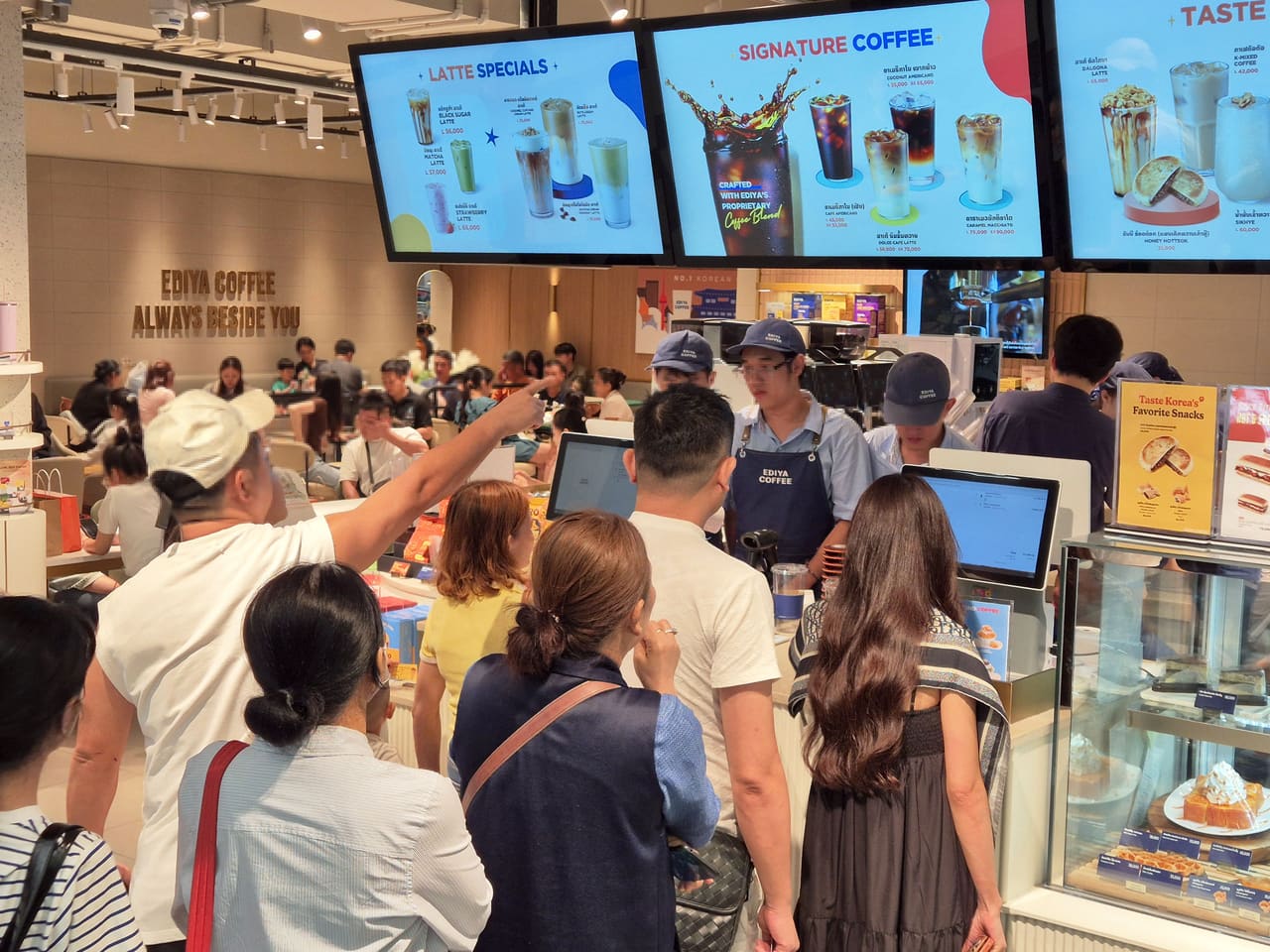
South Korea's low-cost coffee chains are accelerating their push into foreign markets as conditions at home grow more challenging. Ediya Coffee opened its first location in Laos this month through a master franchise agreement, marking the latest in a rapid succession of international store launches that have come within days of each other.
The timing reflects a strategic pivot. Domestic saturation has left little room for growth in South Korea's already crowded coffee market, where chains compete block by block in dense urban centers. At the same time, rising arabica bean prices and unfavorable currency movements are compressing margins, making the economics of each new domestic store less attractive.
Korean Identity as Market Entry
The chains are framing their overseas expansion around Korean cultural identity rather than competing solely on price. Interest in Korean food, entertainment, and lifestyle has climbed across Southeast Asia and other regions, creating a receptive audience for brands that position themselves as part of that broader cultural export.
Ediya, which operates more than 3,000 stores in South Korea, has structured its Laos entry through a master franchise model that transfers operational responsibility to a local partner while maintaining brand standards. This approach allows the chain to scale quickly without direct capital expenditure on each location.
Other Korean budget coffee operators are following similar paths. The flurry of openings this month, each spaced a day apart, suggests coordinated expansion strategies designed to build momentum and signal market presence to both consumers and potential franchise partners.
Economic Pressure at Home
The shift abroad comes as economic fundamentals in the domestic market deteriorate. Arabica coffee futures have climbed steadily over the past year, driven by weather disruptions in key growing regions and tightening global supply. For chains built on thin margins and high volume, even modest increases in input costs can erode profitability quickly.
Currency pressure adds another layer of difficulty. The Korean won has weakened against major currencies, making imported beans more expensive in local terms. Budget chains, which rely on aggressive pricing to maintain foot traffic, have limited ability to pass these costs on to consumers without losing their core value proposition.
Domestic market saturation compounds the problem. Seoul and other major cities already have multiple coffee shops per block, many operating under franchise agreements with established chains. Opening new stores in these markets risks cannibalizing existing locations rather than generating incremental revenue.
Franchise Model as Growth Engine
The master franchise structure that Ediya used in Laos has become the preferred vehicle for international expansion among Korean coffee chains. Under this model, a local partner acquires the rights to develop the brand within a specific territory, handling site selection, staffing, and day-to-day operations.
For the Korean parent company, this structure minimizes financial risk and allows rapid scaling without the overhead of managing foreign operations directly. The local partner assumes most of the capital burden and operational complexity, while the parent collects franchise fees and royalties.
The trade-off is less control over execution. Quality, service, and brand consistency depend on the local partner's capabilities and commitment. Chains that expand this way must balance the speed and capital efficiency of franchising against the risk of diluting brand standards in markets where they have limited oversight.
Southeast Asia in Focus
Southeast Asia has emerged as the primary target for Korean coffee chains looking to grow abroad. The region offers a combination of rising incomes, urbanization, and cultural familiarity with Korean brands that makes it an attractive market for affordable coffee concepts.
Laos, where Ediya launched its first store, represents a relatively early-stage market compared to more developed neighbors like Thailand and Vietnam. Entering now allows the chain to establish brand presence before competition intensifies, though it also means navigating less mature retail infrastructure and consumer habits still forming around coffee consumption.
Other Korean chains are pursuing similar regional strategies, targeting cities across Southeast Asia where Korean cultural influence is visible in entertainment, fashion, and food. The concentration of openings in a short time frame suggests that operators see a window of opportunity before the market becomes as crowded as it is at home.
What Comes Next
The success of this international push will depend on whether Korean coffee chains can translate their domestic formula to markets with different competitive dynamics and consumer expectations. Affordability alone may not be enough if local competitors can match prices or if consumers prioritize other attributes like ambiance, convenience, or product variety.
Currency risk also travels with the business. Chains that source beans internationally will face the same input cost volatility abroad that they do at home, while revenue in local currencies introduces new exposure to exchange rate fluctuations.
The rapid pace of expansion this month signals confidence among Korean operators that their brand identity carries weight beyond price. Whether that confidence is justified will become clear as these new locations mature and operators assess whether the economics abroad prove more favorable than the saturated, margin-squeezed market they are leaving behind.
RELATED STORIES
South Korea Records Biggest Tourism Surplus in Nearly Two Decades
Cheng Wei-Lun · 3 min

Jollibee Brings Compose Coffee to Manila With Five-Year Expansion Plan
Priyanka V. Rao · 3 min

Korea Zinc Eyes US Market as Washington Commits $3 Billion to Critical Minerals
Cheng Wei-Lun · 3 min

Korean Builders Race to Secure Power Equipment for AI Data Centers
Jun-ho Seo · 3 min
Spot something wrong? Email editor@briefasia.com. We log every correction publicly.