Asia · Business
Korea Aerospace Industries Delivers Final Six T-50i Jets to Indonesia
The completion of a 2021 contract brings Indonesia's total fleet of South Korean advanced trainers to 22 aircraft, cementing a defense partnership that began over a decade ago.
KEY TAKEAWAYS
- ·Korea Aerospace Industries completed delivery of six T-50i advanced trainer jets to Indonesia under a 2021 contract, expanding the country's fleet to 22 aircraft.
- ·Indonesia became the first export customer for the T-50i in 2011 with an order for 16 jets, establishing a defense partnership now over a decade old.
- ·The deliveries reflect South Korea's growing defense export footprint in Southeast Asia, where air forces are modernizing amid regional security concerns.
Delivery Milestone for Regional Defense Partnership
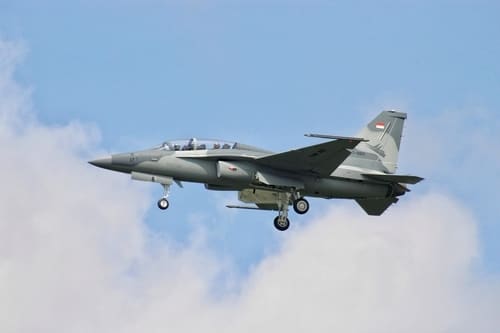
Korea Aerospace Industries completed delivery of six T-50i advanced trainer jets to the Indonesian Air Force this week, fulfilling a contract signed in 2021. The company announced Thursday that the final aircraft from that order arrived in February, marking another chapter in a defense relationship that stretches back more than a decade.
Indonesia now operates 22 T-50i aircraft in total. The country became the first international buyer of the T-50i platform in 2011, when it ordered 16 units. That initial deal established Indonesia as the launch export customer for South Korea's domestically developed supersonic trainer.
The T-50i represents the export variant of South Korea's T-50 Golden Eagle, a supersonic advanced jet trainer and light attack aircraft. KAI developed the platform with technical support from Lockheed Martin in the early 2000s, positioning it as a cost-effective alternative to Western trainers for air forces transitioning pilots to fourth-generation fighters.
Building on a Decade of Cooperation
The 2021 contract extended an existing supply relationship between KAI and Jakarta. Deliveries under that agreement began in February of this year, according to the company's statement. The six additional aircraft augment the 16 jets delivered under the original 2011 framework, giving Indonesia's air force a substantial fleet of advanced trainers capable of both pilot instruction and light combat roles.
Indonesia's acquisition of the T-50i aligns with broader modernization efforts across Southeast Asian air forces. The country operates a mix of fighter types, including Russian-made Sukhoi Su-27 and Su-30 variants, American F-16s, and more recently, French Rafale fighters. Advanced trainers like the T-50i provide a bridge between basic flight instruction and operational conversion to frontline combat aircraft.
South Korea's defense industry has pursued export growth aggressively over the past decade, with KAI at the forefront of international campaigns. The company has pitched the T-50 family to air forces in the Philippines, Thailand, and Poland, among others. Poland ordered 48 FA-50 light attack variants in 2022, a deal valued at approximately $3 billion, representing one of the largest export contracts in South Korean defense history.
Regional Context and Strategic Implications
The completion of this delivery occurs against a backdrop of heightened defense spending across Asia. Regional tensions in the South China Sea, Taiwan Strait, and Korean Peninsula have driven procurement budgets upward. Indonesia, an archipelagic nation with vast territorial waters, faces persistent challenges in maintaining air and maritime domain awareness.
Advanced trainers serve dual purposes in many air forces. Beyond pilot training, aircraft like the T-50i can conduct air policing, border patrol, and close air support missions at a fraction of the operating cost of frontline fighters. For Indonesia, which must patrol airspace spanning thousands of islands, this operational flexibility carries strategic value.
KAI's success in Indonesia also reflects South Korea's broader strategy of cultivating defense partnerships in Southeast Asia. Seoul has positioned itself as a supplier of capable, affordable platforms that come without the geopolitical strings sometimes attached to sales from larger arms exporters. The T-50i deal predates more recent high-profile contracts, including Indonesia's purchase of South Korean KF-21 fighter development stakes and commitments to acquire additional fighter aircraft.
The Indonesian Air Force has not publicly disclosed plans for further T-50i acquisitions, but the platform's operational track record over the past decade provides a foundation for potential follow-on orders. With 22 aircraft now in service, Indonesia operates one of the largest T-50 fleets outside South Korea itself.
For KAI, the steady fulfillment of contracts in Southeast Asia bolsters its credentials as a reliable defense partner. The company continues to compete for trainer and light attack aircraft contracts globally, leveraging its experience in Indonesia and Poland to pursue opportunities in the Middle East, Latin America, and Eastern Europe. The T-50 family remains a cornerstone of KAI's export portfolio as the firm expands production of more advanced platforms, including the KF-21 next-generation fighter being developed with Indonesian participation.
RELATED STORIES
South Korea Breaks Full-Year Export Record in September
Tran Quoc Bao · 3 min

SK Chemicals Targets Europe's Can-Coating Shift After BPA Ban
Cheng Wei-Lun · 2 min
SK Hynix Union Rejects Wage Deal in Razor-Thin Vote
Cheng Wei-Lun · 3 min
Hyundai Motor Faces First Full-Day Strike in a Decade as Wage Talks Stall
Jun-ho Seo · 2 min
Spot something wrong? Email editor@briefasia.com. We log every correction publicly.