Technology · Dev
Japan Builds Lunar Launch Independence with ispace H3 Mission
Tokyo's push to establish domestic lunar transportation infrastructure takes shape as private operator schedules 2028 launch on homegrown rocket
KEY TAKEAWAYS
- ·ispace will launch its next lunar mission in 2028 on Japan's H3 rocket, shifting from previous reliance on SpaceX's Falcon 9.
- ·The move aligns with Tokyo's policy to build domestic lunar transportation infrastructure and reduce dependence on foreign launch providers.
- ·Japan's strategy mirrors U.S. and Chinese approaches linking national space goals to homegrown industrial capacity as Asia's lunar competition intensifies.
Domestic Launch Strategy
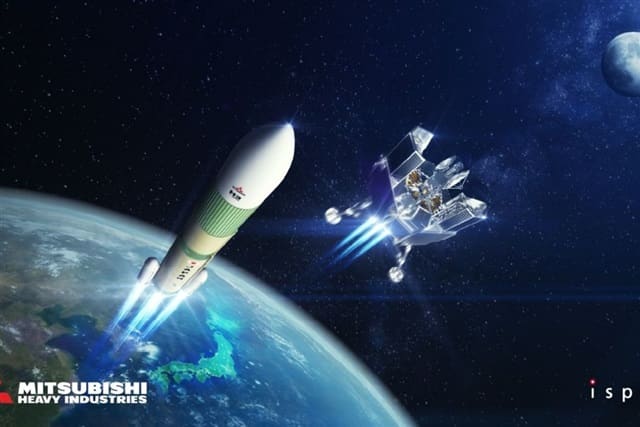
ispace has selected Japan's H3 rocket to carry its next lunar mission in 2028, marking a deliberate shift toward domestic launch infrastructure as the country seeks to reduce dependence on foreign transportation services for its expanding Moon economy ambitions.
The Tokyo-based lunar logistics company's decision represents more than a simple vendor change. It signals alignment between Japan's government space policy and commercial operators around establishing a vertically integrated lunar supply chain rooted in Japanese technology and manufacturing.
The H3, developed by JAXA and Mitsubishi Heavy Industries, completed its first successful flight in February 2024 after an initial setback. The rocket is designed to carry payloads up to six metric tons to geostationary transfer orbit, with capability to support lunar trajectories through extended upper-stage burns.
Building an Integrated Stack
Japan's approach mirrors strategies adopted by the United States and China, both of which have tied national space ambitions to domestic industrial bases. Tokyo views lunar transportation not as an isolated capability but as a critical node in a broader cislunar economy that includes resource prospecting, communications infrastructure, and eventual surface operations.
ispace previously relied on SpaceX's Falcon 9 for its inaugural Hakuto-R Mission 1 in December 2022, which ended in a hard landing on the lunar surface in April 2023. The company's second mission, also contracted to launch on a Falcon 9, is scheduled for later this year.
The transition to H3 for the 2028 flight reflects both maturation of Japan's heavy-lift rocket program and a policy preference for keeping mission-critical capabilities within national control. The Japanese government has publicly stated its intention to support commercial lunar activities through procurement contracts and infrastructure investment, provided operators utilize domestic launch and manufacturing capacity where feasible.
Regional Competition and Capacity
The move comes as Asia's spacefaring nations accelerate their lunar programs. China has announced plans for a robotic research station at the Moon's south pole by 2030, while India's Chandrayaan-3 mission successfully landed near the lunar south pole in August 2023. South Korea launched its first lunar orbiter, Danuri, in 2022.
ispace operates within this competitive landscape as a private entity aiming to offer lunar surface delivery services to government and commercial customers. The company is developing a series of progressively capable landers designed to carry payloads ranging from tens to hundreds of kilograms.
By committing to H3, ispace gains access to a launch system that Japan intends to operate with high cadence. JAXA has projected annual launch rates that could support multiple lunar missions as demand from both government science programs and commercial operators grows.
Long-Term Infrastructure Play
The partnership between ispace and Japan's state-backed rocket program underscores a broader strategy: building the ground infrastructure, manufacturing expertise, and operational experience necessary to support sustained lunar activity without relying on foreign launch providers.
This approach carries risks. The H3 program is still early in its operational life, and launch reliability remains to be demonstrated over multiple flights. However, Japan's calculus appears to prioritize strategic autonomy and domestic industrial development over short-term cost optimization.
Other Japanese space companies are watching closely. If ispace's 2028 mission succeeds, it could establish a template for how commercial lunar operators and national launch programs collaborate to create a self-sufficient lunar transportation ecosystem anchored in Japanese technology.
RELATED STORIES

Fujifilm Commits $83 Million to Semiconductor Materials Plant in India
Siti Nuraini · 3 min

Fujitsu to Exit Commodity Hardware as AI Shifts Production Strategy
Aiko Nakamura · 4 min

Minebea Mitsumi Halts Acquisitions to Prioritise AI Component Demand
Cheng Wei-Lun · 3 min

Kioxia Rules Out SK Hynix Merger, Focuses on Stabilising Memory Chip Prices
Tran Quoc Bao · 3 min
Spot something wrong? Email editor@briefasia.com. We log every correction publicly.