Asia · Business
Indonesia's Consumer Giants Face Profit Squeeze From Currency Slide
First-half results reveal how dollar-denominated debt and import dependency are compounding margin erosion as the rupiah hits historic lows
KEY TAKEAWAYS
- ·Indonesia's consumer companies reported stable revenue but shrinking net income in the first half of 2026 as the rupiah's decline drove up dollar-denominated debt costs and import expenses.
- ·The rupiah hit record lows in July after accelerating its slide in Q2, with S&P Global Ratings warning importers will face intensified margin pressure in the second half.
- ·Weak domestic consumer spending and volatile commodity prices are limiting companies' ability to raise prices, forcing them to absorb cost increases or risk losing market share.
Currency Headwinds Hit Profitability
Indonesia's consumer sector is grappling with a profitability crisis that has little to do with top-line performance. While revenue figures remained stable across the first six months of the year, net income took a beating as the rupiah's decline translated directly into higher costs for companies dependent on dollar-denominated borrowing and imported inputs.
The currency's slide accelerated sharply in the second quarter and reached all-time lows in July, creating a cascading effect across balance sheets. Companies that had locked in dollar debt to finance expansion now face ballooning interest expenses when converted back to rupiah terms. At the same time, manufacturers reliant on imported ingredients, packaging materials, and intermediate goods are paying more for the same volume of inputs.
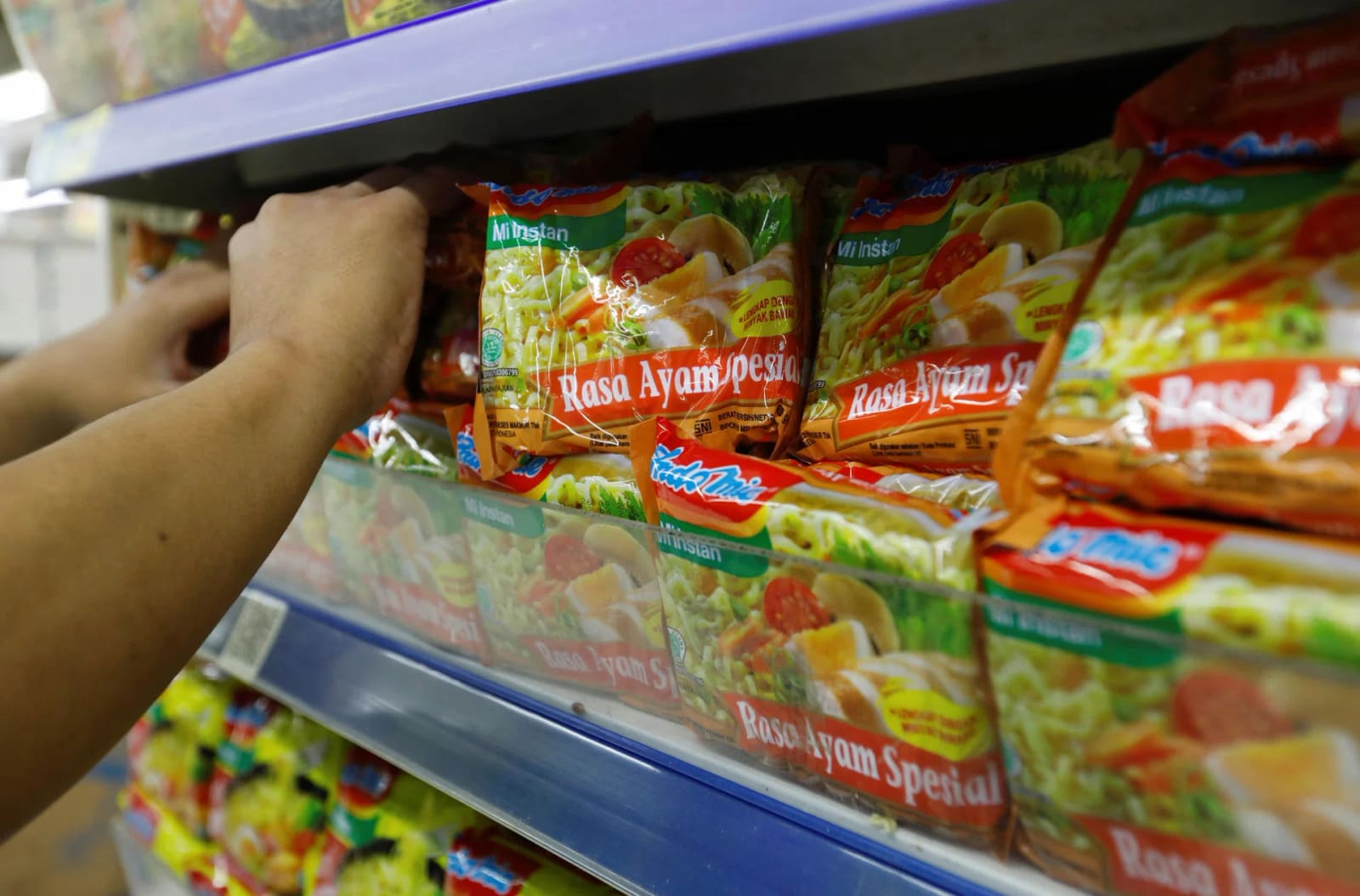
Indofood Sukses Makmur, the conglomerate behind Indomie noodle maker Indofood CBP Sukses Makmur, exemplifies the challenge. Despite steady consumer demand for its staple products, the parent company's earnings came under pressure from foreign exchange losses and the rising cost of wheat, palm oil, and other commodities priced in dollars.
The dynamic underscores a structural vulnerability in Indonesia's consumer industry. Many of the country's largest food, beverage, and household goods manufacturers expanded aggressively over the past decade using dollar funding, betting on stable or appreciating rupiah conditions. That calculus has reversed.
Import Dependency Amplifies Risk
Indonesia's consumer sector has long relied on overseas suppliers for critical raw materials. Wheat for instant noodles, milk powder for dairy products, synthetic fibers for garments, and specialty chemicals for personal care goods all flow in through Jakarta's ports, invoiced in dollars.
When the rupiah weakens, the landed cost of these inputs rises even if global commodity prices hold steady. For companies operating on thin margins in a price-sensitive market, that squeeze can be difficult to pass on to consumers without risking volume loss.
The situation is compounded by volatile commodity markets. Global wheat prices have swung on weather disruptions and export restrictions, while palm oil, a key input for cooking oil and packaged foods, has seen sharp moves tied to Indonesian export policy and Malaysian supply dynamics. Currency depreciation layers additional uncertainty on top of these baseline swings.
According to S&P Global Ratings, importers are now facing a dual margin compression. Ng Yijing, corporate ratings director at the firm, noted that the rupiah's accelerated decline in the second quarter has set the stage for even tighter conditions in the latter half of the year. Companies that managed to hedge some exposure in early 2026 are now seeing those contracts roll off, leaving them more exposed to spot rates.
Weak Domestic Demand Limits Pricing Power
Ordinarily, companies facing input cost inflation would raise prices to defend margins. But Indonesia's consumer spending environment has been fragile, limiting the ability to push through increases without triggering volume declines.
Household purchasing power has been constrained by elevated food inflation, modest wage growth, and uneven post-pandemic recovery across income segments. Middle-class consumers, a core demographic for packaged goods and discretionary categories, have become more price-conscious and willing to trade down to cheaper alternatives or reduce purchase frequency.
This leaves manufacturers in a bind. Raising prices risks losing market share to smaller local competitors or private-label products. Holding prices steady means absorbing cost increases and accepting lower operating margins. Many companies have opted for a middle path, implementing selective, staggered price adjustments while cutting costs elsewhere, including marketing spend and promotional activity.
The result has been a sector-wide margin contraction that is likely to persist. Analysts expect the second half to bring continued pressure as the full impact of the rupiah's July lows works through supply chains and as companies refinance maturing dollar debt at higher effective rates.
Dollar Debt Refinancing Looms
A significant portion of Indonesia's consumer sector debt is denominated in dollars, a legacy of years when offshore borrowing offered lower interest rates than domestic rupiah loans. As these facilities come up for renewal, companies face a double hit: higher global interest rates and a weaker currency that inflates the rupiah-equivalent of each dollar borrowed.
For companies with strong cash flow and diversified revenue streams, this is manageable. But smaller players and those with stretched balance sheets may find refinancing difficult, particularly if lenders grow cautious about Indonesia's consumer sector outlook. Credit conditions have already tightened, and any further rupiah weakness could prompt rating agencies to review outlooks or downgrade credits.
The rupiah's trajectory will depend on a mix of domestic monetary policy, global dollar strength, and investor sentiment toward emerging Asian markets. The central bank has intervened periodically to smooth volatility, but it faces limits given the need to preserve foreign exchange reserves and avoid undermining export competitiveness.
Outlook Hinges on Currency Stability
The path forward for Indonesia's consumer companies hinges largely on whether the rupiah can stabilize. A sustained recovery in the currency would ease both financing and input cost pressures, giving companies room to rebuild margins. Conversely, further depreciation would deepen the profitability squeeze and potentially force more aggressive cost-cutting or restructuring.
Sector fundamentals remain intact. Indonesia's population of over 270 million, rising urbanization, and long-term consumption growth trends have not changed. But the near-term picture is clouded by currency volatility, commodity price swings, and tepid household spending.
Investors and analysts will be watching second-half earnings closely for signs of stabilization or further deterioration. Companies that have hedged currency exposure, diversified supply chains, or built pricing power through strong brands may weather the storm better than peers. For the sector as a whole, however, the next six months are likely to test resilience and management's ability to navigate a challenging macro environment without sacrificing long-term market position.
RELATED STORIES

Destry Damayanti Emerges as Top Candidate for Bank Indonesia Governor
Priyanka V. Rao · 3 min

Indonesia's Rupiah Defense Drains Reserves as Central Bank Rethinks Strategy
Siti Nuraini · 2 min

Indonesia's Finance Ministry to Take Control of Loss-Making Whoosh Railway
Siti Nuraini · 2 min

Brazil's JBS Commits $2.5 Billion to Indonesia Protein Venture With Danantara
Priyanka V. Rao · 5 min
Spot something wrong? Email editor@briefasia.com. We log every correction publicly.