Technology · Products
Hyundai Prepares European Subcompact EV Push With Turkey Plant Inspection
Executive Chair Chung Eui-sun reviewed Ioniq 3 production lines and battery assembly operations at the Izmit facility as the automaker targets affordable electric mobility in Europe
KEY TAKEAWAYS
- ·Hyundai Motor Group's Executive Chair Chung Eui-sun inspected the Izmit, Turkey plant on July 30 to review Ioniq 3 production and battery assembly readiness.
- ·The Ioniq 3 is Hyundai's first subcompact electric vehicle designed for Europe, targeting the cost-sensitive segment amid tightening emissions regulations.
- ·Turkey's proximity to European markets and customs union status offer Hyundai logistical and tariff advantages over Chinese EV competitors.
Manufacturing Readiness Under Scrutiny
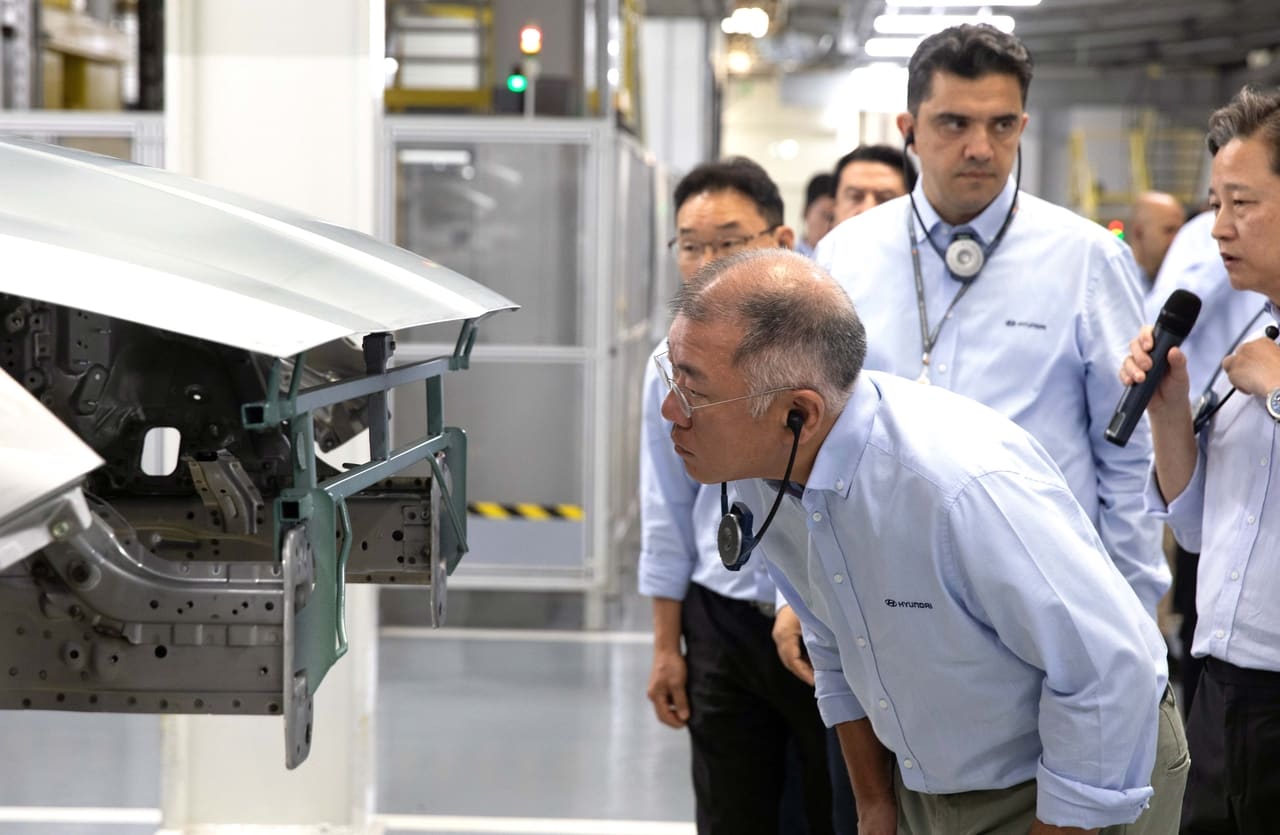
Hyundai Motor Group's top executive spent July 30 walking the production floor at the company's Izmit plant near Istanbul, examining each stage of assembly for the Ioniq 3, the automaker's inaugural subcompact battery-electric model aimed squarely at European buyers. Executive Chair Chung Eui-sun's visit focused on production preparedness and quality protocols, according to Hyundai Motor Group, as the company gears up to deliver its smallest electric vehicle yet to a market increasingly shaped by emissions regulations and urban mobility demands.
The inspection tour covered the full manufacturing sequence, from body panel welding through final vehicle assembly. Chung also reviewed operations at Hyundai Mobis' adjacent Battery System Assembly facility, underscoring the integrated supply chain Hyundai has built in Turkey to support electric vehicle production close to its European customer base.
Strategic Bet on Affordable Electric Mobility
The Ioniq 3 represents Hyundai's attempt to capture a segment of the European market that legacy automakers and Chinese rivals are both eyeing: buyers seeking electric vehicles at accessible price points. Europe's regulatory environment, including tightening CO2 fleet targets and expanding low-emission zones in major cities, has made subcompact EVs a priority category. Yet profitability in this segment remains elusive for many manufacturers, given battery costs and consumer price sensitivity.
Hyundai's decision to manufacture the Ioniq 3 in Turkey rather than South Korea or Southeast Asia reflects both cost considerations and logistics. The Izmit plant sits roughly 100 kilometers from Istanbul, placing it within shipping distance of major European markets while benefiting from Turkey's customs union with the European Union. That positioning helps Hyundai avoid some of the tariff and import friction that Chinese EV makers face when exporting to Europe, a competitive advantage as Brussels weighs further trade measures on battery-electric imports.
The automaker has not disclosed pricing for the Ioniq 3, but industry observers expect it to slot below the Ioniq 5 and Ioniq 6, both of which target mid-market buyers. Subcompact electric vehicles in Europe typically compete in the €25,000 to €35,000 range, a bracket where Renault's Zoe, Volkswagen's ID.2 concept, and several Chinese models are jostling for share. Hyundai's ability to deliver competitive range, charging speed, and interior quality at that price point will determine whether the Ioniq 3 gains traction or joins the ranks of slow-selling electrics.
Turkey as a Regional Production Hub
Hyundai's investment in the Izmit facility dates back to the late 1990s, but the site has taken on renewed importance as the company electrifies its lineup. By co-locating battery assembly with vehicle production, Hyundai reduces logistics costs and shortens lead times, critical factors when managing expensive battery inventory. Hyundai Mobis, the group's parts and components arm, operates the battery assembly line at the same site, integrating cell modules into complete packs ready for installation.
The Turkey plant also assembles internal combustion models, but the addition of the Ioniq 3 signals a shift toward electric output. European demand for small EVs is expected to grow as governments phase out fossil-fuel vehicle sales over the next decade, with several countries targeting 2030 or 2035 deadlines. Hyundai's early positioning in this segment could yield first-mover advantages, particularly if competitors remain focused on higher-margin crossovers and sedans.
Yet the Turkey site is not without risk. The country's currency volatility and inflation have posed challenges for manufacturers, and Hyundai will need to manage input costs carefully to maintain margin targets. Additionally, European buyers have shown wariness toward unfamiliar brands in the subcompact EV space, favoring established nameplates or Chinese entrants offering aggressive pricing. Hyundai's brand equity in Europe is solid but not dominant, meaning the Ioniq 3 will need strong reviews and word-of-mouth to build momentum.
Competitive Landscape and Market Timing
The timing of Chung's inspection visit suggests an imminent production ramp. Automakers typically conduct senior leadership reviews in the weeks before serial production begins, using the opportunity to identify bottlenecks and ensure quality standards are met. If Hyundai follows that pattern, the Ioniq 3 could reach European showrooms by late 2026 or early 2027, positioning it to capture year-end sales and benefit from any incentive programs tied to calendar-year budgets.
Hyundai faces a crowded field. Volkswagen is developing the ID.2, a subcompact electric hatchback expected to launch around the same timeframe. Renault has refreshed its Zoe and is working on next-generation small EVs. Chinese manufacturers, including BYD and Geely, are expanding European distribution networks and have shown willingness to undercut established players on price. Hyundai's challenge is to differentiate on build quality, after-sales service, and technology features without inflating the sticker price beyond what budget-conscious buyers will accept.
The company's E-GMP platform, which underpins the Ioniq 5 and Ioniq 6, is not used for the Ioniq 3. Instead, Hyundai is believed to have developed a smaller, cost-optimized architecture for this segment, balancing range and performance with affordability. Details on battery capacity, motor output, and charging capability have not been released, but industry norms for subcompact EVs suggest a 40 to 60 kilowatt-hour pack and a range of 300 to 400 kilometers on the WLTP cycle.
Implications for Hyundai's European Strategy
The Ioniq 3 is more than a single model launch; it is a test of Hyundai's ability to compete across the full spectrum of electric vehicle segments in Europe. The company has found success with the Ioniq 5, which appeals to tech-forward buyers and design enthusiasts, but the subcompact category requires a different playbook. Cost discipline, volume production, and dealer network density matter more than cutting-edge styling or luxury features.
Hyundai's partnership with Mobis on battery assembly also points to a broader strategy of vertical integration. As battery costs remain the largest single expense in EV production, controlling more of the supply chain can improve margins and reduce exposure to supplier pricing power. Other automakers are pursuing similar strategies, but Hyundai's early investments in Turkey give it a foothold in a region that bridges Asia and Europe.
The success or failure of the Ioniq 3 will influence how Hyundai allocates capital over the next five years. A strong reception could justify further investment in the Izmit plant and additional subcompact models. A lukewarm response might push the company to focus resources on higher-margin segments, leaving the affordable EV space to Chinese competitors. For now, Chung's decision to personally review production readiness signals that Hyundai is treating this launch as a strategic priority, not a side bet.
RELATED STORIES

Hyosung Heavy Gains Ground in US Power Grid Market With Early Manufacturing Push
Jun-ho Seo · 4 min
Samsung and SK Hynix Turn Down KEPCO's Multibillion-Dollar Prepayment Demand
Cheng Wei-Lun · 4 min

South Korea Records Highest September Export Start on Semiconductor Demand
Tran Quoc Bao · 3 min
LG Pivots to AI-Defined Vehicle Platform as Korea Chases China's Self-Driving Lead
Jun-ho Seo · 3 min
Spot something wrong? Email editor@briefasia.com. We log every correction publicly.