Asia · Business
Google's $15 Billion India Data Hub Faces Rising Local Resistance
Water scarcity fears and wildlife sanctuary proximity spark legal challenges and street protests in Visakhapatnam as construction advances on tech giant's largest India investment
KEY TAKEAWAYS
- ·Google's $15 billion data center project in Visakhapatnam faces multiple legal challenges over water supply impact and proximity to a wildlife sanctuary 860 meters away.
- ·Visakhapatnam faces a 70-million-liter daily water deficit, prompting activists to argue that data center cooling demands will worsen rationing for 2.5 million residents.
- ·Andhra Pradesh High Court will hear a public interest petition on August 24 challenging the project's approval process and water resource allocation.
Construction Advances Amid Growing Opposition
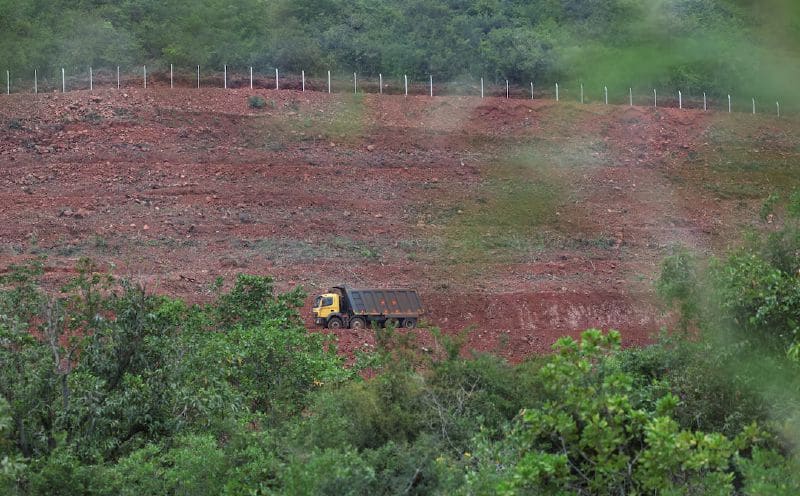
Heavy machinery carves terraces into a hillside above Visakhapatnam, transforming the landscape for what Google envisions as its largest Indian data center hub. Yet as earthmovers continue reshaping the terrain, a different kind of resistance is building below.
The $15 billion project, announced as a cornerstone investment in Andhra Pradesh, now confronts legal challenges and street-level activism centered on two core concerns: the strain on an already stretched municipal water system and potential disruption to wildlife habitat less than a kilometer away.
Andhra Pradesh officials have defended the approval process, but the state's High Court agreed Monday to hear allegations from activist group Jal Biradari that the development will deplete water from a nearby reservoir serving residential needs. The next hearing is scheduled for August 24.
Water Rationing in a City of 2.5 Million
Visakhapatnam receives 410 million liters of water daily from reservoirs and rivers, according to government figures. Daily demand stands at 480 million liters. The 70-million-liter shortfall means rationing is routine for the city's 2.5 million residents.
Activists argue that introducing industrial-scale data center cooling loads into this equation will deepen existing scarcity. Recent demonstrations in the city featured children carrying signs reading "We cannot drink DATA" and posters depicting handcuffs superimposed on corporate branding.
Raja Rama Mohan Roy, founder of non-profit Green Visakha, presented water supply statistics at a public gathering Sunday that drew dozens of residents. The group is organizing door-to-door awareness campaigns and beach protests in coming days. "Development should not be at the cost of livelihood of the people," Roy said at the event.
The state government maintains that no water designated for rural or residential use will be diverted to the data centers, and the nearby reservoir will remain untapped. Officials called activist claims "incorrect and misleading" but indicated openness to dialogue if concerns prove legitimate.
Google stated it will deploy advanced air cooling technology to minimize water consumption and ensure compliance with applicable laws. The company is partnering with the Adani Group, controlled by billionaire Gautam Adani, to construct the facility. The project is projected to generate up to 188,000 jobs.
Wildlife Sanctuary 860 Meters Away
A separate line of legal challenge targets the project's proximity to Kambalakonda Wildlife Sanctuary, home to leopards and pangolins. The sanctuary boundary sits 860 meters from the construction site. Petitions argue that heavy construction activity and operational noise could disturb protected species.
State officials responded that the distance exceeds legal minimum setback requirements. Google committed to implementing sound-dampening measures to function as "a quiet, unobtrusive neighbour."
Three additional cases filed at India's National Green Tribunal by the Human Rights Forum seek a halt to construction. Court documents show these petitions allege the state approved the project without adequately assessing the impact of drawing supply from a rural drinking water scheme.
The state has promised "guaranteed" water supplies to the project for 20 years, a commitment activists view as incompatible with existing shortages.
Regional Context for Data Center Scrutiny
The Visakhapatnam pushback mirrors a broader pattern across Asia and beyond as hyperscale data center construction accelerates. Rapid buildouts to support cloud computing and artificial intelligence workloads require vast quantities of electricity and water for server cooling, straining infrastructure in regions where both resources face constraints.
In the United States, opponents staged 142 protests across 42 states in July alone, citing similar water and energy concerns. India's developing infrastructure and existing resource stress make the trade-offs more acute.
Prime Minister Narendra Modi has publicly hailed the Google-Adani project as transformational for Andhra Pradesh, which is governed by an ally of his administration. The political backing underscores the investment's strategic importance, yet also raises the stakes for how authorities navigate local opposition.
Construction activity observed Monday showed work proceeding at pace, with exposed red earth and ongoing grading operations across the hillside site. Whether legal challenges or sustained civic pressure will slow or reshape the project remains an open question as court dates approach and activists prepare additional public actions.
RELATED STORIES
Google's $15 Billion India Data Center Sparks Water Crisis Fears
Priyanka V. Rao · 3 min
India Extends Tax Certainty for Electronics Suppliers, Eases Data Center Approvals
Priyanka V. Rao · 3 min

India Commits $5 Billion to Border Railway Network Expansion
Priyanka V. Rao · 3 min

Japan Prepares Diplomatic Push to Help Companies Enter Indian Market
Cheng Wei-Lun · 2 min
Spot something wrong? Email editor@briefasia.com. We log every correction publicly.