Finance · Deals
Fujian Wanchen Food Group Leads Fortune China 500 in Return on Equity
The parent company of Haoxianglai discount snack stores reported an 88% ROE, outpacing consumer darling Pop Mart by 32 percentage points
KEY TAKEAWAYS
- ·Fujian Wanchen Food Group topped Fortune's China 500 ranking with an 88% return on equity, outperforming Pop Mart's 56%.
- ·The company operates Haoxianglai, a discount snack chain that leverages low overhead and high inventory turnover to generate exceptional profitability.
- ·Sustaining such returns will depend on whether Wanchen can scale while maintaining operational discipline in an increasingly competitive value retail sector.
An Unlikely Leader
Fujian Wanchen Food Group claimed the top spot in Fortune's China 500 ranking by return on equity this year, a metric that measures how effectively a company converts shareholder capital into profit. The Fujian-based food retailer posted an 88% ROE, according to Fortune's data, placing it well ahead of Pop Mart, the collectible toy maker that landed second at 56%.
For every renminbi of shareholder equity, Wanchen generated 0.88 yuan in annual profit. The performance signals operational efficiency in a segment of China's consumer market that has seen intense competition and margin pressure.
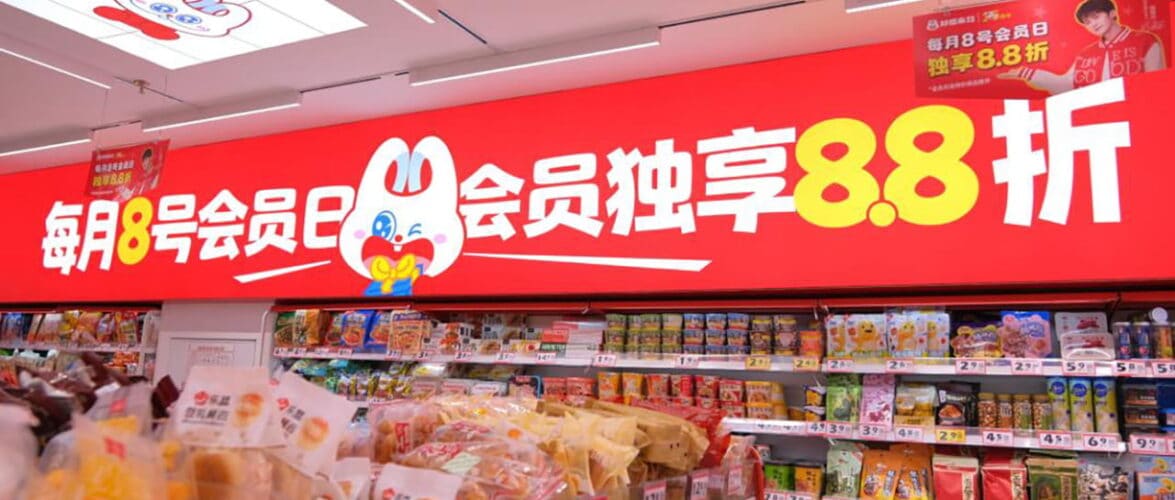
While Wanchen remains relatively unknown outside industry circles, its Haoxianglai chain has become a familiar presence across Chinese cities. The discount snack stores stock packaged foods, beverages, and impulse-buy items at price points that appeal to budget-conscious shoppers.
The Discount Retail Play
Haoxianglai operates on a model that keeps overhead low and inventory turnover high. Stores are typically compact, located in high-foot-traffic areas, and staffed leanly. Product selection skews toward branded snacks and beverages available at discounts, alongside private-label offerings that carry higher margins.
The chain has expanded rapidly in recent years as Chinese consumers, squeezed by a slowing economy and weakening job market, have gravitated toward value-oriented retail formats. Discount grocery and snack chains have proliferated across tier-two and tier-three cities, where rent is lower and competition from premium supermarkets less intense.
Wanchen's ability to extract such high returns from its equity base suggests tight working capital management and a franchise or asset-light expansion strategy. Companies with high ROE often operate with minimal fixed assets, relying instead on supplier credit terms and rapid cash conversion cycles.
Context in the China 500
Pop Mart's second-place finish at 56% ROE reflects the strength of its blind-box business model, which commands premium pricing and benefits from low manufacturing costs. However, Wanchen's lead underscores a broader shift in China's consumer landscape, where value retail is gaining ground against aspirational spending.
The Fortune China 500 list ranks publicly traded and privately held companies by revenue, but the ROE metric offers a different lens, highlighting profitability relative to capital employed. High ROE can indicate competitive advantages, operational discipline, or, in some cases, high leverage.
Wanchen's performance stands out in a year when many consumer-facing businesses have struggled with demand headwinds and pricing pressure. The food retail sector in China has seen consolidation, with smaller players exiting and larger chains competing aggressively on price.
What the Numbers Reveal
An 88% ROE is exceptional by any standard. For comparison, global consumer retail giants typically post ROE figures in the 15% to 25% range. Such elevated returns can stem from several sources: minimal equity capital on the balance sheet, high profit margins, rapid asset turnover, or financial leverage.
In Wanchen's case, the discount snack format likely contributes to fast inventory turnover and low capital intensity. Stores require limited upfront investment, and supplier payment terms can effectively finance much of the working capital needs.
The model also benefits from China's dense urban population and established logistics networks, which allow for frequent restocking and tight supply chain coordination. Haoxianglai stores can operate profitably in smaller retail footprints than traditional supermarkets, reducing lease costs per square meter.
Regional and Sector Implications
Wanchen's ascent reflects broader trends in Asian retail, where discount formats have gained traction amid economic uncertainty. In Japan, chains like Don Quijote have thrived by offering treasure-hunt shopping experiences at low prices. In Southeast Asia, value grocers and cash-and-carry formats are expanding into underserved markets.
China's discount snack sector has attracted attention from both domestic entrepreneurs and international investors. The segment offers resilience in a consumption environment where big-ticket purchases have softened but everyday spending on affordable treats remains steady.
For Wanchen, the challenge will be sustaining such high returns as the chain scales further. ROE can compress as companies reinvest profits into expansion, or as competition intensifies and margins narrow. The company's ability to maintain operational discipline while growing its footprint will determine whether it can hold onto its ranking in future Fortune lists.
Investors and analysts watching China's consumer sector will be tracking whether Wanchen's performance represents a sustainable competitive edge or a snapshot of favorable market conditions. Either way, the Haoxianglai chain has emerged as a case study in how value retail can deliver outsized financial returns in Asia's largest consumer market.
RELATED STORIES

China's New Offshore Trust Tax Rules Send Ripples Through Singapore Wealth Industry
Cheng Wei-Lun · 2 min

Unitree Robotics IPO Draws 9.8 Million Retail Accounts for 9.7 Million Shares
Cheng Wei-Lun · 3 min

Chinese Banks Move to Offload $8.2 Billion in Soured Credit Card Debt
Cheng Wei-Lun · 3 min
SK Hynix Eyes Investor for Chongqing Chip Plant as Korean Investment Accelerates
Cheng Wei-Lun · 2 min
Spot something wrong? Email editor@briefasia.com. We log every correction publicly.