Real Estate · Homes
Frasers-Led Group Moves 212 Units in Singapore Launch Despite Cooling Market
A consortium backed by Thai tycoon Charoen Sirivadhanabhakdi cleared more than half of its Dunearn House inventory in one weekend, reigniting debate over pricing power in Singapore's sluggish Core Central Region.
KEY TAKEAWAYS
- ·A Frasers Property consortium sold 212 of 380 units at Dunearn House during its launch weekend, averaging S$3,140 per square foot in Singapore's District 11.
- ·The 56 percent take-up rate trails the 75.8 percent average for first-half launches, signaling uneven buyer confidence in the Core Central Region amid higher interest rates.
- ·The project is the first private residential launch in the Bukit Timah Turf City precinct, with Frasers backed by Thai billionaire Charoen Sirivadhanabhakdi's US$11.5 billion empire.
Strong Weekend for District 11 Project
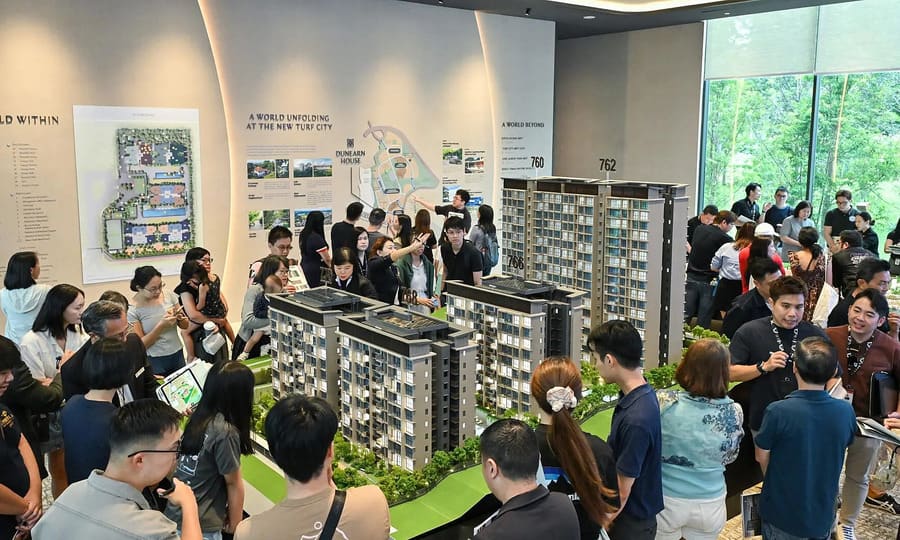
A development consortium led by Frasers Property cleared 212 apartments at its Dunearn House condominium project in Singapore during the launch weekend, moving 56 percent of the 380-unit inventory. The average transaction price reached S$3,140 per square foot, equivalent to approximately US$26,197 per square meter, according to figures released by the consortium on Sunday.
All three-bedroom units sold out during the weekend. The project, a joint venture among Frasers Property, CSC Land, and Sekisui House, sits on 145,173 square feet in District 11 and comprises five blocks: two at 19 stories and three at 10 stories. Dunearn House is the first private residential development to launch within the emerging Bukit Timah Turf City precinct, a district earmarked for residential expansion.
Singaporean citizens accounted for 86 percent of buyers. Permanent residents from China, Indonesia, Malaysia, and South Korea represented 13 percent, while foreign nationals from the United States made up the remaining one percent. Previews began earlier in July.
Pricing and Unit Mix
Two-bedroom apartments measuring between 527 and 678 square feet start at S$1.475 million. Three-bedroom units, which range from 872 to 1,001 square feet, carry a minimum price of S$2.597 million. Four-bedroom layouts spanning 1,184 to 1,378 square feet begin at S$3.588 million.
The pricing strategy appears calibrated to appeal to upgraders and first-time buyers seeking entry into the Core Central Region, a segment that has seen limited new supply and tepid transaction volumes in recent quarters. The weekend result suggests that developers willing to price competitively can still unlock demand, even as macroeconomic headwinds and higher interest rates weigh on buyer sentiment across the island.
Regional Context and Market Momentum
Singapore's Core Central Region recorded zero new project launches and only 70 unit sales in the second quarter of 2026, a sharp retreat from the 701 units launched and 697 sold in the first quarter, according to data from real estate agency SRI. Mohan Sandrasegeran, head of research and data analytics at SRI, described Dunearn House as a catalyst that injected much-needed momentum into the segment during the second half of the year.
Sandrasegeran emphasized that the launch demonstrates developers can still attract buyers by combining quality design with accessible entry prices, even amid uncertainty over monetary policy and regional growth forecasts. The broader slowdown in the Core Central Region reflects a combination of factors: tighter lending standards introduced by the Monetary Authority of Singapore, elevated borrowing costs, and a shift in buyer preference toward suburban districts with larger floor plates and lower per-square-foot pricing.
Yet the result also drew more cautious assessments. Nicholas Mak, chief research officer at property portal Mogul.sg, noted that Dunearn House's 56 percent take-up rate lagged the average for launches in the first half of 2026, when nine projects totaling 4,854 units posted a mean launch-weekend sales rate of 75.8 percent. River Modern, another Core Central Region development, moved 90 percent of its 455 units during its March launch weekend, underscoring the variability in buyer response even within the same market segment.
The divergence suggests that location, product mix, and pricing remain decisive. Dunearn House benefits from proximity to established schools and green corridors, but it lacks the waterfront or downtown adjacency that drove River Modern's velocity. Analysts expect developers to continue testing the market with staggered releases and flexible payment schemes to sustain absorption rates.
Developer Pedigree and Broader Ambitions
Frasers Property, listed in Singapore, forms part of the business empire managed by Charoen Sirivadhanabhakdi and his family. Charoen ranked fifth on Forbes' latest list of Thailand's richest individuals, with a combined net worth estimated at US$11.5 billion. His holdings span Thai Beverage, the country's largest beverage producer and distributor; packaging firm Berli Jucker; property developer Asset World; and hypermarket operator Big C Supercenter.
Earlier in July, a consortium led by Frasers secured the tender for the mixed-use Bayshore Drive waterfront site in eastern Singapore with a top bid of S$2.13 billion. That consortium includes Malaysian billionaire Jeffrey Cheah's Sunway MCL. The Bayshore Drive win signals continued confidence in Singapore's long-term residential and commercial fundamentals, even as near-term headwinds persist.
Frasers' aggressive land acquisition and launch cadence position the group to capture share in a market that remains supply-constrained by historical standards. The government's measured release of residential sites, coupled with en-bloc activity that has slowed relative to the 2017-2018 peak, means developers with sizable land banks and patient capital retain pricing leverage.
Outlook for Turf City Precinct
Dunearn House's debut offers early clues about demand dynamics in the Bukit Timah Turf City area, which is transitioning from former Singapore Turf Club land into a mixed-use residential quarter. The precinct is expected to yield several thousand homes over the next decade, supported by infrastructure upgrades and connectivity improvements.
Future launches in Turf City will compete not only with each other but also with established neighborhoods in Districts 10 and 21, which offer mature amenities and school networks. Developers will need to differentiate through design, community facilities, and smart-home integration to sustain pricing premiums.
The broader question for Singapore's residential market is whether the second half of 2026 can sustain the momentum generated by Dunearn House and a handful of suburban launches. Inventory overhang remains modest, but buyer confidence hinges on clarity around interest-rate trajectories and employment stability in finance, technology, and professional services sectors.
For now, Dunearn House's weekend performance suggests that well-located projects with disciplined pricing can still draw crowds. Whether that translates into a broader revival of the Core Central Region, or remains an isolated bright spot, will become clearer as additional launches roll out through the fourth quarter.
RELATED STORIES

Five ASEAN Members Back Regional Oil Stockpile as Study Nears Completion
Tran Quoc Bao · 3 min

Southeast Asian Firms Overlook Digital Pact Worth USD 2 Trillion
Lim Hui Ying · 4 min
Frasers Property Wins Shareholder Backing for S$2.1 Billion Hospitality Reshuffle
Lim Hui Ying · 3 min
CIMB Commits to 55% Dividend Floor as Regional Portfolio Offsets Indonesia Pressure
Priyanka V. Rao · 4 min
Spot something wrong? Email editor@briefasia.com. We log every correction publicly.