Asia · Business
Eppendorf Plants RM180 Million Manufacturing Base in Penang
The German life sciences firm's first Southeast Asian production facility will supply US and European markets with centrifuges and lab instruments by 2028.
KEY TAKEAWAYS
- ·Eppendorf signed a lease to build a RM180 million manufacturing facility in Penang, its first production site in Southeast Asia after three decades of regional presence.
- ·The plant will manufacture centrifuges, mixers and cyclers for US and European markets, with operations starting in 2028 and an initial workforce of 130 by end-2029.
- ·Penang attracted RM2.3 billion in scientific and measuring equipment investments from 2021 to Q1 2026, accounting for nearly 20 percent of Malaysia's total in the sector.
German Life Sciences Firm Expands Regional Footprint
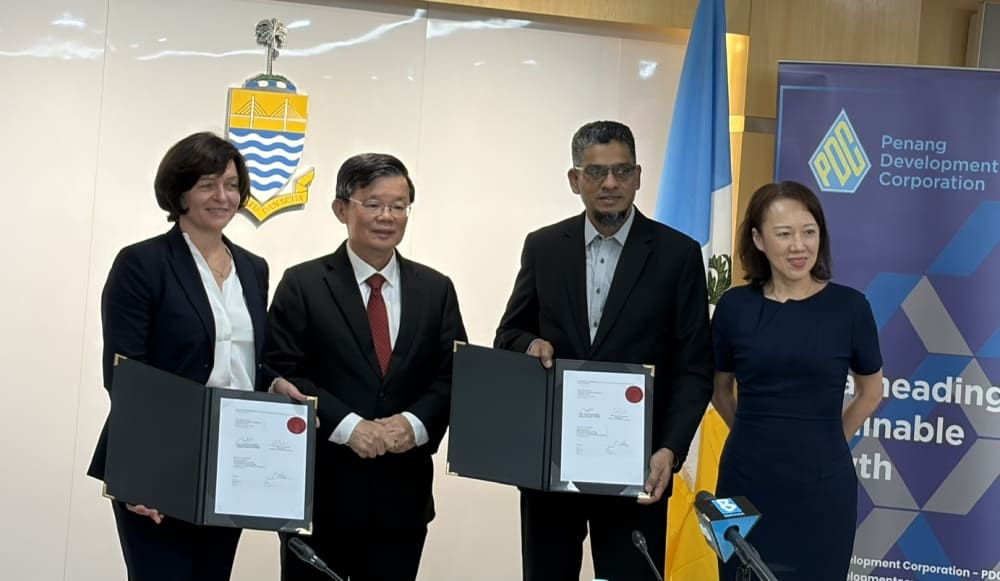
Eppendorf SE formalized a lease agreement with Penang Development Corporation to establish a greenfield manufacturing facility at Bandar Cassia Technology Park, according to the company. The RM180 million investment (approximately €40 million) represents the firm's first production site in Southeast Asia, three decades after opening its regional headquarters in Kuala Lumpur in 1995.
The facility will manufacture products from Eppendorf's Centrifuges and Instruments portfolio, including centrifuges, mixers and cyclers deployed in research laboratories, diagnostic centers, pharmaceutical manufacturing and quality control operations worldwide. Production is scheduled to commence by 2028, with an initial workforce of approximately 130 employees by end-2029.
Strategic Location for Global Supply Chains
The Penang facility will serve markets in the United States and Europe, according to Eppendorf CEO Christine Munz. She cited geopolitical stability and an established supplier network as decisive factors in the site selection. The plant will function as a production platform within Eppendorf's global manufacturing network, strengthening supply chain resilience across multiple continents.
Penang's scientific and measuring equipment sector attracted RM2.3 billion in approved manufacturing investments between 2021 and the first quarter of 2026, according to state data. These investments spanned 40 projects and generated close to 4,500 jobs, representing nearly 20 percent of Malaysia's total in the category.
The state exported RM187 billion worth of professional, scientific and controlling instruments and apparatus between 2021 and 2025, accounting for an average of 72 percent of Malaysia's exports in that segment. In 2025, Penang contributed RM611 billion to national trade, or 38 percent of Malaysia's total exports, maintaining its position as the country's leading exporting state.
Industrial Ecosystem and Value Chain Integration
Penang Chief Minister Chow Kon Yeow emphasized that the investment extends beyond manufacturing capacity expansion. The facility is expected to deepen industrial capabilities, create opportunities for Malaysian companies to advance in the value chain, and foster collaboration between industry, universities and research institutions.
The state government invited Eppendorf to collaborate with local companies through the Penang Automated Test Equipment Campus in areas including technology development, localization, supplier development and supply chain strengthening. Chow highlighted that the investment aligns with long-term initiatives such as Penang Medi-City by reinforcing laboratory technologies, scientific instrumentation and research alongside healthcare services.
Three Decades of Regional Presence
Eppendorf has operated in the Asia-Pacific region for more than 30 years, with Malaysia serving as a key hub for Southeast Asian operations. The company's history in life sciences spans over eight decades globally. The Penang project marks a significant escalation in the firm's regional commitment, transitioning from distribution and service operations to full-scale manufacturing.
The facility will manufacture instruments used across the pharmaceutical value chain, from early-stage research to final quality assurance. Centrifuges separate biological materials by density, mixers prepare samples, and cyclers amplify DNA sequences for diagnostic and research applications. These tools form the backbone of modern laboratory workflows in biotechnology, clinical diagnostics and pharmaceutical development.
As production ramps up beyond 2029, Eppendorf plans further workforce expansion at the site. The investment reflects a broader trend of European life sciences companies establishing manufacturing operations in Southeast Asia to diversify supply chains, reduce logistics costs for key markets, and tap into the region's engineering talent and industrial infrastructure.
Penang's concentration of precision manufacturing, electronics assembly expertise, and established supplier networks for high-tolerance components provided a ready-made ecosystem for Eppendorf's lab equipment production. The state's track record in scientific instrumentation exports and its network of technical universities offer both immediate operational advantages and long-term collaboration potential for product development and process innovation.
RELATED STORIES
Penang Captures 34% of Malaysia's Manufacturing Investment in First Half
Anand Sundaram · 2 min
Malaysia's July Trade Surge Points to Strengthening Regional Demand
Priyanka V. Rao · 3 min
Malaysia's Petronas Reports Steady Earnings Amid Energy Security Push
Priyanka V. Rao · 2 min

Selangor Pulls RM70 Billion in Six Months as Services and Manufacturing Drive Malaysia's Richest State
Anand Sundaram · 4 min
Spot something wrong? Email editor@briefasia.com. We log every correction publicly.