Technology · Products
Delta Electronics Unveils AI-Powered Dual-Arm Cobot for Server Assembly
Taiwanese automation giant showcases embodied AI robotics integrated with Nvidia platform, while pivoting strategy to supply components rather than finished humanoid robots
KEY TAKEAWAYS
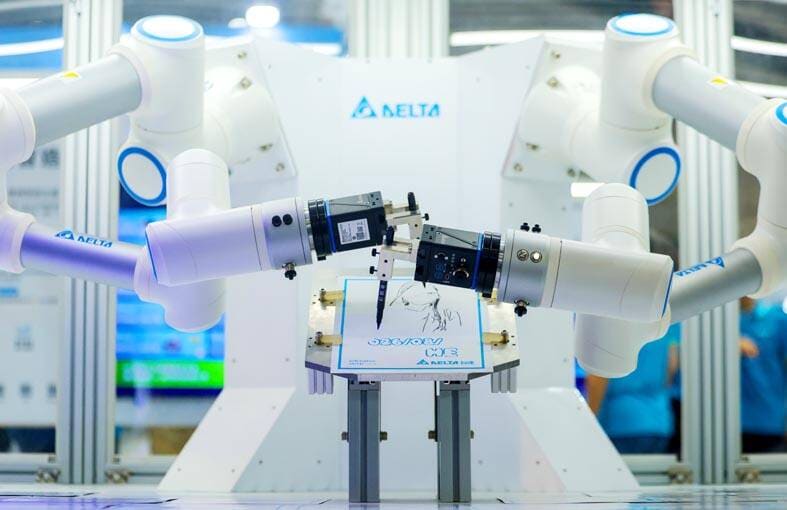
- ·Delta Electronics introduced an embodied AI dual-arm cobot integrated with Nvidia's platform that autonomously plans and executes complex assembly tasks without preprogramming, targeting AI server production lines.
- ·The company will supply robot components including motors, drives, encoders, and joint modules to other manufacturers rather than launching its own humanoid robots, citing unmet industrial standards for reliability and precision.
- ·Aurotek Corp demonstrated a personnel-less factory solution integrating multiple robot types, with robotics accounting for 10 percent of its first-half revenue as labor shortages drive automation demand.
Autonomous Assembly Without Preprogramming
Delta Electronics introduced an embodied artificial intelligence dual-arm collaborative robot at an automation and robotics exhibition in Taipei this week, marking a shift from traditional robotic systems that require extensive manual programming. The solution integrates with Nvidia's platform and can autonomously understand, plan, and execute multi-step assembly processes for AI server production, according to Nat Huang, general manager of Delta's industrial motion solutions business.
The technology eliminates the need for engineers to preprogram every movement and workflow, Huang explained. When production lines switch between different products, the system reduces downtime associated with reprogramming and equipment adjustments, delivering greater manufacturing flexibility in an industry where rapid changeovers are increasingly critical.
Components Over Complete Systems
Delta also unveiled a next-generation joint module designed for humanoid and dual-arm robots. The integrated unit combines a drive, motor, reducer, encoder, and force sensor into a single package suitable for both upper and lower limbs of humanoid platforms. The company maintains in-house design and production capabilities for all five core components, with select reducers sourced from partner firms, Huang noted.
Despite establishing a robotics innovation center in August last year to develop humanoid robots and quadruped platforms, Delta has no immediate plans to launch complete humanoid systems. Lisa Kao, general manager of Delta's industrial automation business group, stated that current humanoid robots do not yet meet industrial standards for reliability, speed, and precision.
Instead of competing in the crowded market for finished humanoid robots, Delta intends to position itself as a tier-one supplier of critical components to other robot manufacturers. The company plans to provide motion controls, drives, motors, encoders, reducers, force sensors, joint modules, and software platforms to the broader robotics ecosystem.
Brain Over Skeleton
Kao described Delta's strategic focus as developing the "brain, cerebellum, and nervous system" of robots rather than the physical frame. Once these core capabilities are established, the technology can be deployed across multiple robot designs from various manufacturers, creating a platform play rather than a product-specific approach.
This strategy reflects the company's assessment of the current robotics market, where dozens of firms are racing to commercialize humanoid platforms but few have demonstrated sustainable industrial applications. By concentrating on enabling technologies, Delta aims to capture value across the entire sector rather than betting on a single robot form factor.
Broader Industry Push Toward Unmanned Operations
Other exhibitors at the Taipei show demonstrated the industry's direction toward fully automated facilities. Aurotek Corp showcased a personnel-less factory solution integrating retail robots, autonomous forklifts, mobile robots, wheeled platforms, and humanoid units to handle tasks from inventory detection to shelf restocking.
Chang I-sheng, chairman of Aurotek, pointed to persistent labor shortages as a long-term challenge driving demand for smart robotics and automation solutions that integrate seamlessly with existing operations. Aurotek, which primarily supplies automation components, turnkey surface-mount technology solutions, and semiconductor process subsystems, has expanded into functional robots, humanoid platforms, and physical AI applications.
For humanoid systems, Aurotek is prioritizing real-world data collection and industrial deployment, leveraging system integration capabilities to build datasets for AI model training. The company provides services spanning deployment to maintenance. Robotics represented approximately 10 percent of Aurotek's first-half revenue, compared with 54 percent from automation equipment and subsystems and 36 percent from automation components, according to company data.
Taiwan's Position in the Robotics Supply Chain
The product launches arrive as Taiwan-based firms navigate their role in an increasingly bifurcated global robotics supply chain. With humanoid robots still largely unproven in industrial settings, Taiwanese manufacturers are positioning themselves as critical suppliers of precision components and enabling technologies rather than competing directly with Chinese volume producers or Western integrators.
Delta's component-focused strategy aligns with this broader trend, allowing the company to serve multiple customer segments while avoiding the capital intensity and market risk associated with launching complete humanoid platforms before the technology matures.
RELATED STORIES
Solomon Technology Records Highest Quarterly Profit on AI Vision Demand
Cheng Wei-Lun · 3 min
Gigabyte Lifts Capital Spending as AI Server Orders Drive Record First Half
Cheng Wei-Lun · 2 min
Asia's AI Chip Startups Face Manufacturing Reality Check
Priyanka V. Rao · 4 min
Techman Unveils Heavy-Duty Dual-Arm Robot for AI Server Assembly
Cheng Wei-Lun · 3 min
Spot something wrong? Email editor@briefasia.com. We log every correction publicly.