Technology · Dev
China Targets Lunar South Pole Ice Deposits in New Space Mission
Beijing's latest moon exploration effort focuses on extracting water ice from permanently shadowed craters near the lunar south pole, one of the coldest environments in the solar system.

KEY TAKEAWAYS
- ·China is targeting water ice in the lunar south pole's permanently shadowed craters, where temperatures fall below -230°C, to demonstrate resource extraction capabilities for future missions.
- ·The mission focuses on proving that in-situ resource utilization can function reliably, potentially enabling refueling depots and sustained human presence beyond low Earth orbit by the mid-2030s.
- ·Asia's space agencies, including Japan and South Korea, are accelerating lunar programs that view the moon as infrastructure rather than a symbolic destination, intensifying regional competition for polar resources.
Racing for the Moon's Frozen Resources
China's space agency has initiated a mission to locate and analyze water ice trapped in the lunar south pole's permanently shadowed craters, regions that rank among the coldest environments in the solar system. The China Lunar Exploration Program is focusing on areas where temperatures drop below -230 degrees Celsius, conditions that have preserved frozen volatiles for billions of years.
The mission represents Beijing's most ambitious attempt to demonstrate resource extraction capabilities beyond Earth. Water ice at the lunar poles could be converted into drinking water, oxygen for breathing, and hydrogen fuel for rockets - a logistics advantage that would eliminate the need to transport these materials from Earth at enormous cost.
Strategic Terrain in Space Competition
The lunar south pole has emerged as contested territory in the new space race. Unlike the equatorial regions explored during the Apollo era, the pole's deep craters contain ice deposits that NASA, the European Space Agency, and private companies also aim to access. India's Chandrayaan-3 lander touched down near the south pole in August 2023, making it the first mission to successfully operate in that region.
China's program builds on its Chang'e series of lunar missions, which have included sample return flights and the deployment of rovers on the far side of the moon. The current effort involves advanced drilling and spectrometry equipment designed to confirm ice concentrations and assess extraction feasibility.
Permanently shadowed regions pose unique engineering challenges. Without sunlight, solar panels cannot generate power, forcing missions to rely on nuclear batteries or alternative energy sources. Surface temperatures in these craters never rise above -173 degrees Celsius, cold enough to freeze carbon dioxide and preserve other volatile compounds alongside water ice.
Asia's Expanding Lunar Ambitions
China's intensified focus on lunar resources aligns with broader regional momentum in space exploration. Japan's SLIM probe demonstrated precision landing technology in January 2024, while South Korea's lunar orbiter has been mapping potential landing sites since 2022. These national programs increasingly view the moon not as a destination for flags and footprints, but as infrastructure for sustained human presence and eventual Mars missions.
The technical challenges are formidable. Extracting ice from lunar regolith requires heating frozen soil in a vacuum environment, then capturing and purifying the released water vapor. Prototype systems tested on Earth suggest the process demands significant energy input and produces modest yields - constraints that will shape the economics of any lunar outpost.
Beijing has signaled its intention to establish a permanent research station at the lunar south pole by the mid-2030s, in partnership with Russia and potentially other nations. That timeline depends on demonstrating that in-situ resource utilization - using materials found on the moon rather than shipped from Earth - can function reliably in extreme cold and vacuum.
Implications for Deep-Space Infrastructure
Success in this mission would position China as a leader in space resource technology, a field that could determine which nations maintain a long-term presence beyond low Earth orbit. The ability to refuel spacecraft at a lunar depot would extend mission durations and enable more ambitious exploration of asteroids and Mars.
Commercial interest in lunar ice remains speculative but growing. Several startups in the United States and Japan are developing extraction and processing equipment, betting that demand for water and fuel in cislunar space will materialize as launch costs decline and satellite constellations expand.
For now, the immediate goal is scientific validation. Confirming the quantity, purity, and accessibility of lunar ice will require drilling into shadowed crater floors and analyzing samples under conditions that have never been tested in an operational mission. China's current effort will provide data that shapes not only its own plans but the strategies of every nation and company eyeing the moon's frozen poles.
RELATED STORIES
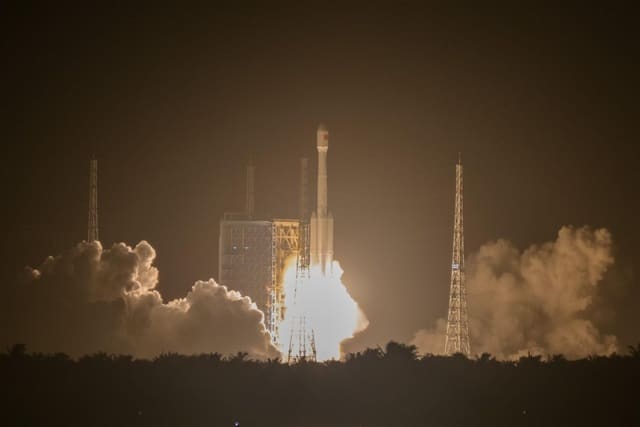
China's Long March 7A Rocket Destroyed 85 Seconds After Launch
Cheng Wei-Lun · 2 min

Xiaomi's Q2 Revenue Slides 6% as Smartphone Sales Weaken Despite EV Gains
Cheng Wei-Lun · 3 min

Nvidia's Madison Huang Tours Asia Robotics Hubs in Seoul and Beijing
Cheng Wei-Lun · 3 min
Chinese Manufacturers Command Over 70% of Global LCD TV Panel Market
Cheng Wei-Lun · 2 min
Spot something wrong? Email editor@briefasia.com. We log every correction publicly.