Technology · Dev
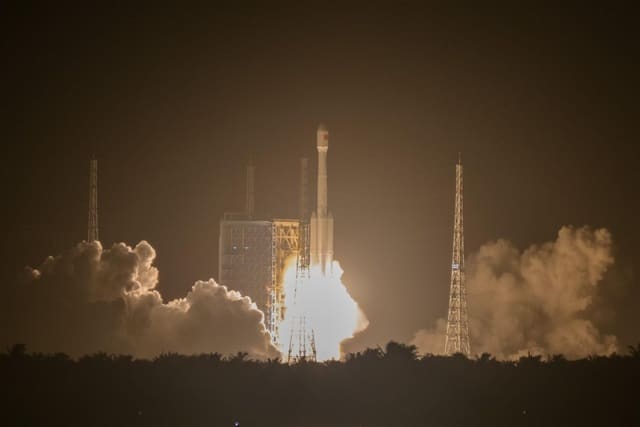
China's Long March 7A Rocket Destroyed 85 Seconds After Launch
The August 10 explosion over Wenchang marks a rare failure for China's space program, with the ChinaSat-4B satellite believed lost and no official cause yet disclosed.
KEY TAKEAWAYS
- ·China's Long March 7A Y18 rocket exploded 85 seconds after launch from Wenchang on August 10, destroying the ChinaSat-4B communications satellite.
- ·Authorities confirmed an in-flight anomaly but have not disclosed whether the cause was system failure or deliberate flight termination.
- ·The incident marks a rare setback for China's high-cadence space program and may delay upcoming Long March 7A missions pending investigation.
Mid-Air Destruction Over Hainan
A Long March 7A rocket carrying the ChinaSat-4B communications satellite broke apart in mid-air on the evening of August 10, roughly 85 seconds after lifting off from the Wenchang Space Launch Site in Hainan province. The Y18 vehicle exploded during its ascent phase, with debris falling over the coastal region and the satellite payload presumed destroyed.
Chinese space authorities acknowledged the launch failure hours later, attributing it to an unspecified in-flight anomaly. The brief official statement provided no technical detail on whether the vehicle suffered a propulsion or structural failure, or whether ground controllers deliberately activated the rocket's flight termination system to prevent an uncontrolled descent over populated areas.
Rare Setback for China's Space Ambitions
The incident represents a significant disruption for China's space program, which has maintained a high launch cadence in recent years. The Long March 7A is a medium-lift vehicle designed to place payloads of up to 7,000 kilograms into geostationary transfer orbit, making it a workhorse for communications satellite deployments and deep-space missions.
ChinaSat-4B was intended to expand domestic communications capacity, serving government and commercial users across the Asia-Pacific region. The satellite's loss will likely delay coverage expansion plans and force operators to rely on existing orbital assets while a replacement is constructed.
The Long March 7A variant entered service in 2020 and has experienced a mixed operational record. An earlier mission in March 2021 also ended in failure, raising questions about the design maturity of the rocket's upper stage and guidance systems. Since then, the vehicle had completed several successful flights, including high-profile missions to lunar and planetary orbits.
Investigation and Supply Chain Implications
Chinese aerospace officials have not released a timeline for the investigation, nor have they indicated whether upcoming Long March 7A missions will be delayed pending a root-cause analysis. Standard practice in the global space industry calls for grounding similar vehicles until engineers can rule out systemic design or manufacturing flaws.
The failure arrives at a moment of heightened activity in Asia's space sector. Japan, India, and South Korea have all accelerated their launch schedules, while private companies in the region are developing new small-satellite launchers. Any extended pause in Long March 7A operations could open opportunities for competing providers to capture commercial contracts that would otherwise have flown on Chinese rockets.
Regional satellite operators will be watching closely to see whether the incident affects insurance premiums for payloads booked on Long March vehicles. Launch failures typically trigger industry-wide reviews of risk models, particularly when the root cause remains undetermined.
What Comes Next
China's space authorities are expected to convene a technical review board to examine telemetry data, recovered hardware, and manufacturing records. The investigation will likely take several months, with preliminary findings potentially released sooner if a clear fault is identified.
In the near term, the loss of ChinaSat-4B may prompt operators to accelerate the construction of backup satellites or redirect traffic to other orbital slots. The broader question is whether this failure signals deeper challenges in China's rapidly expanding launch infrastructure, or whether it represents an isolated anomaly in an otherwise maturing program.
For now, the skies over Wenchang remain quiet, and the next Long March 7A sits grounded pending answers.
RELATED STORIES

Chinese Robotics Firms Capture Near-Total Control of Humanoid Market
Cheng Wei-Lun · 3 min
Amkor Explores Options for China Operations Amid Regional Shift
Cheng Wei-Lun · 3 min

Samsung Doubles BOE Panel Orders as Chinese Suppliers Tighten Grip on TV Display Market
Cheng Wei-Lun · 3 min

Seoul Warns Against Redistributing Chip Profits as China Investment Accelerates
Jun-ho Seo · 2 min
Spot something wrong? Email editor@briefasia.com. We log every correction publicly.