Finance · Deals
DeepSeek and State Oil Giant Join Unitree's $900 Million Shanghai IPO
China's humanoid robotics sector draws heavyweight backers as developer prepares market debut
KEY TAKEAWAYS
- ·Unitree Robotics is raising 6.1 billion yuan in a Shanghai IPO backed by AI developer DeepSeek and a Chinese state oil company.
- ·The listing will test investor appetite for China's emerging humanoid robotics sector amid strong recent gains in semiconductor and AI listings.
- ·The IPO comes as US restrictions target Chinese robotics firms, prompting companies to prioritize domestic capital markets over international funding.
Blue-Chip Backing for Robotics Upstart
Unitree Robotics has secured commitments from two heavyweight Chinese investors for its 6.1 billion yuan ($900 million) initial public offering on the Shanghai Stock Exchange. Artificial intelligence developer DeepSeek and one of China's state-owned oil giants are leading the roster of backers for the humanoid robot maker, signaling institutional confidence in a sector still finding its footing.
The developer, known for its quadruped and bipedal robots, is preparing to list shares in a move that will serve as a litmus test for investor sentiment around commercial robotics in China. The participation of DeepSeek, a company whose AI models have gained traction in recent months, adds a layer of strategic credibility to the offering.
Measuring Market Appetite
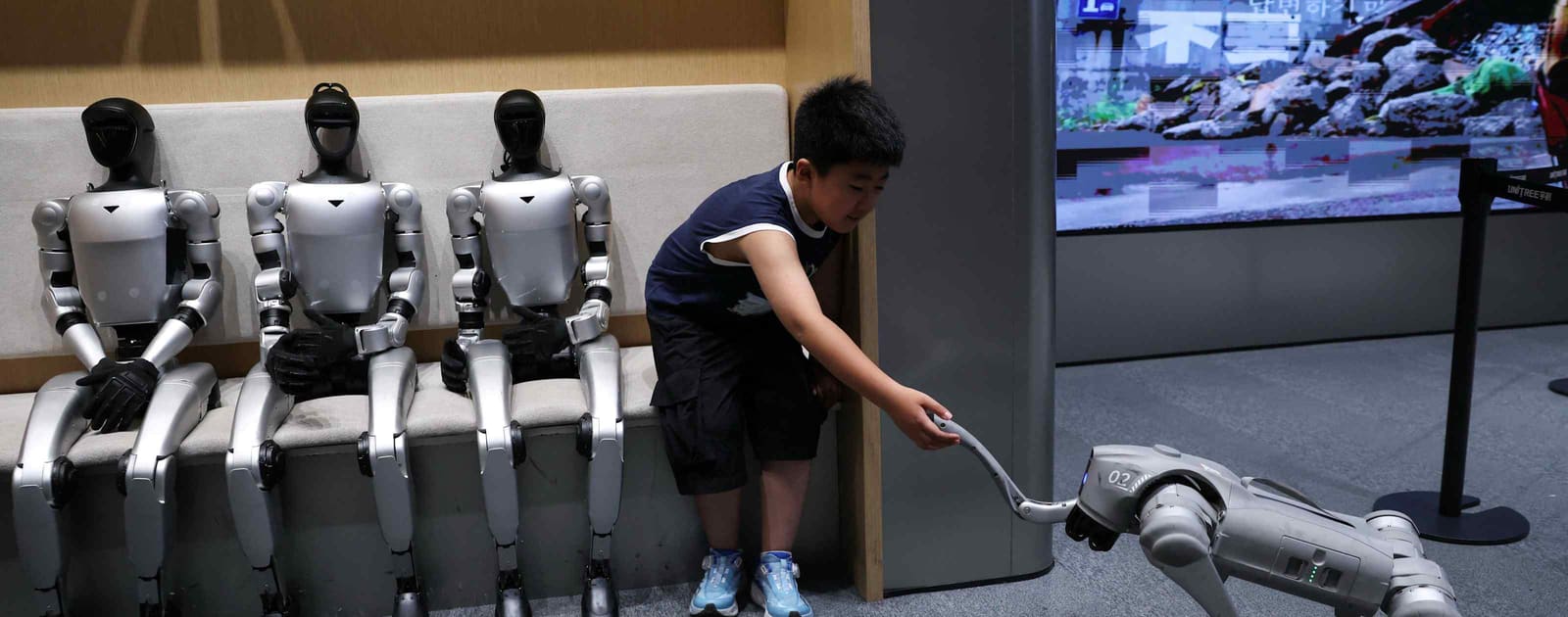
Unitree's IPO arrives at a moment when China's robotics industry is racing to translate laboratory breakthroughs into viable products. The company has built a reputation for lower-cost humanoid platforms, positioning itself against both domestic competitors and established international players. Its store in Beijing has become a showcase for quadruped robots that demonstrate mobility and adaptability in consumer settings.
The involvement of a state oil enterprise, typically focused on energy infrastructure, suggests cross-sector interest in automation technologies that could eventually serve industrial applications. Energy companies across Asia have begun exploring robotics for inspection, maintenance, and hazardous-environment tasks, where humanoid and quadruped designs offer advantages over traditional wheeled or tracked systems.
Shanghai's Tech Listing Momentum
The Shanghai listing follows a string of high-profile technology debuts on China's STAR Market, the exchange's answer to Nasdaq. Recent listings in the semiconductor and AI supply chain have posted strong first-day gains, reflecting domestic investor appetite for exposure to strategic technologies amid ongoing US export controls.
Unitree's offering will test whether robotics can command the same premium. The company has emphasized capacity expansion to meet rising demand for humanoid units, though executives have tempered expectations about near-term breakthroughs, describing a "GPT moment" for robots as still years away.
Strategic Investors and Sector Dynamics
DeepSeek's participation is notable given the AI developer's focus on large language models and reasoning systems. Integrating advanced AI into robotic platforms remains a key bottleneck for the industry, and the investment hints at potential collaboration on perception and decision-making capabilities.
State backing, whether direct or through affiliated enterprises, has become a recurring theme in China's push for self-sufficiency in advanced manufacturing. The oil giant's involvement underscores Beijing's interest in ensuring domestic robotics champions have the capital to scale, particularly as Washington has moved to restrict imports of Chinese humanoid robots to protect American AI development.
Geopolitical Headwinds
The timing of the IPO coincides with heightened scrutiny from the United States. Recent US Federal Communications Commission actions and broader technology restrictions have targeted Chinese robotics firms, citing concerns over data collection and AI integration. These measures have prompted some Chinese companies, including service robotics maker Pudu, to consider listings in Hong Kong rather than pursuing international capital.
Unitree's decision to list domestically insulates it from immediate foreign regulatory pressure but may limit access to global investors. The trade-off reflects a broader recalibration in China's tech sector, where companies are prioritizing domestic funding sources and market share over international expansion.
What the IPO Signals
A successful debut would validate the thesis that humanoid robotics is moving from research curiosity to commercial reality, at least in the eyes of Chinese capital markets. It would also provide Unitree with resources to accelerate production and R&D at a time when hardware iteration cycles are compressing.
For DeepSeek and the state oil investor, the bet is on convergence: AI software meeting physical embodiment in machines that can navigate real-world environments. Whether that convergence happens quickly enough to justify a $900 million valuation will depend on how rapidly the technology matures and finds paying customers beyond pilot programs and demonstration units.
The IPO pricing and allocation details have yet to be disclosed, but the roster of anchor investors suggests the deal is likely to attract strong interest when it opens to retail and institutional buyers. How the stock performs in its first weeks of trading will offer a clearer picture of whether China's robotics ambitions have moved from policy priority to market consensus.
RELATED STORIES

DeepSeek Backs Unitree With $20.8 Million Stake in Shanghai IPO
Cheng Wei-Lun · 3 min
Unitree Robotics IPO Oversubscribed 2,700 Times as Investors Bet on China's Robot Push
Cheng Wei-Lun · 3 min
Beijing's AI Bar Offers Free DeepSeek Access as Price Wars Reshape Global Market
Cheng Wei-Lun · 3 min

China's Star Fund Managers Lose Ground After Rotating Into AI Stocks
Cheng Wei-Lun · 4 min
Spot something wrong? Email editor@briefasia.com. We log every correction publicly.